Growth Hacking Course
AI Data Analysis for GTM Teams: Stage 4 Is an Ownership Problem
By
June 24, 2026

Three in 4 GTM leaders report top-down pressure to adopt AI. More than half - 53% - see either no impact or limited impact from it [Growth Unhinged / 2025 State of B2B GTM Report, 2025].
That gap is not a tooling failure. It is an ownership failure.
The ticket queue is the real problem
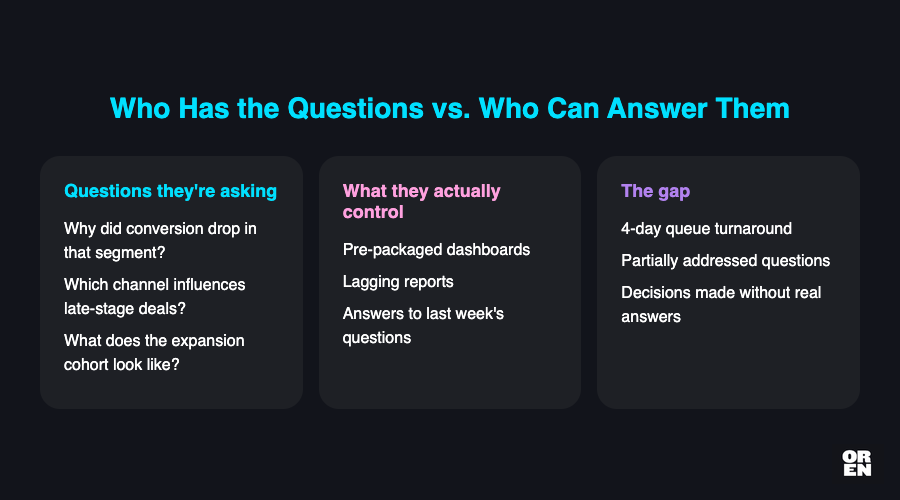
Most VP Marketing and CMO roles inherit the same situation. The data exists. The dashboards exist. The BI team is technically capable.
But every commercial question that requires a non-standard query - why did conversion drop in that segment, which channel is actually influencing late-stage deals, what does the cohort look like for customers who expanded - goes into a queue. The queue has other priorities. The answer comes back 4 days later, partially addressing a question that has already moved on.
GTM leaders end up making decisions on lagging, pre-packaged reports rather than answers to the questions they are actually asking this week.
The average B2B company now runs 5 core GTM channels, each frequently requiring its own dedicated platform or analytics tool [GTM Strategist Knowledge Base / B2B GTM 2025 Report, 2025]. Fewer than 30% of companies have fully integrated GTM tech stacks [GTM Monday Substack, 2025]. The analytical surface area is enormous. The team that can interrogate it is not the team that needs the answers.
That is the structural problem Stage 4 AI maturity solves.
What the maturity stages actually mean
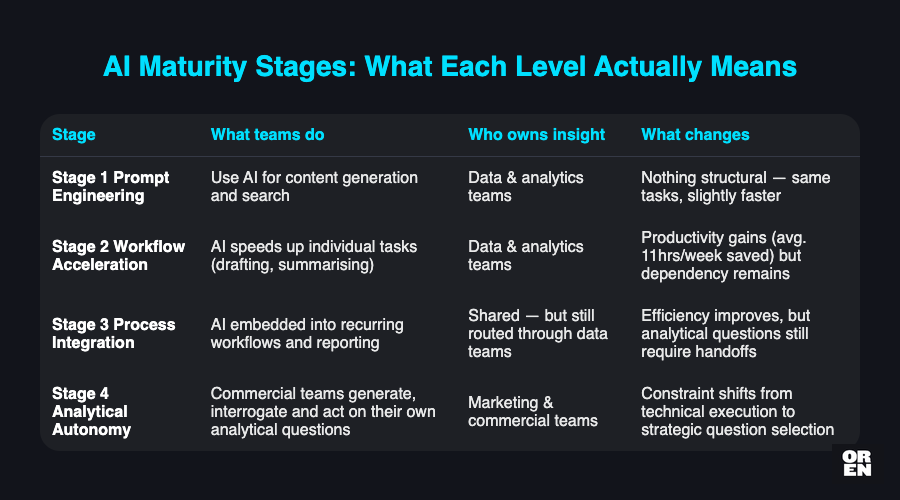
AI fluency is not binary. It is a progressive capability curve - and most enterprise teams are stuck between stages 1 and 2, using AI for content generation and search, whilst reporting to the board that they are "adopting AI."
Counting activated licences is a vanity metric. It measures spending, not capability.
The early stages look like this: prompt engineering for existing tasks, then using AI to accelerate individual workflows. Useful. But these stages do not change who owns insight. They just make the same people slightly faster at the same tasks. Marketers are 44% more productive thanks to AI, saving an average of 11 hours per week [ZoomInfo State of AI 2025, 2025] - but if those 11 hours are saved on content drafting and not redirected toward analytical capability, the structural dependency stays intact.
Stage 4 is categorically different.
It is when commercial teams can generate, interrogate, and act on their own analytical questions without routing through a separate function. Not because they have become data engineers, but because AI has lowered the execution floor enough that a commercially literate marketer can do what previously required SQL fluency, BI tooling expertise, and a data team's bandwidth.
The constraint shifts from technical execution to strategic selection - knowing which questions are worth asking in the first place. That is a marketing problem, not a data problem.
Why most teams miss the transition
63% of marketers use AI at least once a week [ZoomInfo State of AI 2025, 2025]. The majority still report limited impact.
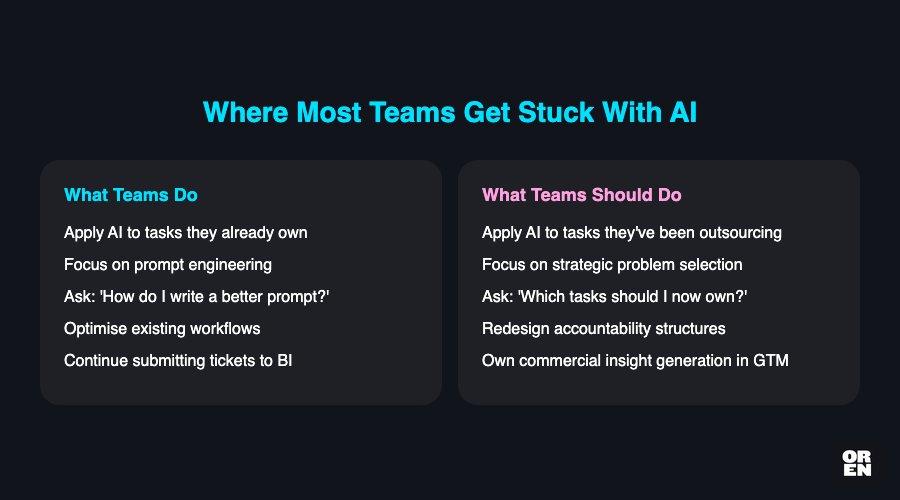
The reason: they are applying AI to tasks they already own rather than to the tasks they have historically outsourced. If your team has never owned the analysis of multi-touch attribution or cohort expansion patterns, they will not instinctively reach for AI to do it. They will continue submitting the ticket.
The primary barrier is not technical execution. It is strategic selection.
Most AI training programmes make this worse by focusing on prompt engineering - how to use the tools better - rather than on which problems deserve AI attention. "How do I write a better prompt?" is a Stage 1 question. "Which analytical tasks am I currently outsourcing that I should now own?" is a Stage 4 question.
"AI is different. It forces teams to redesign the engine itself." - Becca Eddleman, Skaled
That redesign is organisational before it is technical. The tools - whether that is Claude with a data connector, a purpose-built analytics layer, or Gong's proprietary models extracting 300+ signals per opportunity [Demandbase, 2026] - are not the hard part.
The hard part is deciding that commercial insight generation is a GTM function, not a BI function, and then building the accountability structures that make that real.
The complexity argument for owning your own analysis
The scale of modern B2B buying journeys makes the case for analytical independence more urgent than it was 3 years ago.
The average company now requires 2,879 impressions and 266 touchpoints to close a B2B deal - a 20% increase in touchpoints since 2023. For opportunities at or above £80K ACV, that climbs to nearly 5,500 impressions and 417 touchpoints [HockeyStack Research, 2025].
No pre-packaged dashboard was designed to answer the questions that journey complexity generates.
As I have written in Data and Direction, most SaaS companies do not need more data - they need to track fewer, more meaningful metrics. Accumulating analytical surface area without clear ownership of what questions matter leads to overwhelm, not insight.
Stage 4 maturity is not about giving GTM teams access to everything. It is about giving them the capability to answer the specific commercial questions that drive decisions, on their own timeline.
The companies that have built this capability are not necessarily the ones with the biggest data teams. They are the ones that decided commercial insight is a commercial function - and then built the muscle to execute on that decision.
What restructuring insight ownership actually requires
The mistake most organisations make when they try to move toward Stage 4 is treating it as a tooling project. They buy a self-serve analytics platform, run a training day, and call it done.
Six months later, the BI ticket queue is exactly the same length.
Genuine insight ownership requires 3 things that tools cannot provide.
Accountability redistribution. Someone in the GTM function needs to own the analytical questions that drive commercial decisions - not as a consumer of BI outputs, but as the person responsible for generating and validating the answers. This is not a new hire. It is a decision about who in your existing team has both the commercial context and the AI capability to do this. The GTM Engineer and AI GTM Strategist roles emerging in the market are useful frames, but hiring your way to Stage 4 without redistributing accountability across the existing team will not work.
Leader practitioner-level engagement. Leaders who mandate AI adoption without being practitioners themselves create hollow mandates. You do not need to be building agents. But you need enough hands-on experience with AI data analysis tools to understand what is genuinely hard versus what your team is avoiding because it is unfamiliar. The credibility gap between instruction and experience is visible to any team that has been through it.
A sustainable capability-building cadence. Fortnightly is structurally superior to weekly or monthly for this kind of capability development. Weekly does not give teams enough time to implement what they have learned. Monthly kills momentum and the compounding effect. The cadence is a strategic variable, not an administrative detail - and it matters particularly for analytical capability development, where implementation between sessions is where the real learning happens.
The AI Marketing Lab is built around exactly this cadence. Teams that implement between sessions compound faster than teams that attend more sessions without implementation time.
The architecture problem underneath
There is a reason fewer than 30% of companies have fully integrated GTM tech stacks.
The analytical fragmentation that makes self-serve insight so hard is partly a consequence of years of buying disconnected point solutions that each generate their own data in their own format. I covered the architecture dimension of this in Your GTM Stack Is an Expensive Mess. The short version: AI does not fix a broken architecture, it exposes it faster.
Stage 4 AI maturity for data analysis requires that the data your GTM team needs to interrogate is actually accessible to them - not locked in 5 separate platforms with 5 separate APIs and a data team as the only connector.
This is where the tooling conversation is legitimate. Not "which AI analytics tool should we buy" but "what does our data infrastructure need to look like for GTM teams to own their own analytical questions?"
"Organizations that invest early in GTM AI Ops capabilities won't merely automate existing processes - they'll fundamentally outperform competitors by ensuring their digital teammates deliver consistent, high-impact results." - Kristina McMillan, Scale VP
The companies building that infrastructure now - connecting signal data, CRM data, product usage data, and campaign data into a unified layer that commercially literate people can interrogate with AI - are not doing it because they have bigger budgets. They are doing it because they made the organisational decision first, and the architecture followed.
The ownership decision
The question for any VP Marketing or CMO reading this is not "which AI analytics tool should we evaluate?"
It is: who in your organisation is currently accountable for generating the commercial insights that drive your GTM decisions - and is that the right answer?
If the honest answer is "the BI team, when they have capacity," you are not at Stage 4. You are at Stage 1 or 2 with better-dressed outputs.
The path to Stage 4 runs through an organisational decision about accountability, not through a software evaluation. The tools exist. The capability to use them is buildable. What most GTM teams are missing is the decision that it is their job to build it.