Growth Hacking Course
AI Maturity for Commercial Teams: Stage 3 Is an Engineering Problem
By
June 23, 2026
88% of companies report regular AI use [McKinsey, 2026].
Two-thirds of B2B marketing decision-makers think generative AI is overhyped [Forrester, 2025].
Both are true. The gap between them is where the real story lives.
Most B2B SaaS commercial teams are stuck at Stage 2 - better search, faster content, polished emails - and calling it AI adoption.
Stage 3 is where AI first touches revenue-critical workflows: pipeline generation, deal qualification, forecast management, renewal motions.
The transition isn't blocked by skills or confidence. It's blocked by the absence of defined, documented processes that AI can actually automate.
You cannot automate a workflow that lives in someone's head.
The licence fallacy
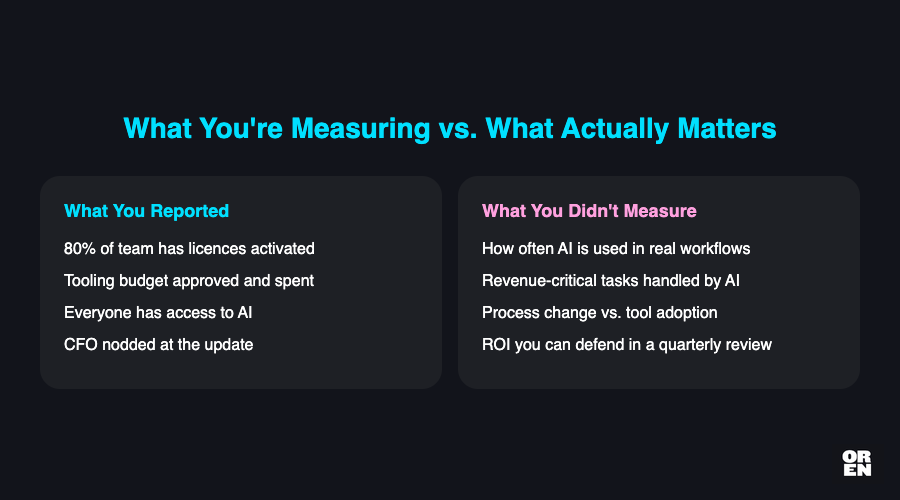
Your board asked for an AI adoption update. You reported that 80% of the commercial team has ChatGPT or Copilot activated. The CFO nodded.
Nobody in that room measured anything that matters.
Licence counts are a spending metric. They tell you what you've purchased, not what you've changed. The gap between "everyone has access" and "AI is doing revenue-critical work" is the gap between Stage 2 and Stage 3 on any serious maturity framework - and it's a process gap, not a tooling gap.
Dig one layer down and the picture inverts.
Microsoft Copilot - a paid, licensed, enterprise product - converts as low as 2%. 80% of licensed users tried it once and disengaged [reloadux.com, 2026].
Average time spent per daily US ChatGPT user dropped 22.5% since July 2025, and sessions per user fell roughly 20.7% over the same period [Apptopia via TechCrunch, 2025].
One Stanford study found 37% of Americans used generative AI at work in September, down from 46% in June [Hartley et al., 2025].
The headline numbers measure access and initial curiosity. The underlying numbers measure whether work has actually changed.
This matters enormously for a CMO or CRO at a 50-500 person B2B SaaS company right now. You're likely spending real money on AI tooling. You're likely being asked to demonstrate ROI to the board. And you're likely discovering that the productivity gains from content generation and search assistance, while real, aren't moving the revenue needle in a way you can defend in a quarterly review.
That's not a coincidence. It's structural.
What the stages actually mean for GTM teams
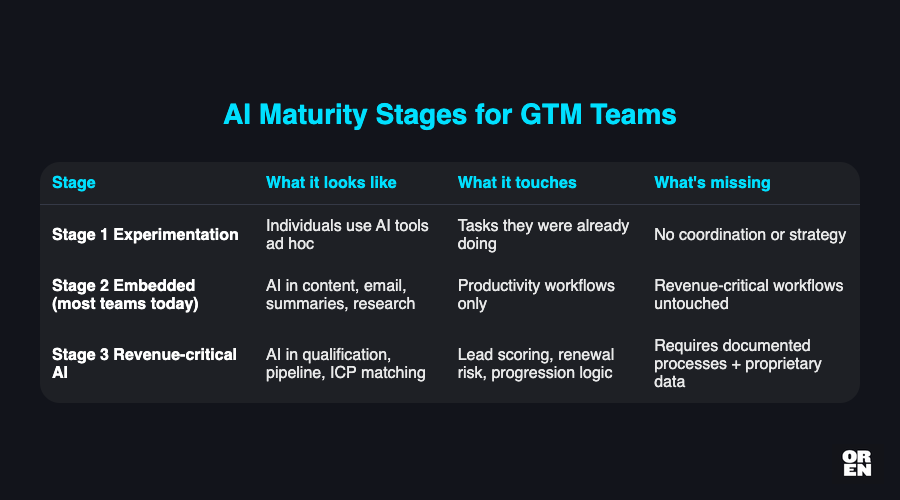
Most AI maturity frameworks - MIT CISR, Accenture, Microsoft's 5-step model - were built for enterprise IT and operations leaders, not CROs or VP Sales. They describe what an organisation looks like at each level. They don't explain what a commercial team must change operationally to move between levels.
Stage 1 is experimentation. Individuals use AI tools ad hoc, mostly for tasks they were already doing. As MIT CISR's Peter Weill puts it: "This first stage is all about experimenting, preparing, and education."
Stage 2 is where most commercial teams currently sit. AI is embedded in content production, email drafting, meeting summarisation, and research. Genuinely useful. Also touches nothing revenue-critical. The workflows that determine whether you hit quota - lead qualification logic, pipeline progression criteria, renewal risk scoring, ICP matching - remain entirely human-operated and largely undocumented.
Stage 3 is the first stage where AI touches those revenue-critical workflows. It requires proprietary data, defined processes, and automation logic. Weill again:
"You have to simplify and automate your processes. If you try to use AI on an incredibly complicated … process, it'll be much harder." - Peter Weill, MIT CISR
That quote is doing more work than it appears to. "Simplify and automate your processes" presupposes that your processes exist in a form that can be simplified. For most commercial teams, they don't. The qualification criteria for a Stage 2 opportunity, the handoff logic between SDR and AE, the conditions that trigger a renewal conversation - these are tribal knowledge, inconsistently applied, entirely undocumented.
You cannot automate tribal knowledge.
The process-definition threshold
The dominant narrative in AI adoption content frames Stage 2-to-Stage 3 as a training and confidence problem. Optimizely's coverage of marketing AI maturity argues that "skills and confidence are the bottleneck, not technology access." LinkedIn's frameworks emphasise capability dimensions and cultural readiness.
That framing is wrong for commercial teams - or at least dangerously incomplete.
Skills and confidence matter at Stage 1. At Stage 3, the bottleneck is process architecture. Specifically: the absence of documented, validated, consistently-executed commercial workflows that AI systems can be built on top of.
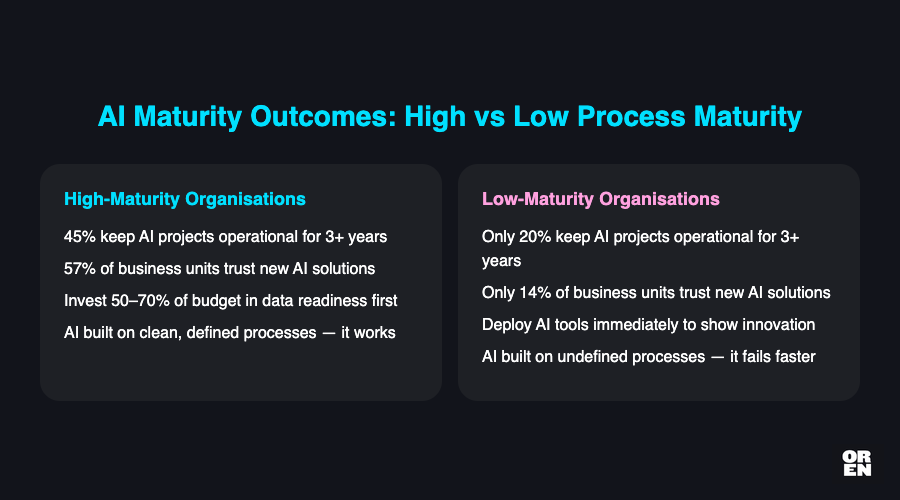
This is why enterprise AI pilots fail at such a striking rate, and why winners invest 50-70% of their budget in data readiness before touching automation. The teams that skip this step - that deploy AI tools immediately to demonstrate innovation - end up automating chaos. Faster chaos. Not revenue impact.
The Gartner data on maturity outcomes makes this concrete: 45% of high-maturity companies keep AI projects operational for over 3 years, compared to only 20% of low-maturity organisations. And 57% of business units in high-maturity firms trust new AI solutions, versus just 14% in low-maturity firms [Gartner, 2025]. That trust gap isn't cultural. It's evidential - high-maturity organisations built AI on top of clean, defined processes and watched it work. Low-maturity organisations built on undefined processes and watched it fail.
If you've had an AI pilot quietly shelved in the last 18 months, this is almost certainly why.
What the frontier actually does differently
OpenAI's B2B Signals report is the most useful dataset on this question, and almost nobody is reading it correctly.
Frontier firms - the 95th percentile of AI use - now run 3.5x the intelligence per worker of typical firms [OpenAI B2B Signals, 2026].
But message volume explains only 36% of that gap.
The other 64% is qualitative.
Frontier firms aren't sending more messages. They're sending different ones - richer context, more substantive tasks, work that actually feeds a decision.
ChatGPT Agent shows an 8.1x gap between frontier and typical firms. Deep Research, 6.0x. Codex, 16x [OpenAI B2B Signals, 2026].
The difference is workflow architecture - what work gets handed to AI, with what inputs, feeding what next. Typical firms gave employees access and called it adoption.
That's expensive autocomplete.
What revenue-critical workflows actually are
The existing frameworks don't fill this gap: nobody names the specific workflows where Stage 3 maturity succeeds or fails in a commercial context.
So here they are.
Lead qualification and ICP scoring - the logic that determines whether a lead enters the pipeline or gets deprioritised. If your qualification criteria aren't written down and consistently applied, you cannot build an AI scoring model on top of them.
Pipeline progression criteria - the conditions under which an opportunity moves from one stage to the next. If your AEs are using different mental models, your pipeline data is noise, and AI forecasting will amplify that noise.
Forecast management - the inputs, weightings, and override logic that produce your weekly number. If this process lives in a spreadsheet maintained by one RevOps analyst, you don't have a process. You have a dependency.
Renewal and expansion triggers - the signals that indicate churn risk or upsell readiness. If these aren't defined, your CS team is guessing, and AI cannot guess better than a human who at least has context.
None of these are exotic. Every commercial team above £10M ARR is nominally doing all of them. The question is whether they're doing them in a documented, consistent, data-generating way that an AI system can learn from and eventually operate.
For most teams, the honest answer is no.
The sequencing problem
This is where the "move fast" instinct actively damages outcomes. The natural pressure on a CRO or CMO is to show the board something - a tool deployed, a workflow touched, a productivity metric improving. That pressure pushes teams to select tools before defining processes.
Which is exactly backwards.
The right sequence for Stage 3 transition:
1. Audit the revenue-critical workflows - not to score them, but to document them. What actually happens, step by step, in your qualification process? Who makes which decisions? On what criteria? A growth audit that treats the commercial engine as a system will surface the gaps here faster than any internal review.
2. Validate and standardise - identify where the process varies by rep or manager, and establish the version you actually want to automate. This is the simplification Weill references. It requires senior commercial judgment, not junior experimentation.
3. Assess data readiness - can the inputs the AI system will need actually be captured cleanly from your CRM, product, and engagement data? Most teams discover significant gaps here.
4. Then select and build tooling - once you know what the process is, what the decision logic is, and what data you have, tool selection becomes tractable. Before that point, it's guesswork.
The leaders already operate this way.
94% of leading AI adopters rely on marketing data for significant business decisions, against 78% of laggards [Forrester, 2025].
And they're roughly twice as likely to name the CMO and CIO as strategic partners [Forrester, 2025].
That isn't culture. It's decision architecture - the unglamorous plumbing that has to exist before automation pays off.
This isn't slow. It's the sequence that produces AI systems that stay operational. The teams skipping steps 1-3 are generating the 80% of pilots that deliver no measurable ROI.
The architecture problem this creates is directly related to what GTM Frankenstacks produce - disconnected point solutions sitting on top of undocumented processes, each generating data in a different format, none of it usable for automation.
Why this is a leadership problem
Weill's observation about Stage 2 culture is worth sitting with:
"The hardest part of Stage 2 is changing. How do we move from a command-and-control culture to a coach-and-communicate culture? AI has a lot to do with not only automating but enabling our front line to make decisions for us and enabling our customers to self-serve. You can't do that if you command and control." - Peter Weill, MIT CISR
Commercial leaders who mandate AI adoption without being practitioners themselves create exactly this problem. The mandate comes from above, the tools get deployed, the junior team experiments, and nothing changes at the process level because nobody with commercial authority has engaged closely enough to understand what needs to change.
Roll out basic Copilot tiers to show the board you're investing, and you trigger two failures at once.
You kill the enthusiasm of the sceptics, who try it once and revert to what they know.
And you push the enthusiasts toward unsanctioned shadow AI - feeding company data into tools nobody has approved.
Adoption failure and security risk, from the same weak mandate.
Practitioner-level experience - not expert-level, but enough to understand what's hard versus easy - is the minimum bar for credibility here. You don't need to build agents yourself. You do need to have used the tools enough to know when an AI system is promising versus when it's a demo that will collapse on contact with real data.
Delegating Stage 3 transition to a junior innovation team is a box-ticking exercise. The process definition work, the workflow standardisation, the data readiness assessment - these require senior commercial judgment. A 23-year-old with a ChatGPT Plus subscription cannot define your qualification criteria for you.
If your board has made AI adoption a KPI, the questions you need to answer before reporting back are process questions, not tooling questions.
The gap is widening
There's a warning buried in the OpenAI data that most teams aren't taking seriously.
The frontier advantage isn't stable. A year ago it was 2x intelligence per worker. Now it's 3.5x [OpenAI B2B Signals, 2026].
The gap is widening.
So a team stalled at Stage 2 isn't holding position while it figures things out.
It's falling behind a moving frontier - not linearly, exponentially.
Every quarter spent automating chaos is a quarter the leaders spend compounding.
That's the real cost of treating Stage 3 as a tooling decision instead of a process one.
The diagnostic you actually need
Before investing further in AI tooling for your commercial team, answer these honestly:
- Are your lead qualification criteria documented and consistently applied across all SDRs and AEs?
- Do your pipeline stages have explicit, written progression criteria, or are they judgment calls?
- Can you describe your renewal risk scoring process in a way that a new hire could replicate on day one?
- Is your ICP definition specific enough to be operationalised in a scoring model, or is it a persona description?
- Does your CRM data reflect actual deal progression, or is it updated retrospectively to match outcomes?
If the answer to more than 2 of these is no, you're not ready for Stage 3 automation. You're ready for process definition - which is the actual prerequisite.
That work isn't glamorous. It won't make a good slide for the board deck. But it's the difference between AI that compounds over time and AI that gets quietly shelved after 6 months.
Stage 3 is an engineering problem. Treat it like one.