Growth Hacking Course
AI GTM Maturity: The Sequencing Problem
By
June 25, 2026
By 2026, 70% of startups will have adopted AI-driven GTM tools [Gartner, 2026]. That sounds like progress. It isn't.
Adoption is not capability. Counting tool licences measures spend, not maturity. The number that matters more: 53% of sales professionals admit they don't know how to get the most value from GenAI tools, and nearly half are unsure about safe or effective usage [amplifai.com, 2026]. Seventy per cent of marketers say their employers don't provide enough training on how to use AI tools properly [masterofcode.com, 2026].
So the majority of teams are running tools they don't understand, in an order they haven't thought about, and calling it transformation.
For a founder without a CMO - someone who owns every marketing decision whilst also running product, fundraising, and the business - this is expensive. Ineffective GTM strategies inflate CAC by up to 35% for early-stage firms [Forrester, 2026]. Pre-Series A or early Series B, a 35% CAC inflation isn't an inefficiency. It's a runway problem.
"If you cannot control value delivery to 5 customers, how do you expect to serve 500 or 5000 customers well?" - Maja Voje, GTM Strategist
Same logic applies to AI. If your ICP is fuzzy, your messaging is untested, and your CRM is a mess, automating outreach at scale doesn't accelerate growth. It accelerates the wrong motion.
Any adoption is not better than none
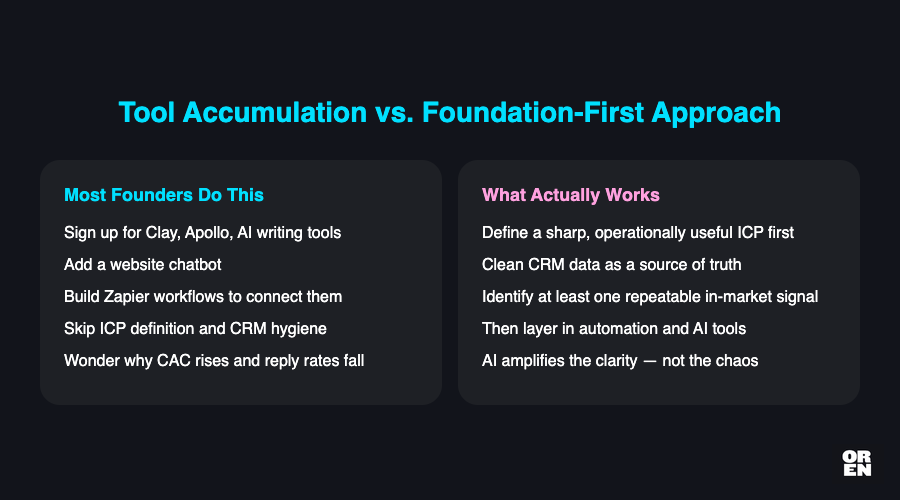
Most founders arrive at AI GTM through tool accumulation. They read a thread, watch a demo, sign up for a trial. Six months later they've got Clay for enrichment, Apollo for sequences, an AI writing tool for content, a chatbot on the website, and a Zapier workflow connecting none of them coherently.
The tools aren't the problem. The order is.
What gets skipped is the foundational layer. Before any automation compounds, 3 things need to be true. ICP definition has to be sharp enough to be operationally useful - not "mid-market SaaS" but a specific firmographic and behavioural profile you can actually run a filter against. A B2B SaaS startup that identified C-level executives in mid-sized tech firms as their ICP reduced targeting costs by 30% [CEO Worldwide, 2026]. That's not an AI win. That's a clarity win that AI then amplifies. Your CRM data needs to be clean enough to function as a source of truth, not a graveyard of imported contacts nobody's touched. And you need at least one repeatable signal - something that tells you a prospect is in-market before you reach out.
None of this requires AI. All of it is what makes AI useful.
The sequencing error compounds quietly. CAC goes up, reply rates go down, and the founder concludes that "AI doesn't work for us." It worked fine. The order was wrong.
The stage-gate model
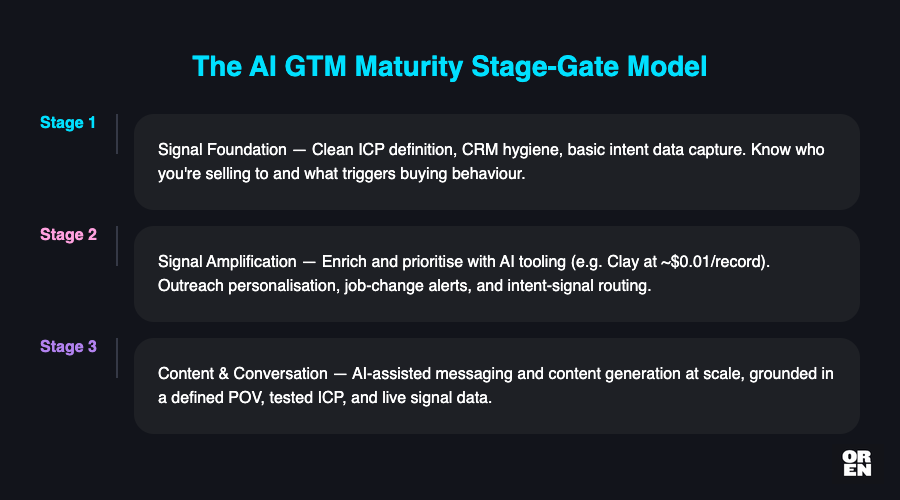
Think of AI GTM maturity in 4 stages. Each one is a prerequisite for the next. Skipping stages doesn't save time - it creates debt you pay back later at a higher cost.
Stage 1 - Signal foundation. The unglamorous work. Clean ICP definition, CRM hygiene, basic intent data capture. The question to answer: do you actually know who you're selling to and what triggers their buying behaviour? A fintech startup that tailored pitches for CFOs versus CTOs improved response rates by 25% [CEO Worldwide, 2026]. That's not personalisation technology. That's knowing your buyer well enough to say different things to different people. AI can't manufacture that knowledge. It can only deploy it.
Stage 2 - Signal amplification. Once you have clean data and a clear ICP, AI starts earning its keep. Tools like Clay (at roughly $0.01 per record versus ZoomInfo's $0.25) let you enrich and prioritise at a cost structure that makes sense for an early-stage company. This is where outreach personalisation, job-change alerts, and intent-signal routing belong. Not before.
Stage 3 - Content and conversation. Now content generation and AI-assisted messaging make sense - because you have a defined point of view, a tested ICP, and signal data that tells you what context each prospect is in. Without Stages 1 and 2, AI content is generic content produced faster. With them, it's specific content produced at scale. The difference is whether your automation is amplifying insight or amplifying noise.
Stage 4 - System intelligence. This is where the real compounding happens. AI that learns from your pipeline data, surfaces pattern-matched lookalikes, and feeds back into ICP refinement. But it only works if Stages 1 through 3 have generated clean, structured data worth learning from. Garbage in, garbage out, at machine speed.
"The only way to differentiate an AI product sustainably is through proprietary data, a well-integrated product within workflows, and powerful feedback loops." - Maja Voje, GTM Strategist
The proprietary data is your customer and pipeline data. The integration is how your tools talk to each other. The feedback loop is Stage 4. None of it works without the foundation.
The founder-specific constraint
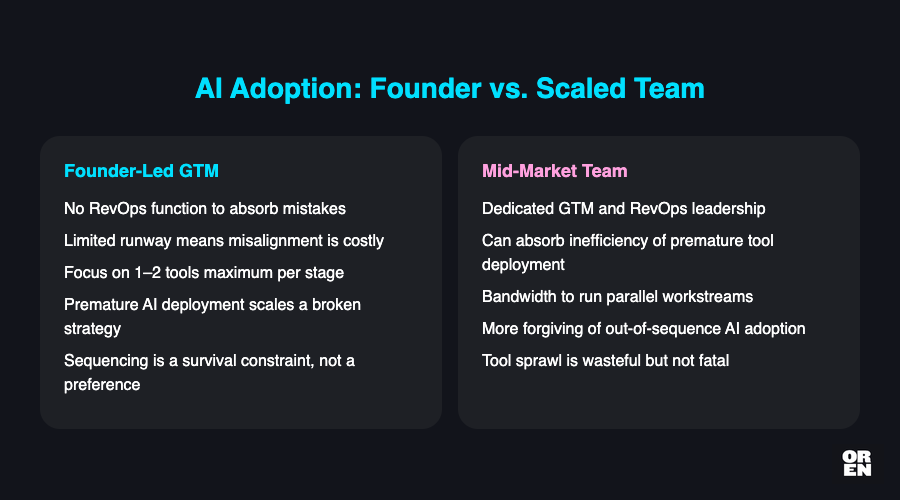
The standard AI maturity models are designed for organisations with dedicated GTM leadership, RevOps functions, and the bandwidth to run parallel workstreams. A founder who owns marketing alongside everything else has a different constraint set.
"Spending 5% of your team's time across 20 channels is unlikely to teach you anything about those channels. But, if you spend a third of your time across 3 channels, you're likely to learn whether those channels are viable, faster." - High Alpha
Same principle applies to AI adoption. Spreading thin across every available tool produces no learning and no compounding. At Stage 1, you're not evaluating AI tools at all - you're doing definitional work that requires human judgement. At Stage 2, you're running one or 2 enrichment and signal tools, not 5. Focus is the mechanism that makes the sequencing work.
This is also why the "any AI adoption is progress" line is specifically wrong for founders. A mid-market team with a RevOps function can absorb the inefficiency of a premature tool deployment. A founder with limited runway cannot. The 35% CAC inflation figure from Forrester isn't a statistic about bad AI. It's a statistic about misaligned GTM strategy - and AI deployed out of sequence is a very effective way to scale a misaligned strategy.
"Founder-led sales, which has historically been thought of as 'doing things that don't scale', may now scale much farther than previously believed." - Ben Borton, PodPlay
That's true. But it scales the motion you already have. If the motion is wrong, AI scales the wrong motion. PodPlay's own experience is instructive: AI tools like Granola reduced the administrative burden of their sales process by at least 75%, with meeting notes and CRM updates dropping from over an hour per day to 15 minutes [PodPlay Blog, 2025]. That's Stage 2 and Stage 3 AI working on a sales motion that was already validated. The Stage 1 work had already been done.
The ordering is the strategy
There's a version of this that looks like a knowledge gap - the founder who says "I don't know what to do first." It isn't a knowledge gap. It's an ordering problem. The tools are documented. The use cases are everywhere. What's missing is a sequenced decision framework that treats each stage as a prerequisite for the next.
The reframe matters because it changes what you do next. If it's a knowledge gap, you research more tools. If it's an ordering problem, you audit what you already have against the stage-gate model and identify where you actually are versus where you've been deploying budget.
For most CMO-less founders, the audit surfaces the same thing: Stage 3 tools running on Stage 1 foundations. Content generation and outreach automation operating on an ICP that hasn't been stress-tested, CRM data that's inconsistent, no reliable signal capture. The tools are fine. The sequence is wrong.
75% of GTM teams report shifting budgets toward founder leadership voices [Q1 surveys of 400+ leaders, 2026]. That's a real shift. But founder authenticity - the kind that actually converts - requires the same foundation as everything else: a clear point of view, a defined buyer, and a message that connects to specific context rather than broadcasting broadly. Both require that definitional clarity before AI amplification makes them more effective rather than just louder.
The sequencing error isn't a failure of ambition. Fix the order and the ambition compounds. Skip it and you're burning runway faster on a motion that was already wrong.