Growth Hacking Course
What Stage 5 Ai Gtm Capability Looks Like In Practice
By
June 23, 2026

62% of GTM organisations are still operating at low-to-mid AI maturity despite concerted effort [Highspot, 2025]. 95% of AI pilots are failing to deliver meaningful business impact [MIT via Forbes, 2025].
And vendor demos are showing you Stage 8 outcomes whilst selling you Stage 2 tooling.
That gap isn't a roadmap. It's an architectural decision that most GTM leaders never get told they need to make.
The maturity curve nobody is honest about
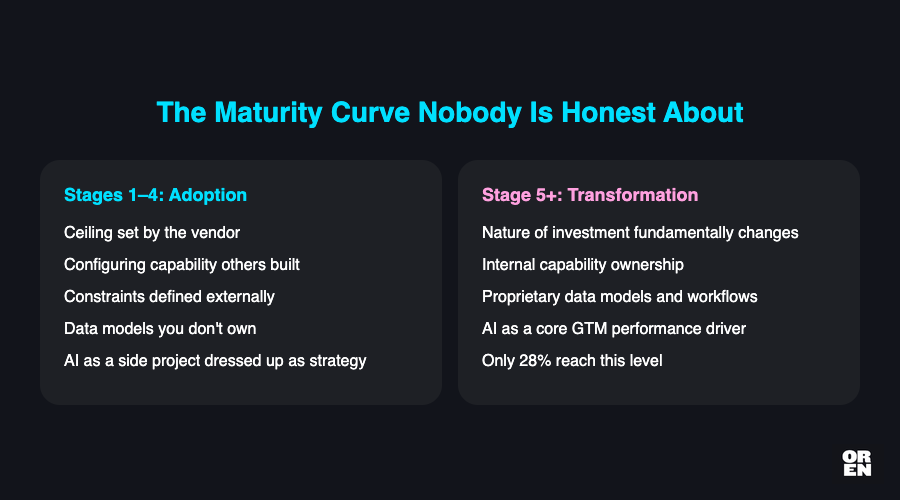
Most 8-stage AI GTM frameworks describe a smooth linear progression. In practice, the curve has a cliff in it.
Stages 1 through 4 are fundamentally about adoption: prompt experimentation, tool deployment, workflow integration, cross-functional alignment. Real and necessary. But they share one characteristic - the ceiling is set by the vendor.
You're configuring capability someone else built, within constraints someone else defined, on data models someone else owns.
"This first stage is all about experimenting, preparing, and education." - Peter Weill, MIT CISR
That's an accurate description of where most GTM teams genuinely are, even when they claim otherwise. Just 28% of sales, marketing, enablement, and revenue leaders say AI maturity is a core driver of GTM performance [Highspot, 2025].
The remaining 72% are running AI as a side project dressed up as a strategy.
Stages 1-4 look like this in practice:
- Stage 1: Prompt engineering, individual experimentation, ad hoc tool trials
- Stage 2: Standardised tool access, basic workflow automation, first integrations
- Stage 3: Cross-functional deployment, CRM enrichment, content at scale
- Stage 4: Unified data layer, intent signal integration, coordinated GTM workflows
The move from 4 to 5 is where the nature of the investment fundamentally changes.
Stage 5 is an architectural decision, not a licence upgrade
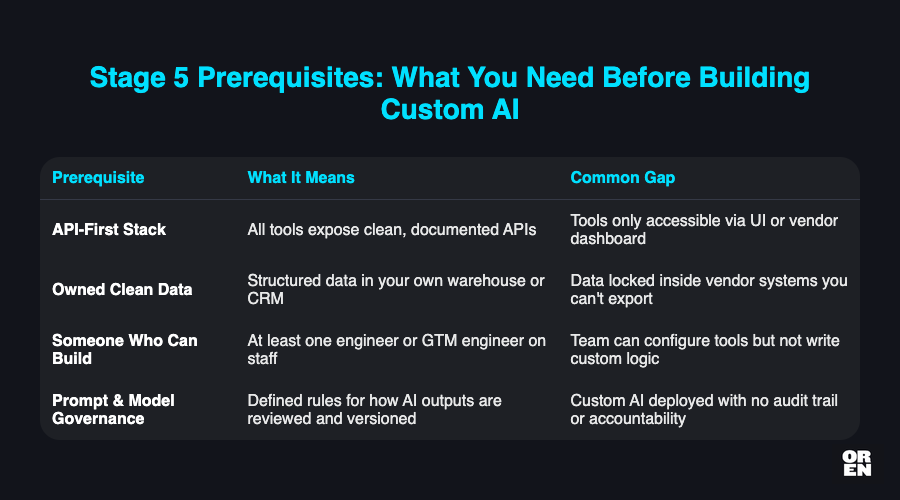
Stage 5 is where teams start building custom AI systems - proprietary enrichment pipelines, bespoke scoring models trained on their own conversion data, AI workflows that encode institutional knowledge rather than generic best practice.
"Companies in the third stage are developing proprietary models, and that leads you to the holy trinity of AI - architecture, reuse, and agents. Those are the really hard parts." - Peter Weill, MIT CISR
The prerequisites for crossing this threshold are specific. You need API-first stack architecture - if your tools don't expose clean APIs, you can't build on top of them. You need owned, clean, structured data - not data sitting in a vendor's warehouse that you access through their UI. You need at least one person who can build, not just configure. And you need prompt and model governance, because custom systems without governance create liability, not leverage.
"The difference between AI tools that deliver real ROI versus expensive 'AI theater' comes down to having good data hygiene, low technical debt, and the discipline to define success metrics before they try to embrace AI." - The GTM Engineer by Clay
This is the diagnostic most teams skip.
They buy the next tool before auditing whether their current stack can support what they're trying to build. I wrote about this architecture problem in detail here - the failure of modern B2B GTM isn't a tooling problem, it's an architectural one, and adding AI capability on top of a Frankenstack compounds the dysfunction rather than resolving it.
Four self-diagnostic questions that determine Stage 5 readiness:
- Do you own your data, or does a vendor own it on your behalf?
- Can your current stack be extended via API without a professional services engagement?
- Do you have someone who can write code or orchestrate AI workflows, not just configure dashboards?
- Have you defined what a successful custom AI output looks like before you build it?
If the answer to any of these is no, you're not being blocked by ambition. You're being blocked by infrastructure.
The vendor demo problem

Vendors selling Stage 2-3 tooling routinely demonstrate Stage 7-8 outcomes in their sales cycles. Autonomous outbound agents. Real-time revenue forecasting. Dynamic personalisation at account level.
These outcomes exist - at companies that have spent 18-24 months building the proprietary data infrastructure and custom orchestration layers that make them possible. They do not exist out of the box.
"For all the benefits B2B companies have seen, some AI programs are falling short." - 2025 Bain & Company Commercial Excellence Survey
Roughly a quarter of sales and marketing AI pilots have failed outright [Bain, 2025]. The failure mode is almost always the same: a team saw an advanced outcome in a demo, purchased the tool that promised to deliver it, and discovered that the outcome required prerequisites the vendor never mentioned and the team didn't have.
53% of sales professionals admit they don't know how to get the most value from GenAI tools [amplifai.com, 2026]. That's not a training failure in isolation - it's a symptom of being sold capability that requires a maturity stage the team hasn't reached.
Questions worth asking any vendor in a sales cycle:
- What does our data need to look like before this works as demonstrated?
- Which of our current integrations need to be in place before we unlock this feature?
- Can you show me this outcome on a dataset similar in size and structure to ours?
- What does a customer at our maturity stage actually use this for in month 3?
If the vendor can't answer the first 2 specifically, the demo is showing you their Stage 8 customer's outcome. Not your Stage 4 team's realistic trajectory.
Stages 6-8: where GTM becomes a proprietary asset
Stage 6 is operational AI - custom models in production, proprietary scoring running live against inbound and outbound signals, AI-assisted deal intelligence feeding the revenue team in real time.
Stage 7 is AI-native GTM - the commercial team is structured around AI workflows rather than retrofitting AI into human workflows. Headcount decisions look different. The ratio of output to people looks fundamentally different from a conventional team.
Stage 8 is autonomous GTM - self-optimising systems, agentic pipelines that act without human initiation, AI that generates net new strategic insight rather than just executing known plays.
"This is where you're all in for AI-enabled decision-making [and] deciding when you need people in the loop and when you don't. You'll develop proprietary AI, and you'll sell new services around it." - Peter Weill, MIT CISR
The companies operating at Stage 7-8 aren't using better versions of the tools you're using. They built different infrastructure.
Cursor reached $1B ARR with 300 people. Clay charges $0.01 per record versus ZoomInfo's $0.25 - not because they negotiated better unit economics, but because they built a different data architecture. These aren't tool adoption stories. They're engineering stories applied to commercial infrastructure.
This is the GTM engineering model - treating commercial infrastructure the way product teams treat product infrastructure, building and shipping in sprints, measuring outcomes not activities. If your RevOps function is primarily a platform maintenance and configuration operation, you're not building toward Stage 6. You're maintaining Stage 3.
Why most teams are stuck between 1 and 4
Only 5% of AI use cases qualify as transformational [Google Cloud, 2026]. The remaining 95% are productivity improvements layered on existing workflows - useful, but not compounding.
The reason is structural, not motivational.
"The problem isn't a lack of effort. It's a lack of alignment." - Highspot 2025 GTM Performance Gap Report
70% of marketers say their employers don't provide enough training on how to leverage AI tools effectively [masterofcode.com, 2026]. But training isn't the primary blocker at Stage 4 and above. The primary blocker is that teams are trying to build custom capability on infrastructure that was never designed to support it.
"We believe most AI pilots fail because organizations are trying to run before they walk. They sprint straight into complex automations but their momentum sputters because they haven't built the right foundations to support their projects." - Hg
Most teams buy tools and hire people before defining what they're trying to build and in what order. The same logic applies to AI maturity: the question isn't which AI tool to buy next, but whether the foundational layer supports the capability you're trying to build on top of it.
Counting AI tool licences activated is a vanity metric. It measures spending, not capability. If your board is using licence activation as an AI KPI, that's a separate problem worth addressing directly - but it's also a symptom of the same underlying confusion between tool access and genuine maturity progression.
The decision in front of you
If you're a founder or CMO at Stage 3 or 4, the decision isn't which AI tool to buy next.
It's whether your current infrastructure can support a move to Stage 5 - and if not, what needs to change before that investment makes sense.
That means auditing your data ownership, your stack's API surface, and whether you have - or can access - someone who builds rather than configures. It means asking vendors the questions above before committing budget. And it means being honest about the gap between the outcome you saw in the demo and the maturity stage your team is actually operating at.
"You have to simplify and automate your processes. If you try to use AI on an incredibly complicated process, it'll be much harder." - Peter Weill, MIT CISR
Stage 5 is achievable. But it requires treating it as an engineering decision, not a procurement one.
The teams who get there aren't the ones who bought the most tools. They're the ones who built the right foundations first - and then built on top of them deliberately.
If you're working through what that looks like for your specific stack and stage, the custom AI systems work I do with B2B teams starts exactly there.