Growth Hacking Course
GTM Engineering and RevOps: How to Draw the Structure
By
June 20, 2026

28% of sales reps hit quota last year [Apollo.io, 2026]. The companies closing that gap fastest aren't running better playbooks - they're running better systems. And the org chart question sitting underneath all of it - who builds those systems, who runs them, and who they report to - is one almost nobody is writing about clearly.
Most revenue leaders bury GTM Engineering inside RevOps by default. Not by design. The results are predictable.
The confusion is a leadership problem
Every LinkedIn thread on this topic is written for the person deciding which role to pursue. Almost nothing is written for the CRO deciding how to structure both.
That gap matters. The confusion is not symmetrical - it costs the revenue leader far more than it costs the individual contributor.
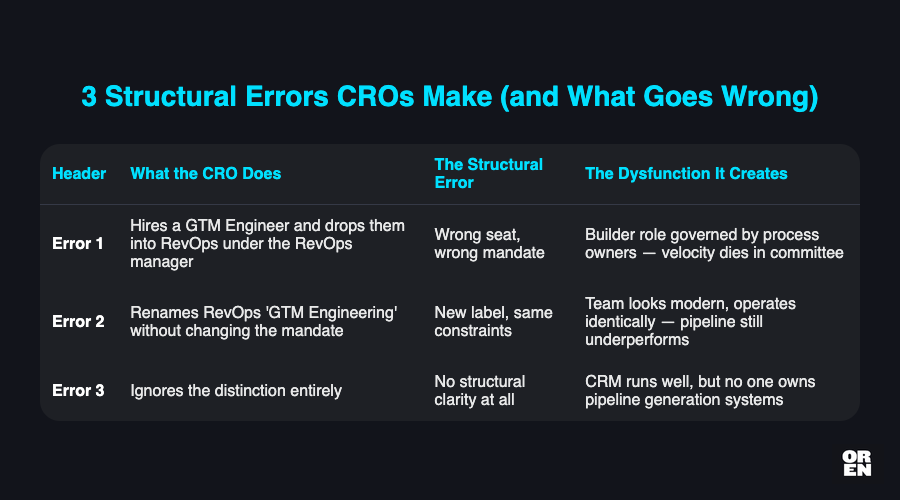
The standard failure mode: a new CRO inherits a RevOps team, hears about GTM Engineering, and does one of 3 things. They hire a GTM Engineer and drop them into RevOps under the RevOps manager. They rename the RevOps team GTM Engineering without changing the mandate. Or they ignore the distinction entirely and wonder why pipeline generation keeps underperforming despite a well-run CRM.
Each of these is a structural error. Each produces a different kind of dysfunction.
"The organizational seat of each role signals its mandate: GTM Engineers to build systems, RevOps to govern processes, and Sales Engineers to close deals." - Eugene Levi, CEO & Co-Founder, Tabula.io
The seat is the mandate. Change the seat without changing the mandate and nothing materially changes. Change the mandate without changing the seat and the person fails politically before they can deliver technically.
Build vs. run
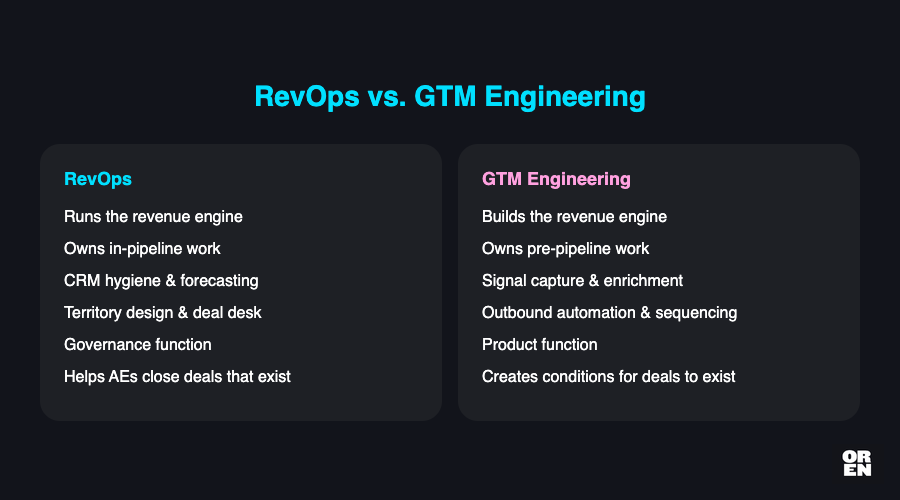
Both roles touch technology. Both touch data. Both nominally serve the revenue team. But they operate at fundamentally different points in the value chain.
"RevOps is the conductor. Their job is to bring order, predictability, and governance to the revenue engine." - Eugene Levi, CEO & Co-Founder, Tabula.io
"A GTM Engineer is the builder. They connect systems, automate workflows, and create the technical scaffolding that makes Sales, Marketing, and CS more effective." - Eugene Levi, CEO & Co-Founder, Tabula.io
In practice: RevOps owns in-pipeline work - CRM hygiene, forecasting accuracy, territory design, deal desk, attribution. GTM Engineering owns pre-pipeline work - signal capture, enrichment infrastructure, outbound automation, intent-to-sequence workflows, tooling that creates pipeline from nothing.
An SDR who previously generated 4 SQLs per month and now generates 6 is a 50% productivity gain per resource [Everstage, 2025]. That delta is almost always a GTM Engineering output, not a RevOps output.
RevOps helps the AE close the deal once it exists. GTM Engineering helps create the conditions for the deal to exist at all.
"GTM Engineering is the R&D arm for RevOps. RevOps keeps the trains running; GTM Engineering experiments with how to build faster trains." - Saad Bayezeed
Useful framing. But for org design purposes I'd push it further: RevOps is a governance function. GTM Engineering is a product function. They need different management models, different success metrics, and different reporting structures.
What the org chart failure looks like
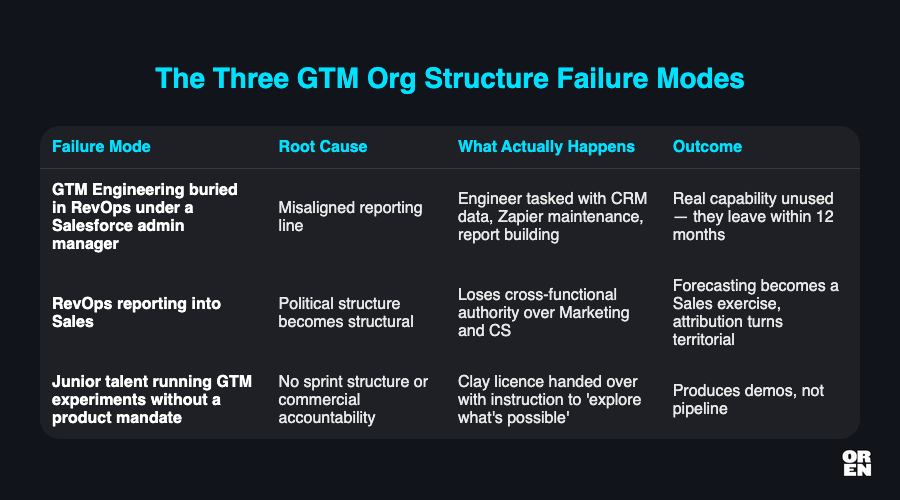
Burying GTM Engineering inside RevOps under a manager who came up through Salesforce administration is the most common structural error at Series B.
The GTM Engineer gets tasked with CRM data projects, Zapier maintenance, report building. Their actual capability - building automated enrichment pipelines, deploying Clay workflows, constructing signal-based outreach infrastructure - never gets used. They leave within 12 months. The CRO concludes GTM Engineering was overhyped.
The second failure mode is RevOps reporting into Sales. This is a political problem that becomes a structural one. When RevOps reports to the CRO of Sales, it loses cross-functional authority over Marketing and Customer Success. Forecasting becomes a Sales exercise. Attribution debates become territorial. The function supposed to create alignment becomes an extension of one function's agenda.
The third failure mode is assigning junior talent to run GTM Engineering experiments without a product mandate or sprint structure. Handing a junior hire a Clay licence and asking them to "explore what's possible" is not GTM Engineering. It produces demos, not pipeline.
Meaningful GTM transformation requires senior operators with commercial acumen holding product mandates with sprint cycles and measured outcomes. Not innovation sandboxes staffed by people who cannot connect what they build to a revenue number.
"Gone are the days when RevOps needed to scramble for someone to write a piece of customized code." - Everstage / Closing Thoughts Newsletter
True. But it does not follow that the code-writing capability should be subordinated to the process-governance function.
The capability difference is real: GTM Engineers command salaries of $131,000 to $180,000+, while RevOps managers average $97,749 with senior roles reaching $136,000 [Databar.ai, 2025]. You are not hiring the same type of person. You should not be managing them the same way.
Sequencing by stage
The right structure at Series A is wrong at Series C. Getting the sequencing wrong in either direction is expensive.
Sub-$10M ARR: GTM Engineering is typically a first ops-engineer hire, reporting directly to a Head of Growth or COO [Tabula.io, 2026]. There is no RevOps function yet - or if there is, it is one person doing everything. The mandate is to build the pipeline generation infrastructure from scratch: ICP enrichment, outbound tooling, signal capture. Do not hire a RevOps manager first at this stage if pipeline creation is the constraint.
$10M-$50M ARR: This is where the structural decision becomes critical. You now have enough pipeline that in-pipeline governance matters - forecasting, territory, deal desk - and enough GTM complexity that the pre-pipeline infrastructure needs dedicated ownership. The correct structure is 2 peer functions, both reporting to the CRO: a RevOps lead responsible for in-pipeline governance, and a GTM Engineering lead responsible for pre-pipeline infrastructure. They collaborate on data standards and tooling decisions. They do not report to each other.
$50M+ ARR: The GTM Engineering function may warrant its own VP-level seat, particularly if the company is running sophisticated signal-based outreach, AI-powered personalisation at scale, or complex multi-channel automation. In high-touch enterprise models, you will see one Sales Engineer for every 2 or 3 AEs - the GTM Engineering team ratio to quota-carrying headcount follows similar logic depending on motion complexity [Tabula.io, 2026].
The consistent principle across all stages: GTM Engineering should never report into RevOps. It can sit alongside it. It can collaborate tightly with it. But subordinating the build function to the run function is how you guarantee the build function never builds anything.
The CRO background bias
Revenue leaders structure teams in the image of their own experience.
A CRO who came up through Sales operations will instinctively centralise everything under RevOps and treat GTM Engineering as a technical sub-team. A CRO who came up through Marketing will over-index on demand generation tooling and under-invest in in-pipeline governance. A CRO with a product background is most likely to get this right - because the build-vs-run distinction maps directly onto product engineering vs. product operations.
If you came up through Sales, the corrective is to treat GTM Engineering the way you would treat a product engineering team: sprint cycles, defined outputs, outcome-based measurement, a mandate protected from service-desk requests.
"We're moving away from sales-led growth toward operations-led growth. Features can be copied; unique operational processes are the real differentiator." - Saad Bayezeed
If operational processes are the differentiator, the function that builds those processes needs the same organisational protection and investment that product engineering gets.
Three questions that determine the right structure
Where is the primary constraint? If you are not generating enough pipeline, GTM Engineering is the priority hire and should report directly to the CRO with a protected mandate. If you have pipeline but cannot forecast or close it efficiently, RevOps is the priority and GTM Engineering can wait.
What is the technical depth of your RevOps lead? If your RevOps lead is strong on process governance but limited on technical build capability, GTM Engineering must be a peer function - not a subordinate one. If your RevOps lead has genuine build capability and a product mindset, a hybrid structure can work temporarily, but it will constrain the GTM Engineer's output and create role ambiguity as the team scales.
What does your motion complexity require? A velocity-driven SMB motion with high-volume outbound needs GTM Engineering investment early and heavily - the automation infrastructure is the competitive advantage. A high-touch enterprise motion with long sales cycles needs RevOps investment in forecasting and deal management first, with GTM Engineering becoming critical as account-based programmes scale.
"GTM engineers don't replace roles. They enhance them - helping GTM teams operate more efficiently, close deals faster, and drive better results." - Everstage / Closing Thoughts Newsletter
Enhancement requires the right seat.
What to do with this
If you currently have GTM Engineering buried inside RevOps, the fix is not a reorg. It is a mandate clarification.
Define what GTM Engineering owns (pre-pipeline infrastructure, signal capture, outbound automation, enrichment tooling). Define what RevOps owns (in-pipeline governance, forecasting, CRM administration, attribution). Give each function a direct line to you with separate OKRs. That structural clarity is worth more than any individual hire.
If you are pre-hire and designing from scratch, the first question to answer is: where in the revenue system is the constraint? The answer tells you which function to build first and how much autonomy it needs. Automating GTM workflows before you have clean data, defined processes, and a validated ICP is the primary reason AI pilots fail - and the same principle applies to org design.
Build the right structure for the right constraint, in the right order.
The org chart is not an administrative document. It is a statement of what the revenue leader believes creates pipeline. Make sure yours reflects what you actually believe - not the confusion you inherited.