Trusted by over 68k marketers (LinkedIn & TikTok)

Thank you! Your submission has been received!
Oops! Something went wrong while submitting the form.

© Copyright 2025. All rights reserved

Who Should Own Your Agentic GTM System When It Breaks a Live Deal?

By
Oren Greenberg
June 9, 2026

Last updated: 2026-06-09

Key Takeaways

  • Agentic GTM systems touching live pipeline require a single named owner with explicit decision rights - not a committee, not a shared Slack channel.
  • The 3-team fragmentation pattern (RevOps, Sales Engineering, Marketing Ops) is the most common structural cause of agentic GTM failure - and it disguises itself as a technical problem.
  • Over 40% of agentic AI projects will be cancelled before the end of 2027 (Gartner, 2025) - unclear ownership is a primary, preventable cause.
  • When an agent misfires at scale, someone needs the authority to halt the system immediately. A committee cannot do that at 11pm on a Thursday.
  • Accountability gaps are an organisational design failure first. The technical failure comes second, and gets blamed for the wrong root cause.

---

Agentic GTM systems touching live pipeline need a named owner with clear accountability.

Most B2B SaaS companies building these systems are spreading responsibility across 3 teams with no single person empowered to make the call when something breaks.

That gap is not a tooling problem. It's not an engineering problem. It's an organisational design failure - and it will surface as a technical failure every single time.

---

What agentic GTM ownership actually means

What agentic GTM ownership actually means

Agentic GTM ownership means one named individual holds decision rights over what an agent can do autonomously, what requires human approval, and who has the authority to halt the system when it produces bad outputs at scale.

Not a governance committee. Not a shared responsibility between functions. A person with a mandate.

The market is moving fast. By 2028, 33% of enterprise software applications will include agentic AI (Gartner, 2025). Usage of AI nodes in n8n grew 340% in 2025 alone, reflecting the shift from single agents to orchestrated workflows (DevCommX / n8n, 2025). Landbase closed a $30 million Series A in June 2025 specifically to scale an agentic GTM platform (Apollo.io Magazine, 2025). The investment is real and the build cycles are underway.

But speed of adoption is not the same as readiness to operate.

Agentic GTM requires a 12 to 16 week build-and-calibrate cycle before meaningful performance data is available (Apollo.io Magazine, 2026). Most companies are not spending that time clarifying who owns the system. They're spending it on architecture.

"The gap between 'we built an agent' and 'we run an agent practice' is not a technology gap. It's an organisational one." - Pankaj Kumar, DevCommX

That distinction matters enormously when an agent enriches the wrong contact, routes a £500K opportunity to the wrong rep, or sends a sequence to a prospect your AE has been nurturing for 6 months.

At that point, the architecture is irrelevant. The question is: who had the authority to prevent this, and who has the authority to stop it now?

---

The 3-team fragmentation problem

The 3-team fragmentation problem

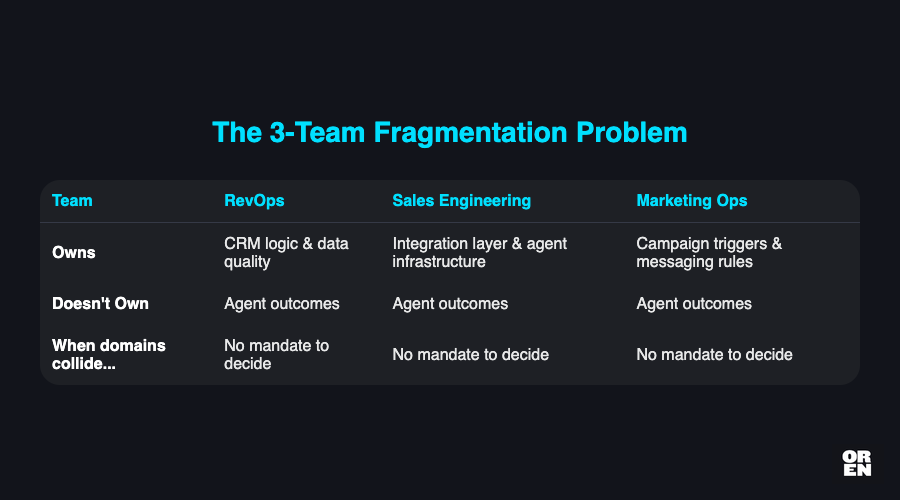
The 3-team fragmentation pattern - where agentic GTM capability is built across RevOps, Sales Engineering, and Marketing Ops simultaneously - creates accountability vacuums because each team owns a piece of the system but no team owns the outcome.

This is the most common structural failure mode in agentic GTM deployments. And it's almost entirely invisible until something goes wrong.

RevOps owns the CRM logic and data quality standards. Sales Engineering owns the integration layer and the agent infrastructure. Marketing Ops owns the campaign triggers and the messaging rules. Each team has legitimate domain expertise. None of them has the mandate to make a unilateral call when the 3 domains collide in a live pipeline event.

"Governance is not an IT problem. Chief Revenue Officers and Chief Technology Officers must jointly define what agents can and cannot do autonomously, or you will lose control of brand voice and buyer experience." - Andy McCotter-Bicknell, Apollo.io Magazine

But 'jointly define' is not the same as 'someone owns.'

Joint definition is where accountability goes to die. It produces documentation, working groups, and escalation paths that nobody follows at 11pm when the agent is misfiring on a deal that closes on Friday.

This is a pattern I've written about before in the context of GTM architecture more broadly - the failure to treat the revenue engine as a system with clear ownership rather than a collection of tools managed by adjacent teams. Agentic capability doesn't fix that structural problem. It accelerates it.

The data reinforces how much is at stake. Traditional revenue team members spend 50-70% of their time on execution work that doesn't require their expertise (Arise GTM Blog, 2026). A RevOps Manager typically spends 30% of their time on CRM hygiene, 25% on report building, 20% on lead routing, and 15% firefighting integration issues - leaving only 10% for strategic projects (Arise GTM Blog, 2026). Agentic systems are being built to free up that capacity.

But if the system itself is ungoverned, you're automating the chaos rather than replacing it.

"Agents do not fix bad data. They operationalize it faster." - Andy McCotter-Bicknell, Apollo.io Magazine

---

Committee governance versus single-threaded ownership

Committee governance versus single-threaded ownership

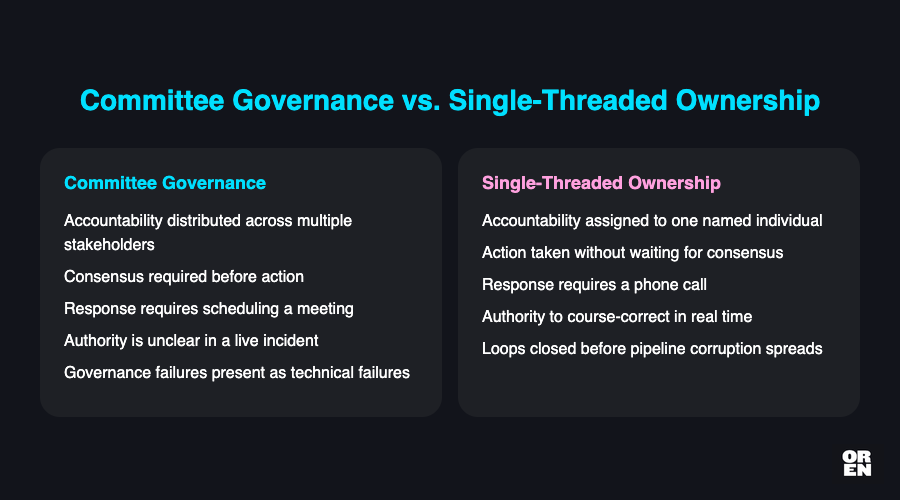
Committee governance distributes accountability across multiple stakeholders and requires consensus to act. Single-threaded ownership assigns accountability to one named individual who can act without consensus.

For agentic GTM systems touching live pipeline, committee governance is structurally incapable of meeting the response time requirements.

Consider the incident scenario: an agent running lead enrichment begins writing incorrect company size data into your CRM at scale. The data feeds your lead scoring model. Your lead scoring model feeds your routing rules. Your routing rules are already re-assigning pipeline. The time from first bad write to meaningful pipeline corruption is measured in minutes, not hours.

A committee requires a meeting. A named owner requires a phone call.

"The fix is loop ownership, not another meeting." - Antoine Buteau

This is not a theoretical risk. Gartner projects that over 40% of agentic AI projects will be cancelled before the end of 2027 (Gartner, 2025). The cancellations won't all be technical failures. A significant proportion will be governance failures that present as technical failures - systems that worked in staging but produced bad outcomes in production because nobody had the authority to course-correct in real time.

"Without traceability, the CRM becomes more complete and less trustworthy. That is the worst possible combination." - Antoine Buteau

The shared-accountability model also creates a specific failure mode in incident response: when something breaks, the first conversation is about whose domain the failure belongs to rather than how to stop it.

That conversation costs time you don't have when the agent is live.

My position on this is consistent with what I've argued about AI adoption programmes more broadly - shared accountability is accountability theatre. It creates the appearance of governance without the substance. Ruthless single-ownership decisions are uncomfortable organisationally and essential operationally.

---

Who specifically should own this

The owner of an agentic GTM system touching live pipeline should be the individual who has both the commercial context to judge whether an agent output is acceptable and the technical authority to halt the system without requiring sign-off from another function.

That profile typically sits in RevOps at companies with a mature RevOps function, or with the CRO/VP Revenue at companies where RevOps reports into revenue leadership.

It doesn't sit in Marketing Ops (who lack pipeline authority). It doesn't sit in Sales Engineering (who lack commercial context). And it doesn't sit in a shared working group (who lack individual accountability).

The owner's mandate should cover 4 specific areas:

| Mandate Area | What It Means in Practice |

|---|---|

| Scope definition | Decides what the agent can act on autonomously versus what requires human approval |

| Data standards | Sets the minimum data quality threshold before agents operate (core fields populated on 80%+ of records is a reasonable baseline (Arise GTM Blog, 2026)) |

| Incident authority | Has unilateral authority to halt any agent touching live pipeline without requiring cross-functional approval |

| Performance accountability | Owns the performance metrics and is accountable to the CRO/CEO for outcomes, not just outputs |

"RevOps cannot treat those loops as side projects. If agents run GTM work, RevOps has to govern how that work enters the system." - Antoine Buteau

At founder-led companies where there's no CRO or senior RevOps function, this ownership sits with the founder directly. Which means the founder needs enough hands-on understanding of the system to exercise that authority meaningfully.

This is consistent with a position I hold firmly: leaders who build AI systems themselves are the only ones qualified to lead agentic transformation. Delegation without comprehension isn't leadership of an agentic system. It's exposure to one.

"The cheaper intelligence becomes, the more your judgment matters. Not less." - Mike Murchison

---

What incident response looks like without a named owner

Without a named owner, the incident response chain for an agentic GTM failure defaults to whoever notices the problem first - usually the wrong person, at the wrong level, without the authority to act.

The practical sequence in an ungoverned system: a sales rep notices their pipeline has been re-assigned incorrectly and raises it with their manager. The manager escalates to RevOps. RevOps identifies the agent as the source but doesn't have unilateral authority to halt it without sign-off from the Engineering team that built it. Engineering is unavailable or deprioritises the ticket. The agent continues operating. By the time the system is halted, the damage is compounded.

"None of these are AI problems. They are management problems. And they are entirely solvable with the right operating structure around your agentic stack." - Pankaj Kumar, DevCommX

Compare that to a named-owner model: the owner receives an alert (or gets called directly), makes the call to halt the agent, and initiates a post-incident review. The authority chain is one step. The decision is made in minutes.

"Execution that is accurate, governable, and safe will always outperform intelligence that is fast, creative - and wrong." - Forrester

The performance case for agentic GTM is real. Traditional teams average 2-6 hours lead response time while agentic teams respond in under 15 minutes. Traditional teams have an 8-12% error rate on repetitive tasks versus under 2% by month 3 for agentic teams (Arise GTM Blog, 2026). But those gains are only realisable if the governance structure can protect them.

A single ungoverned incident that corrupts pipeline data can cost more than months of efficiency gains.

"The north star is system truth plus useful action. If agents increase both, keep going. If they increase activity while reducing trust, stop." - Antoine Buteau

---

Frequently Asked Questions

Can RevOps own an agentic GTM system if they report into Marketing rather than Revenue?

Reporting line matters less than mandate and authority. A RevOps function reporting into Marketing can own an agentic GTM system if they have explicit authority to halt agents touching pipeline without requiring Marketing leadership sign-off. If that authority doesn't exist, the reporting line is irrelevant - the ownership is nominal rather than real. The test is simple: can this person make the call at 11pm without a committee?

What happens if the named owner leaves the company?

This is a genuine succession risk that most companies don't plan for. The owner role should be documented with explicit decision rights, not held informally. When the owner transitions, the incoming person needs a structured handover that covers agent scope, data standards, incident protocols, and the current performance baseline. Treating the owner as a named function rather than a named individual - with documented responsibilities - reduces the transition risk significantly.

Should the agentic GTM owner also be the person who built the system?

Not necessarily, but they need enough technical comprehension to exercise authority meaningfully. An owner who can't distinguish between a configuration error and a data quality problem will struggle to make fast, accurate calls during an incident. This is why hands-on involvement in the build phase matters - not because the owner needs to write code, but because they need to understand the system's failure modes before those failure modes occur in production.

How does this ownership model change as the company scales?

At early stage, the founder or CRO typically holds this role directly. As the company scales past 100 employees and the agentic stack grows in complexity, a dedicated GTM Systems Owner or Head of Revenue Operations role becomes the natural home. The key is that the mandate and authority scale with the role - the owner at a 300-person company has more agents to govern, not a diluted version of the same accountability.

Is 90% of IT executive interest in agentic AI reflected in actual deployment readiness?

No. 90% of IT executives believe agentic AI could improve their business workflows, with 77% planning to invest within the following year (Mindflow survey of IT executives, 2025). But intent to invest is not the same as readiness to operate. The organisational design work - defining ownership, establishing incident protocols, setting data quality standards - is consistently underdone relative to the technical build. The gap between investment intent and operational readiness is where most agentic GTM projects will fail.

---

[AUTHOR_BIO]

Article by

Oren Greenberg

A fractional CMO who specialises in turning marketing chaos into strategic success. Featured in over 110 marketing publications, including Open view partners, Forbes, Econsultancy, and Hubspot's blogs. You can follow here on LinkedIn.

Spread the word

Sign up to my newsletter

Get my 6-part free diagnostic email series.

Thank you! Your submission has been received!
Oops! Something went wrong while submitting the form.

Get my 6-part free diagnostic email series.

Send it Over