Growth Hacking Course
Ai Maturity Plateau Why Teams Stall Between Stages 2 And 3
By
June 23, 2026

88% of companies report regular AI use [McKinsey, 2026]. Ramp's AI Index shows AI use at American firms soared to 40% in early 2025. Paid subscriptions have more than doubled across many industries year-on-year [Ramp, 2025].
Two-thirds of B2B marketing decision-makers think generative AI is overhyped [Forrester, 2025].
Both things are true. And the gap between them is where the real story lives.
The plateau is real. The diagnosis isn't. Teams aren't stalling because they lack tools, training budgets, or executive sponsorship. They're stalling because they're trying to automate workflows they've never mapped. You cannot compound what you cannot define.
The numbers look fine until you read them properly
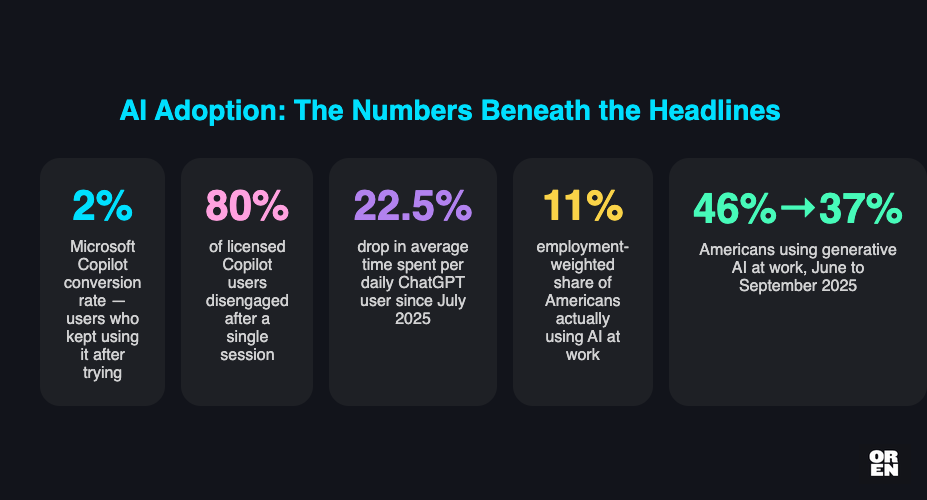
Dig one layer down and the picture inverts.
Microsoft Copilot - a paid, licensed, enterprise product - reported conversion rates as low as 2%, with the majority of users reverting to prior workflows after a single session. 80% of licensed users tried the AI feature once and disengaged [reloadux.com, 2026]. Average time spent per daily US ChatGPT user dropped 22.5% since July 2025, and average sessions per user fell roughly 20.7% over the same period [Apptopia via TechCrunch, 2025].
The employment-weighted share of Americans using AI at work sits at 11% [The Economist / US Census Bureau, 2025]. One Stanford study found 37% of Americans used generative AI at work in September, down from 46% in June [Hartley et al., 2025].
The headline adoption numbers measure access and initial curiosity. The underlying numbers measure whether AI is actually changing how work gets done. They tell completely different stories.
"Three years into the generative-AI wave, demand for the technology looks surprisingly flimsy." - The Economist
What frontier firms are actually doing differently
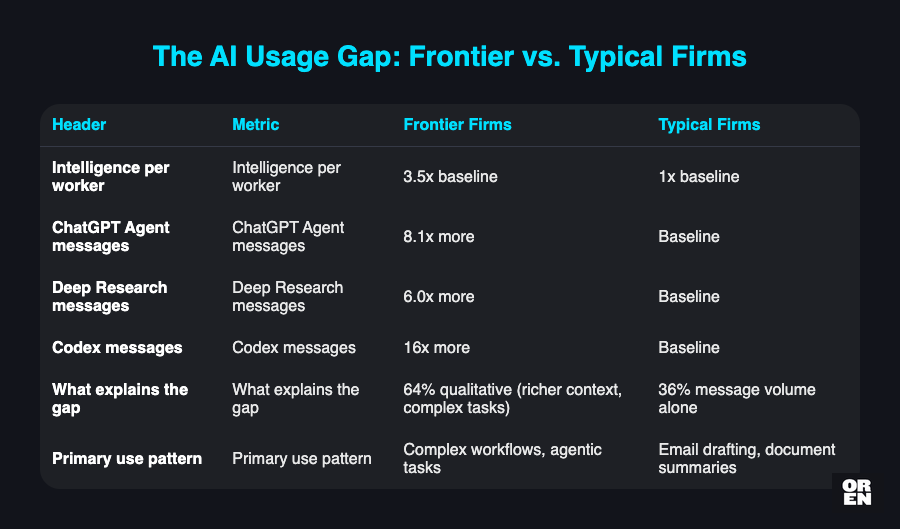
OpenAI's B2B Signals report is the most useful dataset on this question, and almost nobody is reading it correctly.
Frontier firms - those at the 95th percentile of AI use - now use 3.5x the intelligence per worker compared to typical firms, up from 2x a year ago. But the critical detail: message volume only explains 36% of the gap between frontier and typical firms [OpenAI B2B Signals, 2026].
The other 64% is qualitative.
Frontier firms aren't just sending more messages. They're sending different messages, on different tasks, with richer context and more substantive outputs. ChatGPT Agent shows an 8.1x message gap between frontier and typical firms. Deep Research shows a 6.0x gap. Frontier firms send 16x as many Codex messages as typical firms.
"Workers at the frontier ask AI to take on more complex work, provide models with richer context, and generate more substantive outputs." - OpenAI B2B Signals
Typical firms are using AI for the things they already do - drafting emails, summarising documents, answering how-to questions. 60% of IT and Security messages are concentrated in procedural guidance [OpenAI B2B Signals, 2026].
That's not transformation. That's expensive autocomplete.
The gap between frontier and typical firms isn't a gap in tool access - both groups have access to the same products. It's a gap in workflow architecture. Frontier firms have defined what work they're giving to AI, at what stage, with what inputs, and what the output feeds into next. Typical firms have given employees access and called it adoption.
The Stage 2-3 gap nobody names
I've written before about AI adoption as a progressive maturity curve - not a binary state of 'using AI or not' but a staged progression from basic prompt use through to genuinely automated, compounding workflows. Most enterprise teams are stuck between stages 1 and 2 whilst reporting to the board that they're adopting AI.
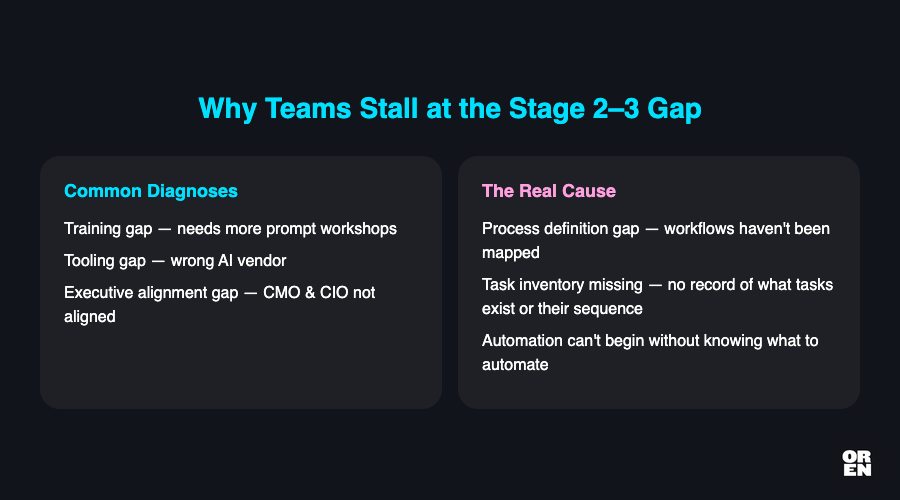
The transition from Stage 2 (consistent individual use) to Stage 3 (automated workflow integration) is where almost every mid-market B2B team stalls.
And the reason isn't what most programmes diagnose.
It's not a training gap. Running another prompt engineering workshop won't fix it. It's not a tooling gap - swapping your AI vendor just treats symptoms whilst the structural problem compounds. It's not an executive alignment gap, though Forrester's finding that leading AI adopters are almost twice as likely to report the CMO and CIO as strategic partners is worth noting [Forrester, 2025].
The Stage 2-3 gap is a process definition gap.
Teams can't automate workflows they haven't mapped. They can't identify which tasks deserve AI attention because they've never inventoried what those tasks are, in what sequence they occur, what data they require, and what decisions they feed. Most AI adoption programmes skip this entirely and then wonder why nothing compounds.
"Closing the capability overhang requires enablement, not just access." - OpenAI B2B Signals
Why tool mandates make this worse
The instinct when adoption stalls is to mandate harder or buy more. Both responses accelerate the wrong thing.
A weak tool mandate - rolling out basic Copilot tiers to demonstrate AI investment - simultaneously kills enthusiasm in sceptics and drives enthusiasts toward unsanctioned shadow AI usage with company data. You get adoption failure and security risk at the same time.
The 2% Copilot conversion rate isn't a marketing problem or a change management problem. It's evidence that employees can't find a workflow to slot the tool into because that workflow hasn't been defined for them.
"A 2% conversion rate on a paid, licensed, enterprise product is a design diagnosis, not a marketing problem." - Faizan Khan, reloadux.com
The design diagnosis framing is useful but incomplete. The deeper diagnosis is operational: the product has no workflow to attach to. Blank-slate interfaces transfer the cognitive work of figuring out where AI fits to the individual user. Most users, facing that cognitive load on top of their actual job, revert to what they know.
That's not laziness. It's rational behaviour in the absence of structural direction.
Forrester's data makes the structural point cleanly: 94% of leading AI adopters report that marketing data is relied upon for significant business decisions, compared to 78% for lagging adopters [Forrester, 2025]. Leading adopters are twice as likely to report working in organisations growing through improved productivity.
The differentiator isn't tool selection. It's data infrastructure and decision architecture - the unglamorous work that precedes automation.
What the fix actually looks like
The sequence that produces compounding AI value: map the workflow, clean the data, define the inputs and outputs, then select and configure the tool.
Most organisations do this in reverse.
They buy the tool, run the training, and ask employees to figure out where it fits. That's why growth audits consistently surface process sequencing as the primary failure mode - not bad tools, not bad people.
Concretely, for a mid-market B2B SaaS marketing team, this means a few things.
Audit before you automate. List every repeatable GTM workflow - ICP research, content briefing, campaign reporting, lead scoring review, competitive monitoring - and document each one at the task level. Not 'we do content' but 'a writer receives a brief, the brief contains X, Y, Z inputs, the output goes to A for review, then to B for distribution.' If you can't document it at that level, you can't automate it. You'll just automate the chaos.
Assign senior operators, not junior experimenters. Meaningful GTM transformation requires folk with commercial acumen running defined sprints with measured outcomes. Delegating AI adoption to an innovation sandbox staffed by junior employees is a box-ticking exercise. The seniority and mandate structure matters as much as the tool selection.
Invest in data before automation. Winners invest 50-70% of their AI budget in data readiness before touching automation. Automating on dirty data or an unvalidated ICP produces faster wrong answers. The 94% figure from Forrester isn't coincidental - data infrastructure is the precondition, not the afterthought.
Measure depth, not breadth. Licence activation counts are vanity metrics. The question is which workflows have been redesigned around AI, and what's the measurable output difference? Leading adopters aren't counting how many employees opened Copilot. They're measuring productivity per workflow.
The compounding problem
The OpenAI data contains a warning most teams aren't taking seriously.
The frontier advantage is compounding. Frontier firms were at 2x intelligence per worker a year ago. They're at 3.5x now [OpenAI B2B Signals, 2026]. The gap isn't stable - it's widening. Teams stuck at Stage 2 whilst frontier competitors reach Stage 4 and 5 aren't just behind on a linear scale. They're falling behind on an exponential one.
The process definition gap is fixable. But it requires acknowledging that the problem is architectural, not motivational - and that buying more licences or running another workshop isn't the same as solving it.
If you're a CMO or VP Marketing sitting on a stack of AI tool licences with nothing compelling to show the board, the question to ask isn't 'which tool should we add?' It's 'which workflows have we actually mapped?'
That question will tell you everything about why the plateau exists and exactly what to do next.