Growth Hacking Course
Is Your Agentic GTM System Safe to Run Without a Human in the Loop?

Last updated: 2026-06-08
Key Takeaways
- The default vendor pitch - maximum autonomy, end-to-end agent execution - is a mismatch with how commercial procurement actually works in mid-market B2B and FinTech.
- AI agents fail multi-step tasks nearly 70% of the time in simulation testing (Carnegie Mellon Study via MLQ.ai, 2025), making unsupervised GTM execution a live revenue risk.
- Human-in-the-loop (HITL) design is not a constraint on agentic GTM - it is the architecture that makes enterprise buyers willing to sign.
- Graduated autonomy - starting at high oversight and expanding trust incrementally - is the design pattern that enterprise procurement teams need to see before contracts move forward.
- Designing override points after you have built the system costs significantly more than designing them in from the start. This is a GTM engineering problem, not an AI problem.
---
What does human-in-the-loop actually mean in an agentic GTM context?

HITL in agentic GTM means embedding explicit pause points, escalation paths, and override controls into automated commercial workflows.
Agents handle routine execution. Humans retain decision authority over anything that carries revenue, compliance, or reputational risk.
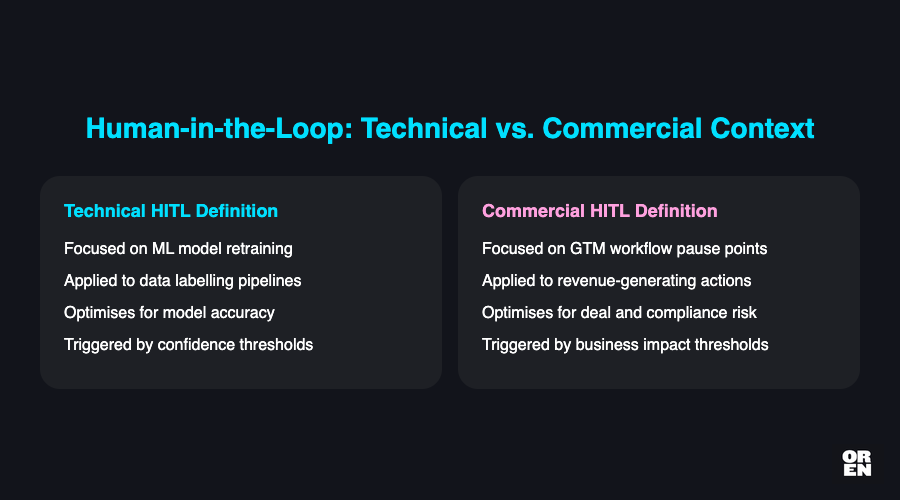
Most technical definitions of HITL focus on ML model retraining or data labelling pipelines. That framing is almost useless for a CRO evaluating whether to let an agent sequence prospects, draft commercial proposals, or trigger contract amendments without review.
The commercial context demands a different vocabulary.
"Human-in-the-Loop (HITL) means pausing an automated process at key points for human review. The system handles the routine, while people handle exceptions that need further judgment or context." - Orkes Blog
The important word there is "key points."
Not every point. Not no points.
The design question is: which actions in your GTM workflow carry enough risk that an unreviewed agent decision could damage a deal, breach a contract, or create a compliance exposure?
Those are your override points. Everything else can run autonomously.
This is not a philosophical question about AI capability. It is a GTM engineering question about where you draw the lines - and it needs to be answered before you build, not after.
---
Why is maximum autonomy the wrong default for commercial workflows?

Because the failure rates are high enough to make unsupervised commercial execution genuinely dangerous to revenue.
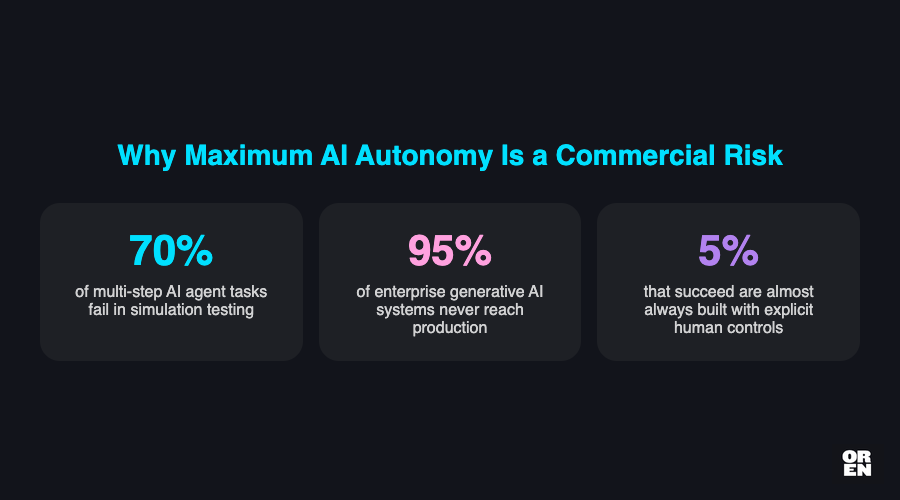
AI agents fail multi-step tasks nearly 70% of the time in simulation testing (Carnegie Mellon Study via MLQ.ai, 2025).
That is not a marginal error rate you can absorb in a low-stakes workflow.
In a GTM context, a multi-step failure might mean a prospect receives an incorrect pricing proposal, a contract trigger fires on the wrong account, or a churn-risk signal gets routed to the wrong team. Each of those failures has a direct cost.
"AI agents aren't as autonomous as we pretend. In production, they get stuck, make bad decisions, or need approvals." - Temporal
The vendor pitch glosses over this entirely. Remove human bottlenecks, compress sales cycles, scale outreach without headcount. Compelling pitch.
But only 5% of enterprise-grade generative AI systems reach production. 95% fail during evaluation (MIT via Forbes, 2025).
The systems that do reach production almost always get there because they were designed with explicit controls - not because the agent was trusted to handle everything.
There is also a procurement dimension that vendor pitches ignore entirely.
Enterprise buyers - particularly in regulated sectors like FinTech - have risk and compliance teams with veto power over commercial technology. An agentic GTM system that cannot demonstrate documented override architecture will fail security review. It will generate legal redlines. It will stall in procurement.
Maximum autonomy is not a feature to enterprise buyers. It is a red flag.
"Autonomous agents can execute financial transactions independently, compressing timelines and increasing the speed of potential fraud or money laundering." - European Systemic Risk Board
If your ICP includes FinTech companies or any buyer operating under FCA, GDPR, or EU AI Act obligations, that is not theoretical. It is the exact sentence your buyer's compliance team will raise in the risk review.
---
What is graduated autonomy and why does it matter for enterprise GTM?
Graduated autonomy means incrementally expanding agent decision authority over time as trust is established.
You start with high oversight and low autonomy. You relax controls as performance data accumulates and the buyer's confidence grows.
Every existing framework treats autonomy as a binary or a simple 3-tier model: in-the-loop, on-the-loop, out-of-the-loop. Fine for a technical architecture diagram. Useless as a commercial design pattern, because it ignores time and trust.
In practice, graduated autonomy works like this:
| Autonomy Tier | Agent Actions | Human Involvement | Typical Stage |
|---|---|---|---|
| Tier 1 - Supervised | Agent drafts, human approves every action | High - review before execution | Initial deployment, new customer segment |
| Tier 2 - Monitored | Agent executes, human reviews outputs daily | Medium - review after execution | 60-90 days post-deployment |
| Tier 3 - Audited | Agent executes, human reviews exceptions only | Low - exception-based escalation | Established trust, stable workflow |
| Tier 4 - Autonomous | Agent executes, system logs for periodic audit | Minimal - scheduled review | Mature, low-risk workflow categories only |
The commercial value of this model is significant.
It gives enterprise buyers a structured path from "we are nervous about this" to "we trust this enough to expand." It reduces the perceived risk of signing in the first place. And it creates a natural land-and-expand motion: buyers start at Tier 1, graduate to Tier 3, then purchase additional workflow coverage because the model has proven itself.
"Adding a human-in-the-loop makes your agentic workflow more of a hybrid model. This lets you keep the speed of automation for straightforward cases, while letting humans handle the complex, ambiguous, or risky ones. So it's not slowing down the process, but making it smarter and more reliable." - Orkes Blog
This is the design pattern that enterprise procurement teams need to see before they sign.
Not a promise of maximum autonomy. A credible, documented path from supervised to autonomous - with explicit criteria for each transition.
---
What does retrofitting HITL controls actually cost?
More than designing them in from the start. Across engineering time, commercial risk, and deal velocity.
The technical cost is the most visible. Agentic workflows built without pause points require architectural rework to insert them. If the system was built on a framework like LangGraph or Temporal, adding checkpoints is feasible - but requires re-mapping the graph structure and rewriting edge conditions.
"LangGraph is a graph based orchestration framework that adds control to agent workflows. LangGraph has a node and edge approach, where each node constitutes a task or can be considered as a step. And edges are links between the nodes which can be subject to conditions which determines to which node the state moves." - Cobus Greyling
"LangGraph makes agents more transparent by allowing you to inspect their behaviour and strike a balance between autonomy and following a defined sequence." - Cobus Greyling
If the system was not built on a structured orchestration framework - common in early-stage agentic builds where speed was the priority - the retrofit cost is substantially higher. You are not adding checkpoints. You are rebuilding the control plane.
The commercial cost is less visible but often larger.
An agentic GTM system without documented override architecture will generate legal and security review delays on every enterprise deal. Those delays compound. A 3-week procurement stall on a £50k ACV deal, repeated across 20 deals per quarter, is a material revenue impact that does not appear in any engineering budget.
There is also a trust cost.
If an agent makes a bad commercial decision before controls are in place - sends an incorrect proposal, triggers an unwanted contract action, contacts a prospect in a suppressed segment - the damage to the customer relationship may not be recoverable regardless of how well the retrofit is executed.
The honest framing: designing HITL controls into your agentic GTM system is a GTM engineering investment, not an AI safety tax. The companies that treat it as the latter will spend more, close less, and retrofit under pressure.
This connects directly to a broader pattern I have written about in the GTM stack architecture piece - the most expensive GTM problems are almost always the ones that were architectural decisions treated as tactical ones.
---
How does HITL design affect enterprise sales cycles and procurement?
Well-documented HITL architecture shortens enterprise sales cycles by reducing the volume and duration of security and legal review.
It also enables deal expansion by giving buyers a credible path to higher autonomy over time.
Most CROs think about HITL as an internal operational decision. It is also an external commercial asset.
Consider what happens during a typical enterprise procurement process for an agentic GTM tool:
- Security review asks: "What actions can the agent take without human approval?"
- Legal asks: "Who is liable if the agent makes a commercial decision that breaches our terms with a third party?"
- Compliance asks: "How do we demonstrate to regulators that a human reviewed this decision?"
A system with no documented override architecture cannot answer any of those questions cleanly. The deal either stalls or dies.
A system with a documented graduated autonomy model - with specific override points, escalation paths, audit logs, and rollback capability - answers all 3 questions before they are asked.
"Most organizations confuse presence with practice. They put someone 'in the loop' without training them on what to approve, when to escalate, or how to spot automation complacency. That's not oversight - it's a liability dressed up as process." - Eric Olden, Strata.io
That is the most common failure mode. A company adds a nominal human review step to satisfy procurement, without designing what the reviewer is actually supposed to do.
Procurement teams at sophisticated buyers will probe this. They will ask what training the human reviewer has received, what criteria they use to approve or escalate, and how the system handles reviewer disagreement. Vague answers stall deals.
The RFP dimension is worth flagging separately.
In competitive RFP responses, risk and compliance teams often have veto power that sales teams underestimate. A well-documented HITL architecture is a direct competitive differentiator in any RFP where the buyer's risk team is involved - which, in mid-market FinTech and regulated B2B SaaS, is most of them.
"Just like cruise control on a car, AI can handle the driving, but a human remains ready to take the wheel the moment conditions demand it." - Oracle Integration 3 Documentation
Cruise control is not a safety failure. It is a feature that works precisely because the driver remains in the system. That is the positioning that converts nervous enterprise buyers into signed contracts.
If you are working through how to structure this for your own commercial team, the growth audit framework covers how to sequence these architectural decisions before they become expensive retrofits.
---
How should a CRO or VP Revenue think about agentic GTM oversight in practice?
Start by mapping your GTM workflows by risk tier - not by automation potential - and assigning HITL requirements to each tier before any agent is built or deployed.
"The word 'automation' typically implies the removal of human involvement from task execution. Would you trust an AI agent to decide critical life choices pertaining to your personal finances, for example? Many of us would not. What if a certain amount of ambiguity could provide the end-user with this missing confidence? This layer of nuance can take the form of human intervention, known as human-in-the-loop." - Anna Gutowska, AI Engineer, Developer Advocate, IBM
The risk-tier mapping for a typical mid-market B2B GTM workflow looks something like this:
High risk - mandatory HITL:
- Contract amendments or pricing exceptions
- Suppression list overrides
- Any agent action that triggers a financial transaction
- Communications to accounts flagged as at-risk or in dispute
Medium risk - HITL on exception:
- Personalised outbound sequences above a defined ACV threshold
- Lead routing decisions for enterprise accounts
- Proposal generation for non-standard deal structures
Low risk - audit-only:
- Standard outbound sequences within defined parameters
- CRM data enrichment and field updates
- Meeting scheduling within pre-approved rules
This mapping does not require a large AI team to produce.
It requires a CRO who understands their own commercial workflows well enough to identify where a bad automated decision would cost real money or damage a real relationship. That is a commercial judgment, not a technical one.
"Simulators don't just teach pilots how to fly the plane; they teach judgment. When do you escalate? When do you hand off to air traffic control? When do you abort the mission? These are human decisions, trained under pressure, and just as critical as the technical flying itself." - Eric Olden, Strata.io
The pilot analogy is the right mental model for revenue leaders.
You are not deciding whether to fly manually or on autopilot. You are deciding which conditions require the pilot's hands on the controls - and making sure the pilot knows what those conditions are before the flight departs.
If you want structured support working through this for your organisation, the AI Advisory and Custom AI Systems work I do with commercial teams starts exactly here - with the risk mapping, before any build decisions are made.
---
Frequently Asked Questions
What is human-in-the-loop agentic GTM?
Human-in-the-loop agentic GTM refers to the design of automated commercial workflows - covering outreach, lead routing, proposal generation, contract actions, and similar functions - with explicit pause points where human review is required before the agent proceeds. The agent handles routine execution; humans retain decision authority over actions that carry revenue, compliance, or reputational risk. The design of those pause points is a GTM engineering decision, not an AI configuration setting.
How do I know which GTM actions need human oversight?
Map your GTM workflows by risk tier before you build. Any action that could damage a customer relationship, breach a commercial agreement, trigger a financial transaction, or create a regulatory exposure belongs in the mandatory HITL tier. Actions that are reversible, low-ACV, and within tightly defined parameters can run with audit-only oversight. Everything in between should be assessed on the basis of the cost of a bad automated decision versus the cost of a human review step.
Does adding HITL controls slow down agentic GTM workflows?
Not if the controls are designed correctly. Poorly designed HITL - where every action requires human approval regardless of risk level - does create bottlenecks. Well-designed HITL routes only genuinely ambiguous or high-risk actions to human reviewers, allowing the agent to execute everything else at full speed. The net effect is a faster workflow than a fully manual process, with materially lower risk than a fully autonomous one.
Why do enterprise buyers care about HITL architecture?
Enterprise procurement teams - particularly in regulated sectors - have security, legal, and compliance reviewers who will ask direct questions about what actions an agent can take without human approval, who is liable for agent decisions, and how the system produces an audit trail for regulators. A system without documented override architecture cannot answer those questions cleanly, which stalls or kills deals. A system with documented graduated autonomy architecture answers those questions before they are asked, which compresses procurement timelines.
What is the cost of retrofitting HITL controls after an agentic system is already built?
The engineering cost depends on how the system was built - frameworks like LangGraph and Temporal make retrofitting feasible but still require significant rework of the control plane. The commercial cost is often larger: every enterprise deal that stalls in security or legal review because the system lacks documented controls represents a direct revenue impact. The reputational cost of a bad agent decision that occurs before controls are in place may not be recoverable. Designing controls in from the start is substantially cheaper across all 3 dimensions.
---
[AUTHOR_BIO]