Growth Hacking Course
Hiring GTM Engineer vs RevOps: The Decision Most Founders Get Wrong
By
June 20, 2026

The job descriptions look nearly identical. Both mention CRM hygiene, automation, pipeline visibility, cross-functional collaboration. Both will attract candidates who describe themselves as "the bridge between sales and marketing."
But a GTM Engineer and a RevOps hire are solving fundamentally different problems.
Hire the wrong one first and you will spend 6 to 12 months watching someone solve problems your company doesn't yet have, while the ones actually stalling your growth go untouched.
The short version: GTM Engineers build the systems that generate pipeline. RevOps governs the systems that convert it. Your hiring decision should start with an honest answer to one question - where is your growth actually breaking?
The job descriptions lie
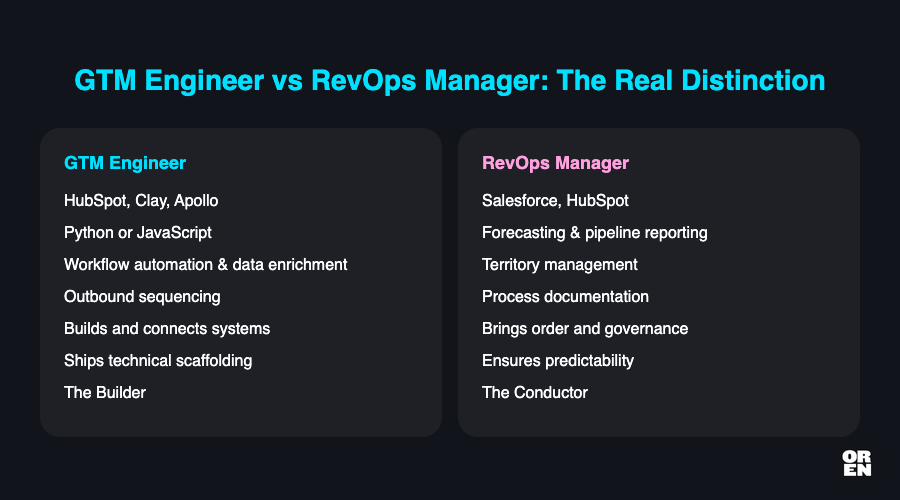
Pull up any 2 postings side by side. A GTM Engineer role at a Series B SaaS company will list: HubSpot, Clay, Apollo, Python or JavaScript, workflow automation, data enrichment, outbound sequencing. A RevOps Manager role at a similar company will list: Salesforce, HubSpot, forecasting, pipeline reporting, territory management, process documentation.
The overlap is real. The work is not the same.
The confusion is partly definitional - one estimate puts GTM Engineering at roughly 90% RevOps evolution and 10% genuinely new capability [Candybox CRM, 2026]. That framing is useful because it explains why the titles feel interchangeable on paper whilst being meaningfully different in practice. The 10% that is genuinely new - the ability to build, not just configure; to ship systems, not just document processes - is precisely what changes the leverage model.
Eugene Levi, CEO and co-founder of Tabula.io, puts it plainly: "A GTM Engineer is the builder. They connect systems, automate workflows, and create the technical scaffolding that makes Sales, Marketing, and CS more effective." And on the other side: "RevOps is the conductor. Their job is to bring order, predictability, and governance to the revenue engine."
Builder versus conductor. That is the actual distinction.
Pre-pipeline vs in-pipeline
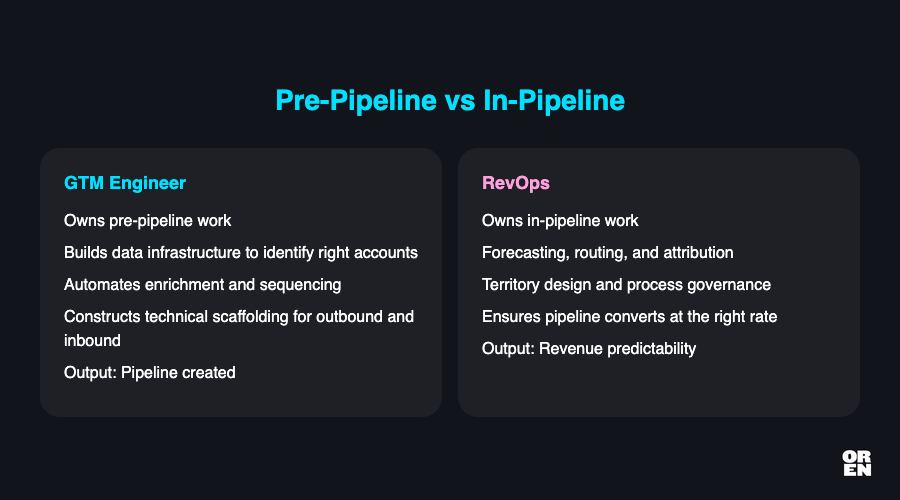
The framing I use is pre-pipeline versus in-pipeline. Not the only way to cut it, but the most useful for a hiring decision.
A GTM Engineer owns pre-pipeline work: building the data infrastructure that identifies the right accounts, automating the enrichment and sequencing that gets them into a conversation, constructing the technical scaffolding that makes outbound and inbound motion scalable. Their output is pipeline created.
A RevOps hire owns in-pipeline work: forecasting, routing, attribution, territory design, and process governance that ensures the pipeline you have actually converts at the rate it should. Their output is revenue predictability.
This is why the LinkedIn debates - "GTM Engineer is just RevOps with Python skills!" versus "RevOps people are glorified spreadsheet jockeys!" - miss the point entirely. These are not competing titles. They are sequential functions in a maturing revenue organisation.
As Levi puts it: "The organizational seat of each role signals its mandate: GTM Engineers to build systems, RevOps to govern processes, and Sales Engineers to close deals." [Eugene Levi, CEO & Co-Founder, Tabula.io]
The sequencing question - which role first - is where most founders get stuck.
What is actually breaking

There is a simple diagnostic. Look at your last quarter and answer honestly.
Hire a GTM Engineer first if your pipeline is thin and inconsistent - not because your AEs are underperforming but because qualified opportunities are not entering the top of the funnel at the right volume or quality. Same if your outbound is manual, ad hoc, or dependent on individual rep effort rather than systematic plays. If you have data sitting in disconnected tools that nobody is enriching, routing, or acting on. If your team is spending meaningful time on research, list-building, or personalisation that could be automated. If you are pre-£10M ARR and making your first or second commercial ops hire.
Hire RevOps first if you have reasonable pipeline volume but your conversion rates, forecast accuracy, or deal velocity are inconsistent. If your CRM is a graveyard - data goes in but nothing useful comes out. If your board is asking for pipeline reporting and you cannot produce it reliably. If you have a sales team of 4 or more and no process governance around how deals are managed, staged, or handed off. If you are post-Series A with a functioning sales motion that needs to be made predictable.
In early-stage companies sub-$10M ARR, GTM Engineers are typically the first ops engineer hire, reporting directly to a Head of Growth or COO [Tabula.io Blog, 2026]. That is a reasonable default - but only if your constraint is pipeline generation rather than pipeline conversion.
The cost of getting it wrong
This is the part nobody writes about. Every piece of content on this topic is written for job seekers choosing a career path. Almost nothing is written for the person signing the offer letter.
The misalignment tax is real.
Hire a GTM Engineer when your constraint is process governance and they will build elegant automated workflows that feed into a CRM nobody trusts, producing pipeline data that cannot be reported on and deals that stall because nobody owns the handoff. Hire a RevOps person when your constraint is pipeline generation and they will produce excellent dashboards showing you exactly how thin your funnel is - without the tools or mandate to fix it.
Six months later, you will have spent £120,000-£150,000 on salary, 3 months of onboarding time, and significant opportunity cost - and you will be back at the same decision point, now with a more complicated internal situation to navigate.
The salary data makes the stakes concrete. GTM Engineers command $131,000 to $180,000+ annually, with a median of $155,000 based on live role data. RevOps managers average $97,749, with senior roles at $118,000-$136,000 [Databar.ai, 2025; RevOps Roles, 2025]. These are not trivial line items for a 30-50 person company. And 66% of current GTM Engineering roles are AI-native, meaning the bar for what the role requires is rising fast - you cannot backfill a GTM Engineer hire with a RevOps person who has picked up a Clay licence.
The stack problem underneath both decisions
There is a deeper issue that makes this decision harder than it should be: most scaling B2B companies have accumulated a GTM stack that was never designed as a system.
Tools were bought to solve point problems, integrated loosely, and are now producing data that nobody fully trusts. I have written about this in detail here - the failure mode is architectural, not tooling.
When you hire into this environment without diagnosing it first, you are handing a new person a brief that is half-explicit and half-inherited. A GTM Engineer will often rebuild what should have been designed properly the first time. A RevOps hire will often spend their first 3 months auditing data quality before they can produce the reporting they were hired for.
The growth audit question - what is the actual constraint, and are we solving it in the right order - applies directly here. Buying tools and hiring people before defining the system they are meant to serve is the most common and most expensive mistake in early commercial scaling.
What happens in smaller organisations
The clean pre-pipeline / in-pipeline split is most visible in larger organisations with dedicated RevOps departments. In smaller companies, the reality is messier.
John Tay puts it well: "From my observation, this split is most obvious in larger organizations where there's a standalone RevOps department. The GTM engineer role gets kinda blurry in smaller companies where there's usually no dedicated RevOps team, or even a single RevOps hire. In those companies, you'll see one GTM engineer wearing both hats: handling the marketing and the revenue operations tasks at the same time."
This matters. If you are a 20-40 person company with no dedicated ops function, the question is not always GTM Engineer versus RevOps - it is sometimes whether a single hybrid hire can hold both responsibilities well enough to unblock growth whilst you scale toward a point where the roles can be separated.
The honest answer: sometimes yes, often no.
A strong GTM Engineer with RevOps exposure can cover both at low volume. But the skills that make someone exceptional at building pre-pipeline systems - comfort with code, product thinking, a bias toward shipping - are not the same skills that make someone exceptional at process governance, forecasting methodology, and cross-functional alignment. You are more likely to find someone who does both adequately than someone who does both well.
Companies that have invested in RevOps functions see 36% more revenue growth [Databar.ai, 2025]. That number does not tell you which role to hire first, but it does tell you that the governance function is not optional - it is a growth lever, not an administrative cost centre.
The sequencing answer
For most B2B SaaS companies at the £2M-£10M ARR stage with founder-led sales and no dedicated commercial ops function, the default sequencing is: GTM Engineer first, RevOps layer second.
Your immediate constraint is almost always pipeline - not enough of it, not consistent enough, too dependent on founder relationships and individual rep effort. A GTM Engineer with AI fluency (66% of current roles require it [RevOps Roles, 2025]) can build the infrastructure that systematises outbound, enriches your ICP data, and creates repeatable pipeline-generation plays. That work compounds. The RevOps layer - forecasting, governance, attribution - becomes the right hire once you have a pipeline motion worth governing.
The exception is companies that have crossed £10M ARR with a functioning sales team but no process infrastructure. At that point, the chaos cost of poor forecasting, inconsistent deal management, and absent attribution is high enough that RevOps governance becomes the more urgent constraint.
Databar.ai's description of the GTM Engineer role captures the pre-pipeline logic well: "You're the person who can build a system that automatically identifies when a prospect changes jobs and triggers a personalized outreach sequence. The business context matters, but your value comes from what you can build." [Databar.ai blog]
Building triggers and sequences. Creating the conditions for pipeline. The RevOps hire then ensures that pipeline is managed, reported on, and converted predictably.
Both roles matter. The question is which problem you are actually trying to solve right now - and whether the person you are about to hire is built to solve it.
---
If you are working through this decision and want a structured view of where your commercial engine is actually breaking, the fractional CMO engagement I run with B2B SaaS founders typically starts with exactly this diagnostic - mapping the constraint before recommending the hire.