Growth Hacking Course
RevOps Scope Creep Is Quietly Killing Your Pipeline
By
June 19, 2026

Last updated: 2026-06-19
The team built to close deals has started owning the work designed to generate them.
Both jobs are suffering for it.
The role keeps getting bigger

RevOps growth is real.
Over 174,000 open RevOps positions sit on ZipRecruiter alone. Organisations with RevOps in place grow revenue nearly 3 times faster than those without it. Public companies with a RevOps function achieve 71% higher stock performance than peers. 75% of high-growth companies have adopted the model [CoreFactors RevOps Blog, 2026; Fullcast, 2026].
That expansion has a logic to it.
Mary Lee, Senior Director of Business Operations at Lionbridge, puts it well:
"Revenue operations is the future evolution of sales operations. The industry is moving on a journey along a continuum from sales operations to revenue operations. Sales operations wasn't even a function 15 years ago. It started as reporting. It expanded into technology with the administration of CRM. Then we had to connect selling measurements to financial measurements. Then we had to integrate marketing technology with sales technology. Then we had to change the behavior of the sales team. And we have to motivate them with incentives and quotas. The role keeps getting bigger and bigger."
The problem is not that RevOps grew.
The problem is that "bigger and bigger" has no natural stopping point - and nobody is drawing the line.
Where RevOps ends and GTM begins

RevOps owns what happens inside the pipeline.
That is where the function was designed to operate: process standardisation, CRM governance, forecasting accuracy, quota design, conversion analysis. Closed-loop, measurable, tightly coupled to revenue outcomes. RevOps is structurally excellent at this work.
Pre-pipeline GTM work is structurally different.
ICP validation, positioning, demand strategy, campaign architecture, market segmentation - these are not operations problems. They are strategic and creative problems. Different accountability model. Different success metrics. Different pace of iteration.
When RevOps absorbs this territory - usually because there is no dedicated function to own it, or because a CRM workflow touches a campaign and scope quietly expands - 2 things break at once.
RevOps loses focus on its core mandate.
And the pre-pipeline work gets owned by a team whose instinct is to systematise and optimise, not to interrogate strategy.
You cannot optimise your way out of a positioning problem.
Tightening a nurture sequence does not fix an incoherent ICP. Improving lead scoring does not fix a message that does not land. The symptom shows up in pipeline. The cause lives upstream. Fixing it at the symptom level is expensive and ineffective - worth reading in more detail here.
The accountability gap nobody names
With 4,914 active RevOps, Sales Ops, and GTM roles listed at any given moment - 690 new jobs added in a single week across 2,680 hiring companies - the category is expanding fast [RevOps Roles, 2025].
Job volume does not resolve the boundary problem. It accelerates it.
As RevOps headcount grows, so does the gravitational pull toward owning adjacent work. A RevOps manager who is competent, well-resourced, and sitting next to a gap in demand generation ownership will fill that gap.
That is not a character flaw. It is what capable people do when structure is absent.
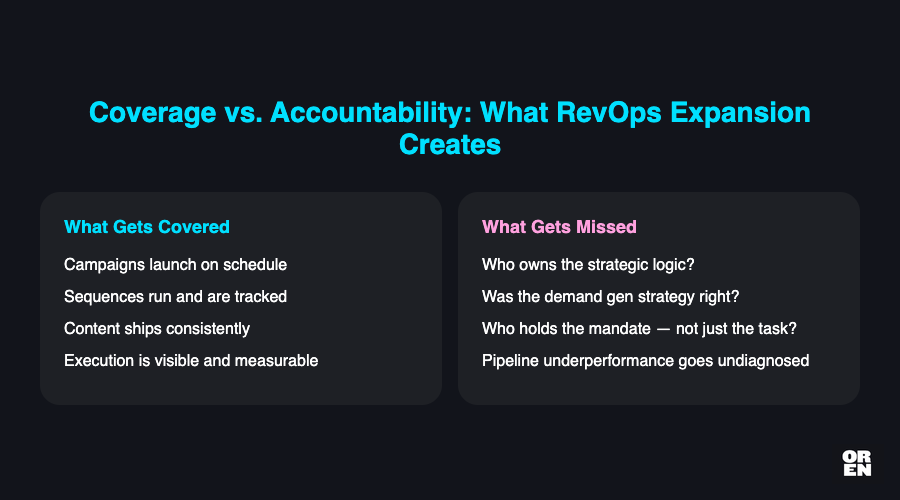
The result is an accountability gap dressed up as coverage.
Campaigns launch. Sequences run. Content ships. But nobody with a demand generation mandate owns the strategic logic behind it. RevOps is accountable for execution. Nobody is accountable for whether the strategy was right.
This is one of the most common reasons B2B SaaS pipeline underperforms.
And it rarely shows up in a board deck because the work is visibly happening.
GTM Engineering is not a RevOps rebrand
One reason the boundary stays blurry: the market has not settled on clear language for what lives on the other side of it.
GTM Engineering is the emerging answer. But it gets misread constantly - either as a RevOps rebrand or as a narrow technical marketing role.
It is neither.
GTM Engineers own pre-pipeline building work: the architecture of how a company reaches, engages, and converts target buyers before a deal exists. RevOps owns what happens after a deal enters the pipeline.
Different positions in the value chain. Different inputs. Different failure modes.
Treating them as competing titles - or assuming one replaces the other - misunderstands how a modern GTM org should be structured. The GTM stack architecture problem is partly a tooling problem. But mostly it is a structural one: the wrong people own the wrong layer, and the tools reflect that confusion.
A simple audit for where scope has drifted
If you are a CMO or VP Marketing trying to locate the boundary in your own org, the test is straightforward.
Ask: does this function exist to accelerate deals already in motion, or to generate the conditions that make deals possible?
Forecasting, CRM hygiene, pipeline velocity, conversion rate optimisation, quota modelling - these accelerate deals in motion. RevOps owns them.
ICP definition, positioning, demand strategy, campaign architecture, market segmentation - these generate the conditions.
If RevOps owns them by default, that is scope creep. Not strategic maturity.
The fix is not to shrink RevOps. It is to build the function that should own the upstream work - and give it a mandate, metrics, and accountability that are structurally separate. That might be a GTM Engineering function, a dedicated demand team, or a fractional CMO brought in to own strategy while the org builds capacity.
The form matters less than the clarity.
The problem is structural, not personal
RevOps professionals are not overreaching.
They are filling vacuums that leadership created by not defining where the function ends.
The rule is simple: if nobody with a demand generation mandate owns the pre-pipeline work, RevOps will own it by default - and pipeline will underperform for reasons that look operational but are actually structural.
Audit where your RevOps scope actually sits.
If it has drifted upstream, the question is not how to optimise the work it absorbed. The question is who should own that work instead.