Trusted by over 68k marketers (LinkedIn & TikTok)

Thank you! Your submission has been received!
Oops! Something went wrong while submitting the form.

© Copyright 2025. All rights reserved

Is Your B2B Pipeline Generation Strategy Solving the Wrong Problem?

By
Oren Greenberg
May 28, 2026

Last updated: 2026-05-26

Key Takeaways

  • Most B2B pipeline problems are systems design failures, not volume or channel failures - adding more activity to a broken system produces more waste, not more revenue.
  • The most over-optimised lever in B2B pipeline generation is top-of-funnel volume; the most under-optimised are mid-funnel conversion rate, ICP precision, and speed-to-first-meeting.
  • The average MQL-to-SQL conversion rate sits at roughly 13% (MetricHQ, 2026) - meaning improving that rate by even a few percentage points outperforms most new-channel investments.
  • Marketing incentive structures are often silently sabotaging pipeline quality by rewarding volume metrics over revenue outcomes.
  • A pipeline systems audit - identifying the single binding constraint in your pipeline - is the highest-leverage diagnostic any founder-led SaaS company can run.

---

What is the real reason B2B pipeline generation stalls?

Pipeline stalls because the system is broken, not because the volume is too low.

Most founder-led SaaS companies between $1M and $5M ARR have a structural problem - a stage where conversion collapses - and they respond by pouring more leads into the top.

That does not fix the leak. It accelerates the waste.

"Unfocused prospecting, unclear value proposition, and misaligned sales and marketing are 3 things that kill early-stage sales." - Jason Lemkin, SaaStr

The dominant advice in the market treats B2B pipeline generation as a tactical execution problem: add an ABM programme, publish more content, hire SDRs, run LinkedIn ads.

These are not wrong suggestions in isolation.

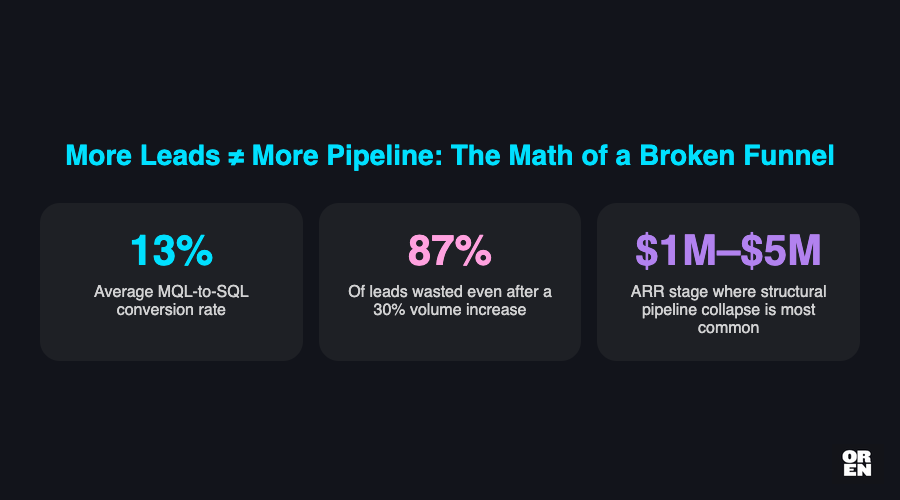
But none of them compound if the underlying system is broken. A 30% increase in lead volume through a funnel with a 13% MQL-to-SQL conversion rate (MetricHQ, 2026) still produces 87% waste.

The tactic is not the constraint. The system is.

---

Why do most B2B companies optimise the wrong lever?

Because it is the lever they can measure most easily.

And because their incentive structures reward activity at the top of the funnel.

Marketing teams are structurally rewarded for MQL volume. Dashboards light up when traffic increases. Reporting cycles celebrate lead counts. But 79% of marketing leads never convert to sales (MarketingSherpa, 2026), and 84% of businesses face a significant challenge converting MQLs to SQLs (Gartner, 2025).

These are not edge cases. They are the norm.

"Without proper alignment, marketing ends up being more about numbers than impact. The focus should be on strategic campaigns that fill the pipeline with quality leads that matter to the business." - Ryan Gould, COO & Executive Vice President, Client Strategy at Elevation Marketing

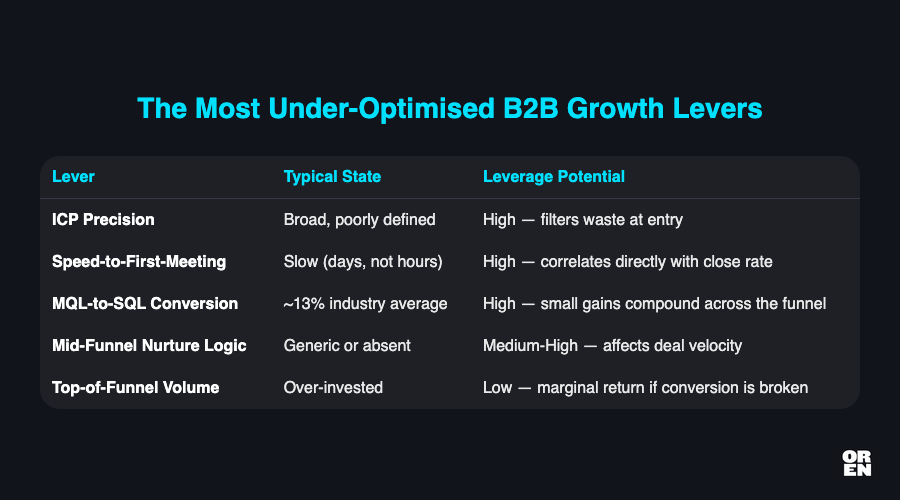
The levers that are chronically under-optimised:

| Lever | Typical State | Leverage Potential |

|---|---|---|

| ICP precision | Broad, poorly defined | High - filters waste at entry |

| Speed-to-first-meeting | Slow (days, not hours) | High - correlates directly with close rate |

| MQL-to-SQL conversion rate | ~13% industry average | High - small gains compound across the whole funnel |

| Mid-funnel nurture logic | Generic or absent | Medium-high - affects deal velocity |

| Top-of-funnel volume | Over-invested | Low marginal return if conversion is broken |

43% of sales reps say the single thing they need most from marketing is higher quality leads (ZoomInfo / Pipeline, 2026).

Not more leads. Better ones.

That is a systems signal, not a volume signal.

---

What does a pipeline systems audit actually involve?

It is a structured diagnostic that identifies the single binding constraint in your pipeline - the stage where conversion is lowest relative to the volume entering it - and focuses improvement effort there before touching anything else.

"Many businesses treat lead generation as the endgame, but building a pipeline means moving those leads to qualified opportunities. That requires the right strategy, system integration and closed-loop feedback from sales to keep things on track." - Ryan Gould, COO & Executive Vice President, Client Strategy at Elevation Marketing

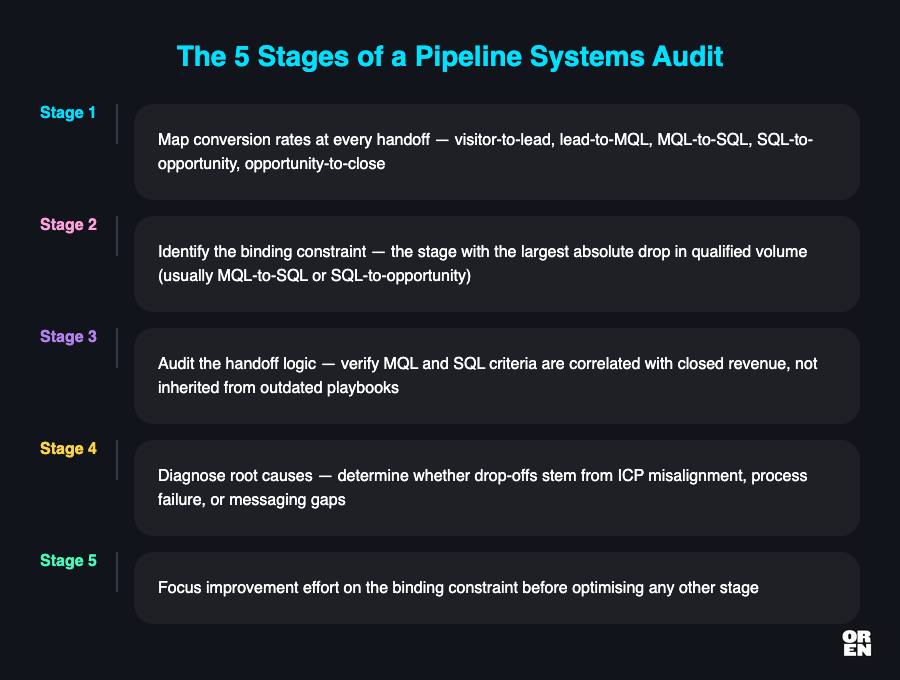
The audit runs across 5 stages.

Stage 1 - Map conversion rates at every handoff

Pull the actual numbers: visitor-to-lead, lead-to-MQL, MQL-to-SQL, SQL-to-opportunity, opportunity-to-close. Do not estimate. Most founder-led SaaS companies have never done this for their entire funnel simultaneously.

Stage 2 - Identify the binding constraint

The binding constraint is the stage with the largest absolute drop in qualified volume. This is almost never top-of-funnel. It is usually MQL-to-SQL or SQL-to-opportunity - the handoff stages where ICP misalignment and process failure compound.

Stage 3 - Audit the handoff logic

What triggers an MQL? What criteria define an SQL? Are those criteria actually correlated with closed revenue, or were they inherited from a previous playbook? 66% of leaders say establishing a lead qualifying and scoring process is the best way to align sales and marketing teams (Gartner, 2025), yet most companies have scoring models that have never been validated against win data.

Stage 4 - Audit ICP precision

Who is actually buying, at what company size, in what role, with what triggering event? Over half of marketers in the UK admit to making limited progress toward their pipeline goals despite increased marketing budgets (Pipeline-360, 2025). Budget is not the constraint. Precision is.

Stage 5 - Identify feedback loop failures

Is closed-won and closed-lost data flowing back to marketing to inform targeting? If not, the system is running open-loop - generating activity with no mechanism to improve over time.

---

How does fixing conversion outperform adding volume?

The maths are not close.

A company generates 500 MQLs per month. At 13% MQL-to-SQL conversion (MetricHQ, 2026), that produces 65 SQLs. A 30% increase in lead volume - a significant investment in paid media, content, or SDR capacity - raises MQL volume to 650 and produces 84 SQLs.

That is 19 additional SQLs.

Now fix the conversion rate instead. A 10 percentage point improvement in MQL-to-SQL conversion (from 13% to 23%) on the same 500 MQLs produces 115 SQLs.

That is 50 additional SQLs from the same top-of-funnel investment - more than 2.5 times the output of the volume increase, at a fraction of the cost.

This is not theoretical. A B2B SaaS company that improved its demo request page through A/B testing and form optimisation saw a 40% increase in inbound demo requests (SalesIntel Blog, 2026) - a mid-funnel intervention with no increase in top-of-funnel spend.

The leverage lives in the middle, not the top.

The buyer environment reinforces this. 92% of buyers already have a vendor in mind before they start formal evaluation (Noble Studios / Forrester, 2026), and 41% already have a single preferred vendor before evaluation begins. Flooding the market with more outreach to buyers who have already decided does not improve pipeline.

It generates noise.

73% of buyers actively avoid suppliers who send irrelevant outreach (Gartner, 2025).

---

Which pipeline generation tactics actually compound inside a healthy system?

Once the system architecture is sound - clear ICP, validated conversion criteria, functioning feedback loops - specific tactics compound rather than collapse.

"For B2B businesses, a real commitment to data, personalized engagement and cross-functional collaboration makes all the difference in developing profitable and sustainable pipelines." - Ryan Gould, COO & Executive Vice President, Client Strategy at Elevation Marketing

Content syndication into a qualified network

When ICP is precise, content syndication can reach buyers at scale without the lag of organic. Instana generated $6M in predictable pipeline using Pipeline360's content syndication approach (Pipeline360 Case Study, 2026), and Fivetran closed $2.3M+ in new enterprise business through the same channel (Pipeline360 Case Study, 2026).

"With Pipeline360's campaign services team as a partner, they feel like an extension of the Instana team. I feel like I have additional team support that minimizes the time spent on manual work, making it easier for my team and me." - Starr Stephenson, Director of Demand Generation, Instana

ABM for high-value, long-cycle deals

ABM works when deployed against the right target profile. It works best for deals above $50K with sales cycles longer than 6 months (The Starr Conspiracy, 2026), and it requires dedicated resources - it does not scale beyond 100-500 target accounts (The Starr Conspiracy, 2026). The mistake is deploying ABM as a volume play.

"ABM is a spear, not a net; you sacrifice volume for precision and pipeline quality." - The Starr Conspiracy

SEO and content with mapped intent

Content marketing combined with SEO takes 6-12 months to show meaningful results (The Starr Conspiracy, 2026), but when built around buyer questions at each stage of the funnel, it creates compounding inbound demand that does not require ongoing spend to maintain.

"Publishing blog posts isn't content marketing. Real content marketing maps specific assets to buyer questions and optimizes for search visibility and conversion." - The Starr Conspiracy

Personalised outbound at precision

Generic outbound fails because buyers have already self-selected their shortlist. A fintech firm that personalised cold email campaigns based on industry and job role achieved a 3x higher response rate (SalesIntel Blog, 2026). Personalisation is not a nice-to-have. It is the minimum viable standard in an environment where 61% of B2B buyers prefer a completely rep-free buying experience (Gartner, 2025).

---

What does a functioning B2B pipeline system look like?

A functioning pipeline system has 4 properties that distinguish it from a collection of tactics.

1. Closed feedback loops

Closed-won and closed-lost data flows back to marketing and informs ICP refinement, scoring models, and channel allocation. Without this, the system cannot improve.

2. Validated handoff criteria

MQL and SQL definitions are grounded in historical win data, not assumed. 42% of business leaders say sales and marketing alignment is crucial for accelerating conversion (Gartner, 2025), but alignment on the wrong criteria is worse than no alignment - it creates false confidence.

3. Single binding constraint ownership

Someone is accountable for the lowest-converting stage in the funnel, with a mandate to fix it before new channels are added.

4. Buyer-first architecture

Buyers complete 80% of their journey alone before talking to a sales rep (Brixon Group, 2026). A functioning pipeline system meets buyers where they are - with content, self-serve proof, and frictionless paths to a first conversation - rather than forcing them through a rep-led process they will avoid.

"Lead generation brings people in. Pipeline gen moves them forward. Sales enablement helps seal the deal." - Callbox Inc.

---

Frequently Asked Questions

What is a B2B pipeline generation strategy?

A B2B pipeline generation strategy is the structured system by which a company moves prospective buyers from initial awareness through to a qualified sales opportunity. It encompasses ICP definition, channel selection, conversion criteria, handoff logic between marketing and sales, and feedback mechanisms that allow the system to improve over time. It is distinct from lead generation, which focuses only on acquiring contact information.

Why is my B2B pipeline inconsistent even when I'm generating leads?

Inconsistent pipeline is almost always a systems problem rather than a volume problem. The most common causes are: ICP that is too broad (leads enter who were never likely to buy), MQL-to-SQL criteria that are not grounded in win data, slow speed-to-first-meeting (allowing intent to cool), and absent feedback loops that prevent the system from learning. The average MQL-to-SQL conversion rate is roughly 13% (MetricHQ, 2026) - if yours is near or below that, the fix is in the conversion stage, not the volume stage.

How do I know which stage in my pipeline to fix first?

Run a pipeline systems audit. Map the actual conversion rate at every stage from visitor to close. The stage with the largest absolute drop in qualified volume is your binding constraint. Fix that stage before investing in new channels or increasing top-of-funnel spend. Adding volume to a broken conversion stage generates more waste, not more revenue.

Is ABM a good strategy for founder-led SaaS at $1-5M ARR?

ABM can work at this stage, but only if your average deal size is above $50K and your sales cycle exceeds 6 months (The Starr Conspiracy, 2026). ABM requires dedicated resources and does not scale beyond 100-500 target accounts (The Starr Conspiracy, 2026). For most founder-led SaaS companies at this ARR range, the higher priority is fixing mid-funnel conversion and ICP precision before layering in a resource-intensive programme like ABM.

How long does it take to see results from a B2B pipeline generation strategy?

It depends on which lever you are pulling. Mid-funnel conversion improvements - better scoring, faster follow-up, improved demo pages - can show results within 30-60 days. Content marketing and SEO take 6-12 months to show meaningful results (The Starr Conspiracy, 2026). Paid channels and content syndication can generate pipeline within weeks if ICP is precise. The fastest path to pipeline improvement for most companies is not adding a new channel - it is fixing the conversion stage that is already leaking.

---

[AUTHOR_BIO]

Article by

Oren Greenberg

A fractional CMO who specialises in turning marketing chaos into strategic success. Featured in over 110 marketing publications, including Open view partners, Forbes, Econsultancy, and Hubspot's blogs. You can follow here on LinkedIn.

Spread the word

Sign up to my newsletter

Get my 6-part free diagnostic email series.

Thank you! Your submission has been received!
Oops! Something went wrong while submitting the form.

Get my 6-part free diagnostic email series.

Send it Over