Growth Hacking Course
Does Your GTM Process Documentation Actually Exist - Or Just Live in Someone's Head?

Last updated: 2026-06-08
Key Takeaways
- GTM process documentation is not a strategy slide deck - it is the operational blueprint that governs how revenue workflows run, and the difference matters enormously when you introduce AI automation.
- Agentic GTM systems execute the process you give them. Undocumented or tacit knowledge fed into an AI agent does not become structured - it becomes automated chaos.
- Companies that extract the most value from agentic GTM are not the ones with the best AI stack. They are the ones that did the unglamorous documentation work first.
- Without clean, explicit process documentation, AI automation amplifies inconsistency at scale rather than compounding performance over time.
- Research suggests businesses without a solid GTM strategy face a 40-80% risk of failure at launch ([Mendez et al, Academic Conferences International, 2025]) - undocumented processes compound that risk as teams scale.
---
What Does GTM Process Documentation Actually Mean?

GTM process documentation is the explicit, written record of every decision rule, qualification threshold, handoff trigger, and sequenced workflow that governs how your go-to-market motion runs.
Not what your strategy says you will do. How execution actually happens, step by step, across every function involved.
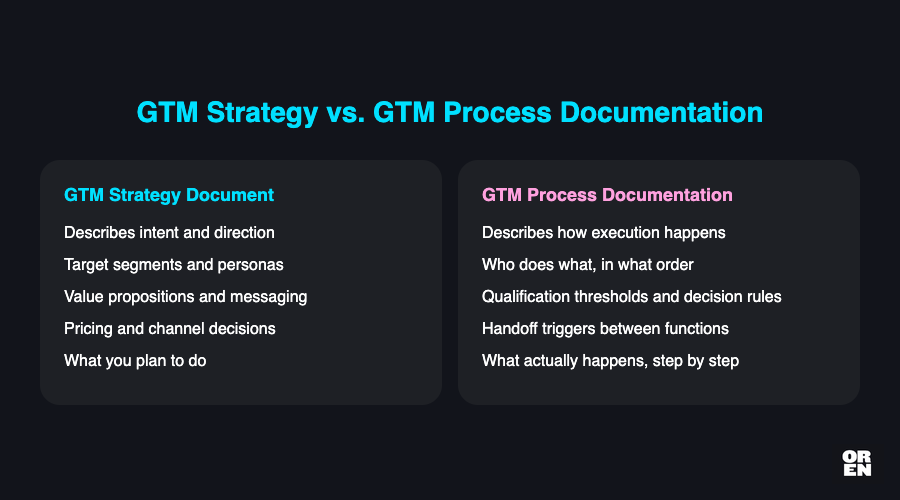
Most founders and revenue leaders conflate 2 very different things: a GTM strategy document and GTM process documentation.
The first describes intent - target segments, value propositions, pricing, channels. The second describes operation - who does what, in what order, under what conditions, and what happens next. As Asana defines it:
"A go-to-market (GTM) strategy is a step-by-step plan that defines how you'll launch a new product or enter a new market, covering your target audience, messaging, pricing, and sales approach." - Asana
That definition is accurate and useful. But notice what it doesn't include: the operational layer beneath the strategy.
The documented process is what sits between your strategy and your results.
And in most B2B SaaS companies at the £2M-£30M ARR stage, that layer doesn't exist in writing. It exists in the heads of 3 to 5 people who've been there long enough to know how things work.
That's fine, until you try to scale it. Or automate it.
---
Why Does the Strategy-Process Gap Cause So Much Damage?

It's invisible until something breaks. And by then, the breakage has usually been compounding for months.
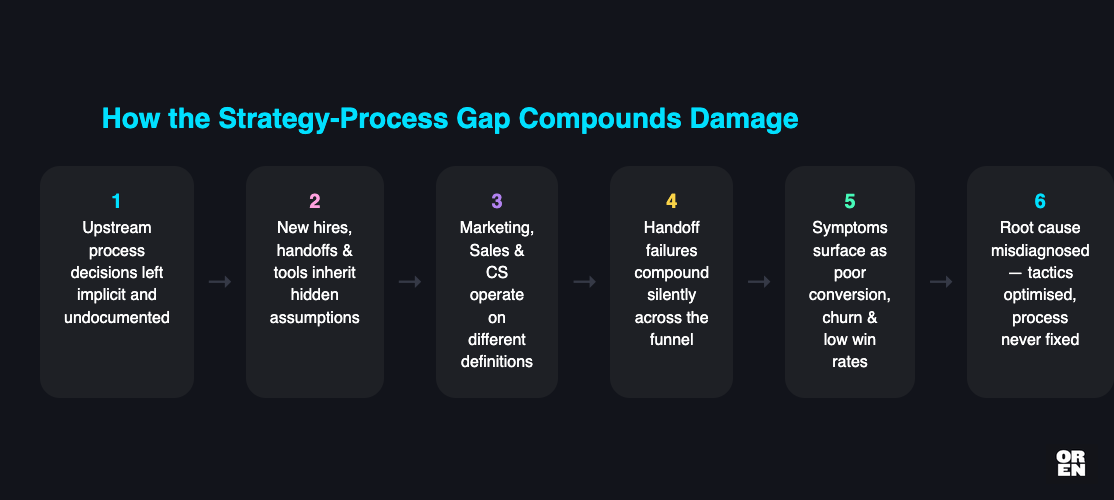
When your GTM process lives in someone's head, every new hire, every handoff, and every tool integration inherits an undocumented assumption.
The sales rep who joined 6 months ago qualifies leads differently from the one who's been there 3 years. Marketing defines an MQL by one criterion. Sales ignores it by another. Customer success doesn't know what was promised in the sales cycle because no one wrote it down.
"The surest way to avoid errors and misalignment is to think about GTM planning sequentially and allowing upstream components to feed and inform those further downstream." - Sean Ryan, Partner, Alexander Group
Sean Ryan's point applies with equal force to process documentation as it does to planning.
When upstream process decisions are implicit, every downstream function inherits the ambiguity. Handoff failures between marketing, sales, and customer success are rarely caused by bad intent. They're caused by the absence of explicit, agreed, documented rules for what a handoff looks like.
This is the structural problem that a genuine growth audit consistently surfaces.
Companies treat symptoms - poor pipeline conversion, high churn, low win rates - as isolated tactical problems, when the actual cause sits at the process and alignment layer. You can't optimise your way out of a process that was never defined.
---
What Happens When You Automate an Undocumented Process?

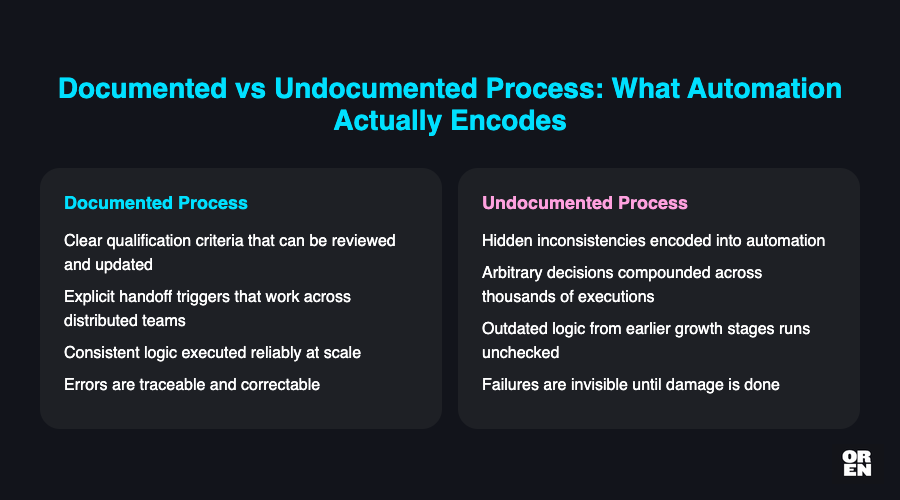
You don't automate a workflow. You encode the inconsistency that already existed and run it at scale, faster and more expensively than before.
This is the failure mode that almost no one in the agentic GTM conversation is talking about.
The dominant narrative is about capability - what AI agents can do, how fast they can execute, how much pipeline they can generate. The question of what you're feeding them gets almost no attention.
Agentic GTM systems - whether that means AI-powered outbound sequencing, automated lead scoring, dynamic content personalisation, or multi-step nurture orchestration - execute the process logic you provide.
If that logic is incomplete, contradictory, or simply absent, the agent doesn't fill the gaps intelligently. It either fails, or it makes arbitrary decisions that compound over thousands of executions.
"Competition and market forces change quickly; what worked for a past launch may not work today." - Asana
That observation about market forces applies with equal force to process logic.
The qualification criteria that worked when you had 50 customers may be wrong for 500. The handoff trigger that made sense when sales and marketing sat in the same room breaks down when you're running automated sequences across a distributed team. If those criteria were never written down, they can't be updated - and they certainly can't be reliably encoded into an agentic system.
My position on this is direct: automating GTM workflows before achieving clean data, defined processes, and a validated ICP is the primary reason AI pilots fail.
Winners invest the majority of their preparation budget in readiness before touching automation. Workflow redesign must precede tool selection, not follow it.
That's the opposite of what most companies do. And it's why most companies get disappointing results.
For a broader view of how architectural decisions compound this problem, the GTM stack architecture piece is worth reading before you touch any automation tooling.
---
What Does Properly Documented GTM Process Actually Look Like?
Properly documented GTM process covers 5 operational layers, each of which must be explicit enough that someone who has never worked at your company could execute it without asking a colleague to interpret it.
| Layer | What It Documents | Why It Matters for Automation |
|---|---|---|
| ICP & Segmentation | Firmographic, behavioural, and intent criteria that define a qualified prospect | Agent scoring and routing logic depends entirely on this being explicit |
| Qualification Rules | The specific thresholds that move a lead from one stage to the next | Automated lead scoring cannot function on implicit criteria |
| Handoff Triggers | The exact conditions under which marketing passes to sales, or sales passes to CS | Agentic handoff systems need binary decision rules, not judgement calls |
| Messaging Logic | Which message, offer, or sequence applies to which segment at which stage | Personalisation agents need documented decision trees, not brand guidelines |
| Escalation & Exception Handling | What happens when a prospect falls outside normal parameters | Agents without documented exception handling default to the worst possible path |
"The critical output of any customer segmentation exercise is a set of prioritized customer segments and quantified revenue potential at the account level." - Sean Ryan, Partner, Alexander Group
That output - prioritised segments with quantified potential - is exactly the kind of explicit, structured input that an agentic system can act on.
Vague ICP descriptions ("mid-market SaaS companies with a sales team") are not.
The documentation standard for agentic readiness is significantly higher than the standard for human execution, because humans can ask clarifying questions and an agent cannot.
Research consistently shows that businesses without a solid GTM strategy face a 40-80% risk of failure at launch ([Mendez et al, Academic Conferences International, 2025]). That risk doesn't disappear as companies mature - it shifts from launch failure to scaling failure, and undocumented process is one of the primary mechanisms by which it manifests.
---
How Do You Build GTM Process Documentation That Is Actually Useful?
Start with the handoffs.
The most useful GTM process documentation is built backwards from the handoff points - the moments where one function's output becomes another function's input - because those are the moments where implicit assumptions do the most damage.
Map every point at which work, information, or a prospect moves from one person, team, or system to another. For each handoff, document: what triggers it, what information must accompany it, who is responsible for initiating it, and what the receiving function does with it.
This alone will surface more ambiguity than most teams expect.
Then work backwards to the decision rules that govern each stage. What makes a lead qualified? What makes a deal at risk? What makes a customer ready for expansion?
Document the criteria in terms specific enough to be testable. Not "good fit" but "company size between 50 and 500 employees, using at least one of the following integrations, with a sales team of 5 or more."
The documentation itself doesn't need to be elaborate. A well-structured set of process maps, decision trees, and qualification matrices in a shared document is sufficient. What matters is that it's written, shared, and maintained - not that it's beautiful.
This is also where my position on AI adoption becomes directly relevant.
Most GTM professionals are still thinking about AI as task-level assistance rather than understanding it requires fundamentally restructuring how work gets done. The restructuring required isn't primarily technical. It's the discipline of making implicit process logic explicit - which is unglamorous, time-consuming, and entirely worth doing before you touch any automation tooling.
---
Is GTM Process Documentation a One-Time Exercise?
Not even close.
It's a living operational input that must be updated whenever your ICP, offer, channels, or team structure changes materially.
The companies that build a genuine competitive moat from agentic GTM aren't the ones that document once and automate. They're the ones that treat documentation as an operational discipline - a continuous practice of making process logic explicit, testing it against outcomes, and updating it when the evidence demands it.
"It is a common misnomer that effective coverage means comprehensive coverage. In the modern B2B technology market, coverage cannot mean that the vendor must proactively cover every potential customer and prospect that could potentially buy something from them." - Sean Ryan, Partner, Alexander Group
This matters for documentation because the scope of what you document should be driven by where your process actually operates - not by an aspiration to cover every possible scenario.
Over-documented processes that no one maintains are worse than under-documented ones. They create false confidence.
The discipline is in keeping the documentation current and decision-rule-level specific, not in making it comprehensive for its own sake.
For founders building this discipline for the first time, the AI Marketing Lab and AI Advisory services are specifically designed to help commercial teams build the operational foundations before they commit to automation tooling.
My related piece on AI training for business teams makes the same point from a different angle: the barrier to effective AI use isn't technical execution but strategic selection - knowing which processes deserve AI attention and whether those processes are documented well enough to be handed to an agent.
---
Frequently Asked Questions
What is the difference between a GTM strategy document and GTM process documentation?
A GTM strategy document describes intent - your target market, value proposition, pricing, and channels. GTM process documentation describes operation - the specific, sequential decision rules, qualification criteria, handoff triggers, and exception-handling logic that govern how execution actually runs. The strategy tells you where you are going. The process documentation tells you, step by step, how you get there. Both matter, but only one of them can be handed to an AI agent.
Why does GTM process documentation matter more when you introduce AI or agentic tools?
Agentic AI systems execute the process logic you provide. Human team members can ask clarifying questions, apply judgement, and fill gaps from context. An agent cannot. This means the documentation standard required for agentic GTM execution is significantly higher than the standard required for human execution. Undocumented or tacit process logic fed into an agentic system does not become structured - it becomes automated inconsistency, executed at scale.
How detailed does GTM process documentation need to be?
Detailed enough that someone with no prior knowledge of your company could execute the process without asking a colleague to interpret it. In practice, this means decision rules must be specific and testable - not "qualified lead" but the exact firmographic, behavioural, and intent criteria that define qualification. Handoff triggers must be binary - not "when the lead seems ready" but the specific condition that initiates the handoff. The test is whether the documentation could be handed directly to an AI agent and produce consistent, correct outputs.
Where should a founder start if they have no GTM process documentation at all?
Start with the handoffs. Map every point where work, information, or a prospect moves from one person, team, or system to another. Document what triggers each handoff, what information must accompany it, and what the receiving function does with it. This single exercise will surface most of the ambiguity in your current process and give you a clear picture of where documentation is most urgently needed. It takes 2 to 3 working days and requires no tooling beyond a shared document.
Does GTM process documentation need to be updated regularly?
Yes - and this is where most companies fail even after an initial documentation effort. Process documentation must be treated as a living operational input, not a one-time project output. Any material change to your ICP, offer, pricing, channels, or team structure should trigger a documentation review. Agentic systems running on outdated process logic will produce compounding errors over time. The discipline of maintaining current documentation is as important as the initial effort of creating it.
---
[AUTHOR_BIO]