Growth Hacking Course
GTM Engineer vs RevOps: Where the Boundary Sits
By
June 20, 2026

Ask a CRO where pipeline generation lives in their org chart. Most point to sales, or marketing, or some blurred overlap they call RevOps. Very few point to a dedicated function whose sole mandate is building the infrastructure that produces pipeline before a single rep touches it.
The argument usually arrives as a title fight - GTM Engineer versus RevOps.
That's the wrong fight.
The real questions are where one function's mandate ends and the other's begins, and whether GTM engineering is just RevOps wearing a new badge.
That ambiguity is expensive. And most companies are getting the sequence badly wrong.
The category error
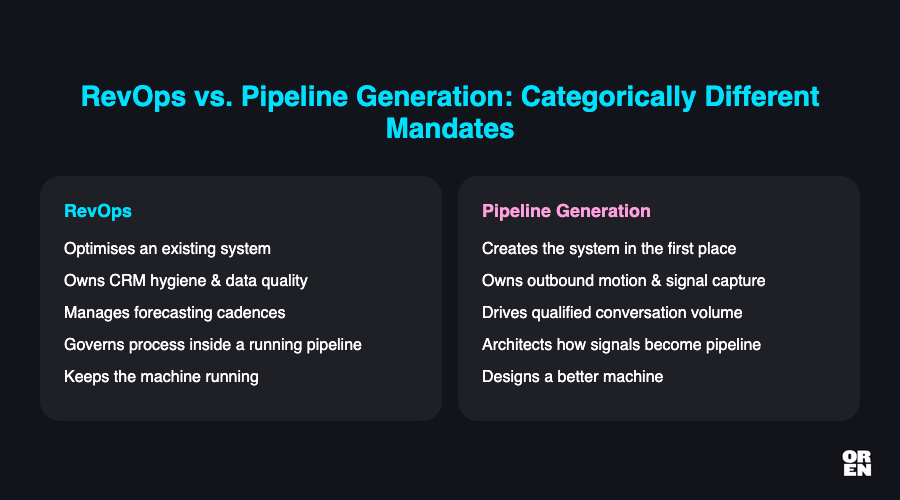
RevOps is an optimisation layer. It owns CRM hygiene, attribution reporting, forecasting cadences, and process governance inside a running pipeline. It's structurally built to make an existing system run better - not to create the system in the first place.
Assigning pipeline generation to RevOps is like asking your infrastructure team to also write the product. The skills overlap at the edges. The mandates are categorically different. One function administers. The other builds.
When RevOps is stretched across both, the consequences are predictable. Pipeline targets get missed. Tool procurement happens without system coherence - the average B2B sales team in 2026 runs 14 tools [Cleanlist, 2026]. Nobody owns the architectural question of how signals become qualified conversations at scale. The ops team is too busy keeping the machine running to design a better one.
This isn't a semantic distinction. It's a structural one.
What GTM engineering actually is

GTM engineering is the discipline of building automated systems that convert buyer signals into pipeline. It sits at the intersection of sales strategy, marketing logic, and software engineering - and it requires someone who thinks like a builder, not an administrator.
"GTM engineering automates sales and marketing workflows using AI, data, and systems thinking, turning buyer intent into real pipeline." - Factors.ai
The day-to-day work looks nothing like RevOps.
A GTM engineer is enriching account records at scale, building waterfall enrichment sequences across multiple data vendors, writing the logic that fires a personalised outbound sequence when a target account hits a pricing page, and instrumenting the signal layer so that intent data from Bombora's cooperative of 5,000+ B2B publisher websites [Bombora / RevOps Impact Newsletter, 2026] actually routes to the right rep at the right moment.
The signal infrastructure matters here. Companies like Factors.ai use waterfall enrichment to identify up to 75% of anonymous website visitors at the account level - compared to the 8-10% industry standard [Factors.ai / RevOps Impact Newsletter, 2026]. Roughly 20% of CRM contacts change jobs each year [RevOps Impact Newsletter, 2026], which means the contact data your RevOps team is maintaining is degrading constantly. Building systems that detect and act on those changes - champion job change tracking, hiring signal monitoring, tech stack changes - is GTM engineering work.
"An account showing topic surge on G2, a pricing page visit, and a recently hired champion represents a fundamentally different targeting opportunity than any one of those signals in isolation." - Jeff Ignacio, RevOps Impact Newsletter
Bloomberry's analysis of 1 million B2B software purchases found that companies adopting enterprise AI tools, making recent tech stack changes, and rapidly growing headcount were the strongest predictors of future software purchasing [Bloomberry, 2026]. Building the system that monitors those signals across your entire addressable market and routes actionable triggers to your pipeline - that's the GTM engineer's job.
It was never RevOps's job.
Pre-pipeline vs in-pipeline

The cleanest way to think about the structural difference is temporal.
GTM engineering owns pre-pipeline: the infrastructure that identifies, enriches, scores, and activates accounts before they enter a sales motion. Signal collection, ICP matching at scale, automated research, sequencing logic, and the data architecture that makes all of it reliable.
RevOps owns in-pipeline: the process governance, stage definitions, forecast accuracy, CRM data quality, and reporting that runs once an account is in a sales cycle.
"RevOps owns the process and reporting, GTM engineering owns the pipes and the code." - Cleanlist blog
These are complementary functions. Neither replaces the other. But the sequence matters: the infrastructure must exist before there's anything to optimise.
Most companies build the RevOps function first, then wonder why pipeline is thin.
I've written about this architectural problem before - the failure isn't usually tooling, it's that companies buy and connect tools without ever designing the underlying system. The result is a Frankenstack that makes selling harder, not easier. GTM engineering is the function that prevents that outcome by treating the pipeline creation layer as something to be deliberately built and iterated - not configured once and left running.
Is this just RevOps rebranded?
The sceptic's case is simple - new tools, same work, shinier title.
"it's mostly RevOps, rebranded by Clay influencers." - Ran Algov
Fair challenge.
But it mistakes the tool for the job.
Ran Algov put it better elsewhere: "Using Salesforce doesn't make you a CRO. Using Clay doesn't make you a GTM leader."
The tool is not the role.
The abstraction dissolves the moment you look at what each function actually ships.
A GTM engineer ships built artefacts that did not exist before and run without ongoing human input:
- a Clay enrichment table that scores inbound leads against ICP fit before they reach a human
- a webhook that fires a Slack alert when a target account hits the pricing page 3 times in a week
- an automated outbound sequence that personalises at scale off job-change signals
RevOps ships governance artefacts that bring order to a system already running:
- a Salesforce pipeline with defined stage criteria
- a weekly forecast cadence with a single source of truth
- an attribution model the board will accept
- a sales-to-CS handoff playbook that cuts first-90-day churn
Brendan Short, founder of The Signal, listed 8 reasons GTM Engineer is not just RevOps rebranded - the distinction carries enough structural weight to sustain a list that long.
The cleanest test is an old one.
Nobody argues that R&D and Operations are the same function because they share a building.
One builds what's next. The other runs what exists.
The confusion only persists in GTM because the tooling overlaps and the titles are new.
The cost of the wrong boundary
Get the boundary wrong and the cost stops being theoretical.
One documented case makes it concrete: a flawed lead-routing system pushed an SDR to quit within 90 days, costing $385,000 in lost pipeline [Revenue Operations Alliance, 2025].
That's not a RevOps failure or a GTM engineering failure.
It's a boundary failure.
The routing system was built by one function and governed by neither.
Run it the other way and the numbers invert. Companies that take a systems-first approach with clear ownership see 42% faster sales cycles, 37% higher response rates, and SDR turnover falling from 25% to zero [Revenue Operations Alliance, 2025].
The variable is not headcount.
It's structural clarity.
And it collapses on bad inputs. Neither function performs well on dirty data.
A GTM engineer cannot build reliable signal capture on a CRM with no consistent account ownership. RevOps cannot forecast off a pipeline filled by inconsistent routing logic.
There's one diagnostic that settles it.
Ask who owns the decision to change how an account enters pipeline.
If the same person owns that decision and owns forecast reporting, the boundary is in the wrong place.
Two ways the hire goes wrong
Conflate the two roles and you make the wrong hire - in both directions.
A founder hires a "RevOps person" expecting them to build automated outbound infrastructure. The hire is excellent at the job they were actually scoped for - they clean the CRM, build the forecast, document the sales process.
Six months later the founder is frustrated: "we still don't have pipeline." The hire is equally frustrated: "I was hired to run operations, not build systems from scratch."
Neither party was wrong. The job description was.
The reverse does equal damage.
A company drops a GTM engineer into a RevOps seat. They ship clever automations, build interesting workflows, iterate constantly.
Three months in, the CRM is a mess, the board can't get a clean forecast, and the VP Sales doesn't trust the numbers.
The GTM engineer was doing their job. The company needed a different one done.
When one person does both
At sub-£5M ARR, you probably can't afford to separate the functions.
One person ends up doing both. That's a legitimate constraint, not a category error - as long as everyone's honest about which hat is on and when.
The tension is built in. The builder instinct and the governor instinct pull against each other.
Someone who loves shipping new systems lets CRM hygiene slide.
Someone who loves process stability under-invests in experimental infrastructure.
The trigger to split isn't headcount or ARR.
It's the moment both problems are urgent at once - the board demanding forecast accuracy while the pipeline runs thin.
That's when the single-person model breaks.
Why this role exploded and why it's still underbuilt
LinkedIn listed over 3,000 open GTM engineer positions in January 2026, and demand has doubled in less than a year - making it one of the fastest-growing jobs in sales and marketing [LinkedIn / Zaphyre, 2026]. Salaries reflect the scarcity: US base compensation ranges from $130K to $260K plus equity [Cleanlist, 2026; Teal / Equinix, 2025].
"Companies are being pushed to 'do more with less,' necessitating rapid execution and adaptability. In this market, only the teams that embrace this tempo and productivity demanded by the market will stay ahead of the curve." - Matteo Tittarelli and Maxence De Villepion, HyperGrowth Partners
The economics are compelling. Teams with a dedicated GTM engineer ran 3.2x more outbound experiments per quarter than teams without one [Cleanlist, 2026]. Companies that built this infrastructure properly report 25% shorter sales cycles and 40% reductions in CAC [LIFEdataX, 2025]. A single great GTM engineer hire can pay back their salary 3 times over inside a year [Cleanlist, 2026].
"If you are a Series A or Series B company without at least one, you are probably behind." - Zaphyre
The reason most companies are still underbuilt here is partly definitional confusion - too many folk still treat GTM engineering as a rebrand of RevOps or a variant of marketing ops - and partly organisational inertia. Existing ops teams are stretched, and adding a headcount that doesn't map cleanly to a known job family is a harder internal sell than expanding an existing function.
But framing this as GTM engineer versus RevOps is a mistake. The question isn't which one to hire. It's recognising that you need both, that they do different things, and that one must logically come before the other.
What breaks when you get the sequence wrong
The downstream consequences of the category error are specific and recognisable.
First, tool sprawl without coherence. When RevOps is asked to generate pipeline as well as manage it, the instinct is to buy more tools - intent data platforms, enrichment vendors, sequencing software. Without a builder's mindset applied to integrating those tools into a coherent system, you get the 14-tool average [Cleanlist, 2026] without the architecture that makes them compound. Each tool becomes a point solution. Nobody owns the logic that connects them.
Second, signal waste. The signal infrastructure exists in most modern stacks - intent data, website visitor identification, hiring signals, champion tracking. But signals sitting in disconnected platforms without a system to score, route, and act on them are just data costs. Vector's contact-level intent platform reports that signal-based ad audiences produce 3%+ click-through rates [Vector, 2026] - but only when the signal layer is actually wired to execution.
Third, the wrong diagnosis when pipeline stalls. When the ops team owns both pipeline creation and pipeline management and pipeline misses target, the default response is to optimise what's already running - tweak sequences, adjust scoring, add reporting. But if the underlying architecture is wrong, optimisation doesn't fix it. As I've argued before, growth engines underperform because companies execute in the wrong order. You cannot optimise your way out of a structural absence.
The hire that reorders the sequence
If you're a CRO or VP Revenue with a stretched ops team and a board asking hard questions about pipeline, the decision you're facing isn't whether to expand RevOps headcount. It's whether to make the prior hire - the one who builds the infrastructure that gives RevOps something to run.
The GTM engineer's output is a system: enriched account data, signal-based triggers, automated research and personalisation at scale, and the experimental cadence that lets you run 3.2x more outbound experiments per quarter than a team without one.
"This is one of the few technical roles where your work ties directly to revenue. You build a system, it generates pipelines, the company makes money. The link is that short." - Zaphyre
The concentric circle logic applies here too: before you try to reach cold ICP accounts at scale, your signal-based GTM should start with the warmest audiences - existing customers, warm prospects, champion movers. A GTM engineer builds that prioritisation into the system architecture from the start, rather than treating every signal as an equal trigger.
None of this threatens RevOps. Companies that invest in RevOps see 36% more revenue growth [Databar.ai, 2025].
That number doesn't fall when you add a GTM engineer. It rises - because RevOps finally has cleanly generated pipeline to govern.
RevOps is not the problem. The problem is asking RevOps to do a job it was never designed to do, then measuring the wrong things when pipeline doesn't materialise.
So if one person is carrying both mandates, you don't have role overlap.
You have an unfilled role.
Building the infrastructure that creates pipeline is a different discipline. It requires a different kind of person. And it comes first.