Growth Hacking Course
Gtm Sprint Retrospective Commercial Teams
By
June 22, 2026

Engineering teams run retrospectives after every sprint - not just when something breaks. GTM teams do the opposite: post-mortems after a missed quarter, silence after a good one. The result is that slow-burn failures - ICP drift, SDR-to-AE handoff degradation, nurture sequences nobody checks - compound quietly for months before they show up as a pipeline problem.
That detection gap is the expensive part.
Post-mortems are not retrospectives
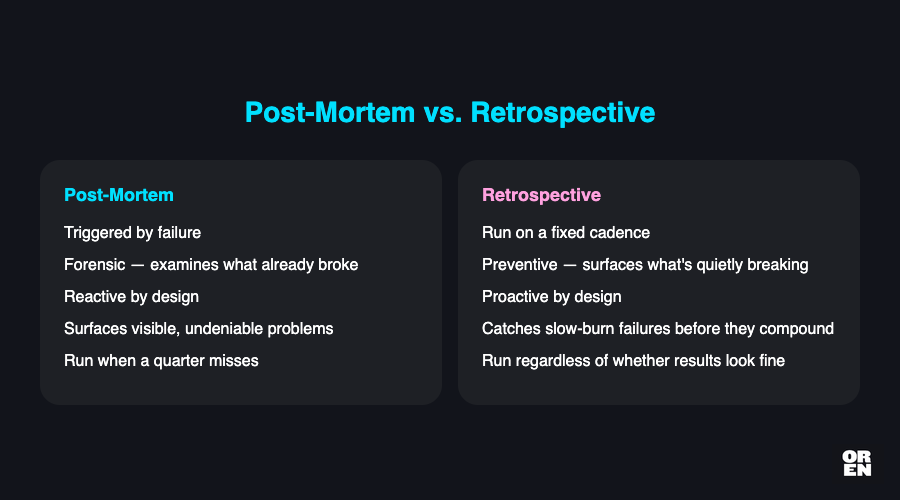
The conflation is the problem.
A post-mortem is forensic. You run it when something has already broken badly enough to be undeniable. A retrospective is preventive - you run it on a cadence, regardless of whether anything looks obviously wrong, specifically to surface the things that don't yet look obviously wrong.
Engineering figured this out decades ago. The Scrum Guide is explicit:
"the purpose of the Sprint Retrospective is to plan ways to increase quality and effectiveness… The Scrum Team discusses what went well during the Sprint, what problems it encountered and how these problems were (or were not) solved… The most impactful improvements are addressed as soon as possible" - Scrum Guide (Schwaber), as cited in the Agile Alliance Experience Report
GTM teams don't operate this way.
They run quarterly business reviews that are really performance presentations, not diagnostic sessions. Pipeline reviews focus on deals in flight, not on the process that put those deals there. When a quarter misses, they do a post-mortem. When a quarter hits, they celebrate and repeat the same motions - including the broken ones.
The slow-burn failures are the expensive ones precisely because they're invisible on a QBR slide. Wrong ICP targeting doesn't announce itself - it shows up as a gradual increase in sales cycle length and a quiet deterioration in win rates. A broken SDR-to-AE handoff doesn't trigger an incident. It bleeds qualified pipeline that nobody can account for. Nurture sequence decay is never a crisis. It's just a slow drip of leads that stop converting for reasons nobody investigates.
What compounds in the silence
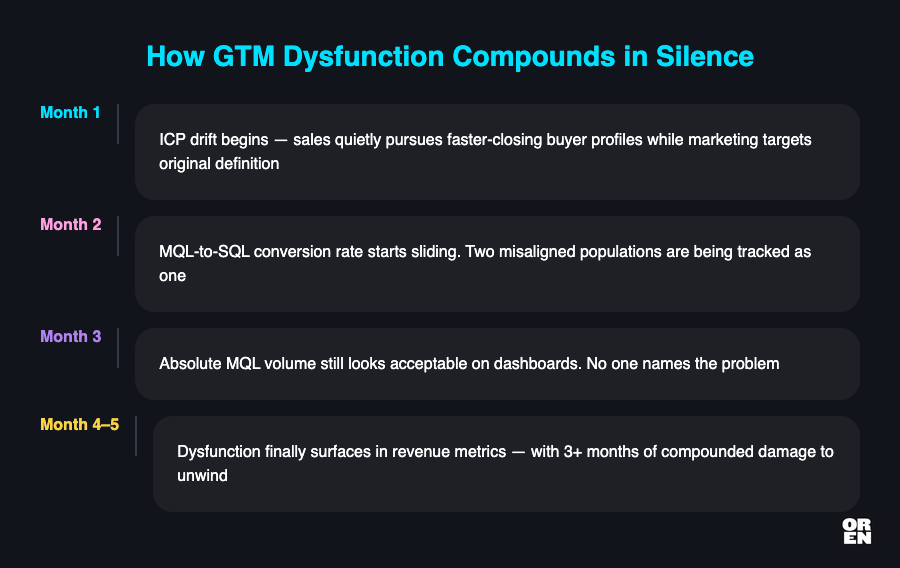
Consider what actually happens between quarters in a typical B2B SaaS commercial operation.
The ICP definition that was sharp 18 months ago has drifted. Sales has quietly started pursuing a slightly different buyer profile because those deals close faster. Marketing is still generating MQLs against the original definition. The 2 populations aren't the same, and the MQL-to-SQL conversion rate has been sliding for 3 months. Nobody has named this yet because the absolute volume of MQLs still looks acceptable on a dashboard.
Meanwhile, nearly 2-thirds (63%) of RevOps leaders at technology, media, and telecom companies say there are insufficient, or simply too many, tools in their shared GTM stack with sales, marketing, and enablement [KPMG, 2025]. Each of those tools generates its own metrics. The result is that SaaS teams systematically default to tracking easily accessible metrics rather than meaningful ones - a structural failure that leads to misallocated effort and poor outcomes.
The ICP drift is happening inside the data. Nobody is looking at the right slice of it.
This is the lag problem. A GTM dysfunction can emerge in month one and not appear in revenue metrics until month 4 or 5, by which point you have 3 months of compounded damage to unwind. A monthly GTM retrospective cadence closes that detection gap - not because it's clever, but because it forces a structured look at leading indicators before they become lagging ones.
The engineering model, translated
The Agile Alliance's experience report on Carl Zeiss Microscopy's R&D software development department is instructive. Eight software and firmware teams operate in joint 2-week increments. A joint retrospective is held monthly covering overarching team topics, and a health check is conducted every 6 months. The cadence is not optional and it is not triggered by failure - it's structural [Agile Alliance, 2025].
"No sprint is ever an unmitigated success and no sprint is ever an unmitigated failure." - Geoff Watts and Paul Goddard, Inspect & Adapt Ltd
That framing is exactly what GTM teams lack. Every quarter is treated as either a win to be celebrated or a loss to be explained. The granular truth - that every quarter contains broken processes worth fixing and working processes worth codifying - never gets examined.
Stop/Start/Continue is the simplest translation: what GTM activities are producing no signal and should stop, what have we been avoiding that evidence suggests we should start, what's working that we should systematise. The 5 Whys format works well for handoff failures. Why did this MQL not convert? Because the SDR didn't follow up. Why? Because the lead routing rule sent it to the wrong queue. Why? Because the ICP criteria in the CRM weren't updated when we shifted segment focus. Five levels down to a structural fix rather than a personnel conversation.
"The best retrospectives are also well structured so that the attendees and the facilitator know what they're planning to cover and how they plan to achieve that." - Geoff Watts and Paul Goddard, Inspect & Adapt Ltd
The GTM-specific inputs that replace sprint velocity metrics are: pipeline velocity changes week-on-week, win/loss pattern shifts by segment, MQL-to-SQL conversion trends by source, and average sales cycle length by ICP tier. These are the signals that carry early warning information. If you're not reviewing them in a structured session with cross-functional accountability, you're running a reporting meeting, not a retrospective.
Who owns it
This is where most GTM retro attempts fail.
Marketing and sales in the same room, looking at a conversion drop, is a blame-assignment exercise by default unless the format explicitly prevents it.
The answer is to make it blameless by design - the same principle engineering post-mortems adopted after Google and Etsy popularised the format. The framing is: we're examining the process, not the people. When MQL-to-SQL conversion drops, the question isn't "why did sales not work these leads" - it's "what in our handoff process created the conditions for these leads to go cold." The distinction sounds semantic. In practice it determines whether people are honest in the room.
Ownership sits with RevOps where it exists, or with whoever holds the commercial operating system. In a founder-led business, that's usually the founder. The fractional CMO function is well-suited to this role in companies that have revenue but no senior marketing hire yet - the retro requires someone who can read commercial signals without a political stake in any single function's performance.
Action items need owners and dates, not just acknowledgement. An improvement identified in a retro that has no owner by the end of the session doesn't exist. It's a conversation, not a change.
Retrospective theatre
There's a failure mode worth naming. The Agile Alliance experience report coins it precisely:
"Ever feel like your worth as a Scrum Master depends on how good your retrospectives are? Ever found yourself making your retrospectives more and more elaborate and enticing to show off your worth as a Scrum Master? If so, you might be doing what we call Retrospective Theatre, where you strive for engagement and novelty, often at the expense of unearthing the real problems." - Debbie and Jonathan, Agile Alliance Experience Report
GTM retros fall into this trap when they become elaborate workshop sessions with post-it notes and frameworks and facilitation energy - but no hard look at the actual numbers and no uncomfortable conversations about what those numbers mean.
"The most common complaint that we hear associated with retrospectives is that they grow stale or repetitive as the coaches and facilitators quickly run out of ideas of ways of running a retrospective." - Geoff Watts and Paul Goddard, Inspect & Adapt Ltd
The solution isn't more elaborate formats. It's better diagnostic inputs. Walk into a GTM retro with pipeline velocity data, win/loss breakdown by segment, and a comparison of this month's MQL-to-SQL rate against the 3-month trend - the conversation won't go stale. The data will surface something uncomfortable, and that discomfort is the work.
This connects directly to the broader architecture problem. If your GTM stack is a collection of disconnected point solutions - and given that 63% of RevOps leaders say their stack is either insufficient or overcrowded [KPMG, 2025] - pulling the right diagnostic inputs for a retro is itself a friction point. The GTM architecture problem is often what prevents retrospectives from happening: nobody wants to run a session where the data is contested because it comes from 4 different tools that don't agree.
The cadence that actually works
Monthly is right. Weekly is too granular - you can't see patterns in a week of pipeline data. Quarterly is too slow - by the time you examine Q1, you're already 3 months into Q2 with the same broken process running.
Monthly gives you enough data to see trends, enough recency to remember the context, and enough frequency to fix things before they compound. The session itself should be 60-90 minutes maximum. Longer than that and it becomes a QBR by another name.
The agenda is simple: review 3 or 4 leading indicators against the prior month and the 3-month trend, identify the one or 2 things that moved in the wrong direction, run a 5 Whys on each, assign an owner and a fix date. The discipline is in doing it every month without exception - not in making it sophisticated.
If you're a founder who owns your own GTM and you're reading this thinking "I don't have a RevOps function to run this" - that's precisely the point. A growth audit often reveals that the order of operations is wrong: tools and hires before process, activity before diagnosis. The GTM retrospective is the process that makes everything else more efficient. It costs nothing except an hour a month and the willingness to look at what the data actually says.
Start with last month's numbers. Ask why each one moved the way it did. Assign a fix. Repeat.
That's the loop that stops you repeating the same mistakes every quarter.