Growth Hacking Course
The GTM Handoff Is Where Your Pipeline Goes to Die
By
June 18, 2026

Last updated: 2026-06-18
Most companies already know the difference between GTM Engineering and RevOps.
They still lose deals in the gap between them.
Not because the roles are wrong. Because the handoff is undocumented, unowned, and nobody is measuring it.
---
The roles are clear. The boundary is not.
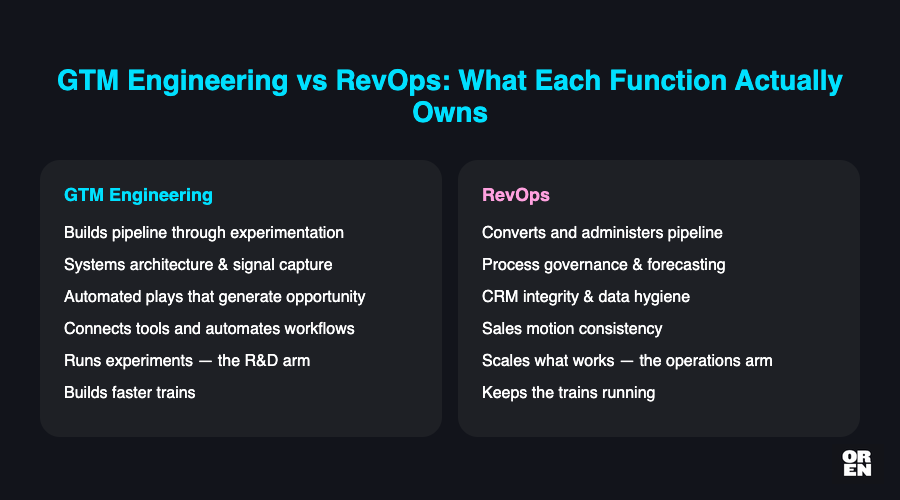
GTM Engineers build systems, automate workflows, and create technical scaffolding. RevOps brings order, predictability, and governance to the revenue engine.
The definitions have been written.
"GTM Engineering is the R&D arm for RevOps. RevOps keeps the trains running; GTM Engineering experiments with how to build faster trains." - Saad Bayezeed
Clean framing. The problem is that most GTM orgs have both functions running in parallel with no agreed protocol for what happens when an experiment is ready to operationalise.
GTM Engineering runs a sequencing play that gets a 40% reply rate. RevOps never gets the documentation. Six weeks later, the play is dead and no one knows why.
That is not a people problem. It is a handoff design problem.
---
What the handoff actually breaks
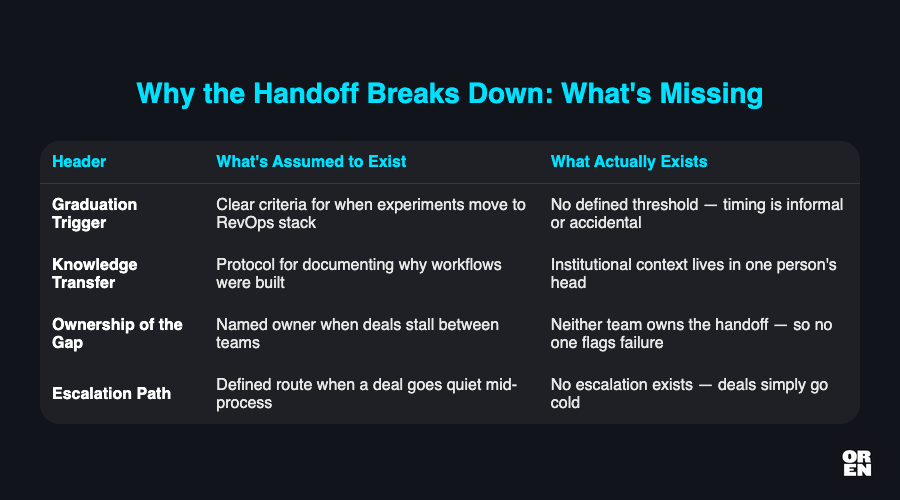
The failure mode is almost always the same.
An experiment works at small scale. The GTM Engineer who built it moves to the next sprint. RevOps inherits a workflow they did not design, with no context on the ICP criteria, the data conditions, or the edge cases.
The workflow degrades. Pipeline stalls.
Companies that align people, processes, and technology in their demand engine achieve 36% more revenue growth - but alignment is not a values statement, it is an operational decision about who owns what at which moment (Apollo.io, 2026).
The gap is structural. GTM Engineers, in most early-to-mid-stage companies, report to a Head of Growth or COO. RevOps sits under the CRO or VP Revenue. Different reporting lines, different incentives, different definitions of done (Tabula.io Blog, 2026).
Nobody owns the transition moment between those 2 worlds.
This is the same pattern that breaks GTM stacks more broadly - not the tools, but the architecture between them. If you have read the argument on GTM architecture failure, this is the human-layer version of the same problem.
---
Shared accountability is the wrong fix
The instinct is to create a joint SLA, a shared dashboard, or a cross-functional working group.
That instinct is wrong.
Shared accountability between functions is not real accountability. It is accountability theatre. When a handoff breaks and 2 teams share ownership of the outcome, the investigation becomes political. Nobody redesigns the interface because nobody owns it.
The fix is not more collaboration.
It is a single, named owner for the handoff protocol itself - a documented set of criteria that define when an experiment leaves GTM Engineering's hands, what must be true about the data and process before it does, and who in RevOps receives it with what context.
"The organizational seat of each role signals its mandate: GTM Engineers to build systems, RevOps to govern processes, and Sales Engineers to close deals." - Eugene Levi, CEO & Co-Founder, Tabula.io
If the mandate is that clear, the handoff criteria can be that clear too.
It rarely is. Because nobody has written it down.
---
The org layer, not the tech
This is not a tooling problem.
Adding another orchestration platform or a shared Notion workspace does not fix an undesigned interface. The problem sits one level above the stack.
Most scaling B2B SaaS companies optimise at the symptom level - pipeline friction, low conversion rates, poor sequence performance - when the actual cause is structural. You cannot process your way out of an ownership gap.
The growth audit framework makes this point directly: when growth stalls, the diagnosis almost always surfaces a structural cause that tactical fixes cannot reach.
Same logic applies here. If your GTM Engineering and RevOps teams are stepping on each other, the answer is not a better CRM workflow or a new enrichment tool.
It is a redesign of the boundary between them.
---
What a designed handoff looks like
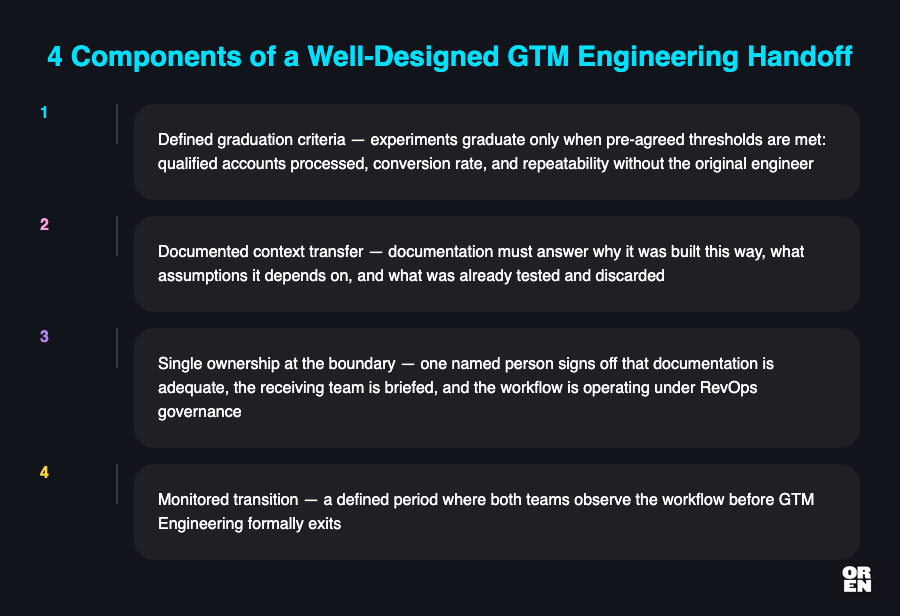
A designed handoff has 4 components. Most companies have none of them.
1. Entry criteria. What must be true before a GTM Engineering experiment is eligible for operationalisation? Minimum sample size, data quality threshold, documented ICP conditions, and a named RevOps owner who has been briefed - not just assigned.
2. A transition document. Not a Slack message. A short, structured record of what the experiment was, what worked, what the edge cases are, and what the workflow assumes about data inputs. This is institutional knowledge. Without it, RevOps is reverse-engineering someone else's logic under pressure.
3. A single owner for the handoff moment. Not the GTM Engineering lead. Not the RevOps lead. One person whose job it is to confirm the criteria are met and the transition document exists before the workflow moves. In smaller teams, this is often the CRO or VP Revenue. In larger ones, it can be a dedicated GTM Programme Manager.
4. A degradation signal. A metric that tells you the operationalised workflow is underperforming - and routes that signal back to GTM Engineering, not just into a RevOps backlog. The feedback loop is what makes the system self-correcting.
"We're moving away from sales-led growth toward operations-led growth. Features can be copied; unique operational processes are the real differentiator." - Saad Bayezeed
If operational processes are the differentiator, the handoff between the team that designs them and the team that runs them is one of the highest-leverage design decisions in your GTM org.
Treat it like one.
---
Nobody has documented this boundary
The entire body of published content on GTM Engineering versus RevOps is taxonomic. It defines the roles, draws the conceptual line, and moves on.
None of it addresses what happens at the line in practice.
Which is where the revenue actually goes.
If you are a CRO or VP Revenue at a scaling B2B SaaS company and your pipeline generation and pipeline management teams keep stepping on each other, the problem is almost certainly not that your people are wrong.
It is that the interface between them has never been designed.
Design the handoff. Assign one owner to it. Write the criteria down.
Everything else is noise.
---
If the structural design of your GTM org is the underlying problem, the fractional CMO engagement is built for exactly this diagnostic and redesign work.