Growth Hacking Course
Your CRM Schema Is Why Signal-Based GTM Keeps Failing
By
June 19, 2026

Last updated: 2026-06-19
Most teams blame data quality.
That's the wrong diagnosis.
The real problem is that their account, contact, and engagement objects were never built to hold signals in the first place.
Buying an enrichment tool pours clean data into a broken container.
Fix the container first.
---
Enrichment tools don't fix a broken schema
The market has a confident answer to signal-based GTM failure: buy better data.
Cognism starts at approximately £22,500/year. 6sense runs to roughly £60,000/year for AI-powered ABM orchestration. Autobound's Signal API sits at £15,000 - £50,000/year and pulls from 35+ data sources across 700+ signal subtypes. Apollo offers entry points from free upwards. [Autobound.ai, 2026]
The spend is real.
The results are frequently disappointing.
The diagnosis is almost always 'data quality'. The prescription is almost always another enrichment vendor.
Neither touches the actual problem.
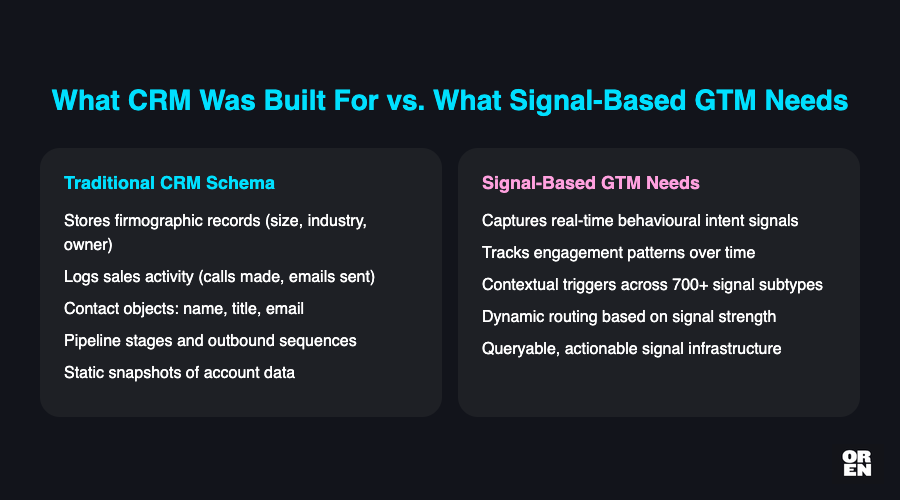
Most CRM schemas were designed to store firmographic records and log sales activity. Account objects hold company size, industry, and owner. Contact objects hold name, title, and email. Engagement objects, where they exist at all, are activity logs - calls made, emails sent.
That architecture was built for a world where GTM ran on outbound sequences and pipeline stages.
Not on behavioural signals.
When you bolt a signal layer onto that schema, you get decoration, not infrastructure. The signals arrive, sit in a custom field nobody queries, and decay.
"I have come to believe that a modern GTM team does not need more tools. It needs a brain." - GTM Engine Blog
The brain is the data model.
Everything else is peripheral.
---
What a signal-ready object actually requires
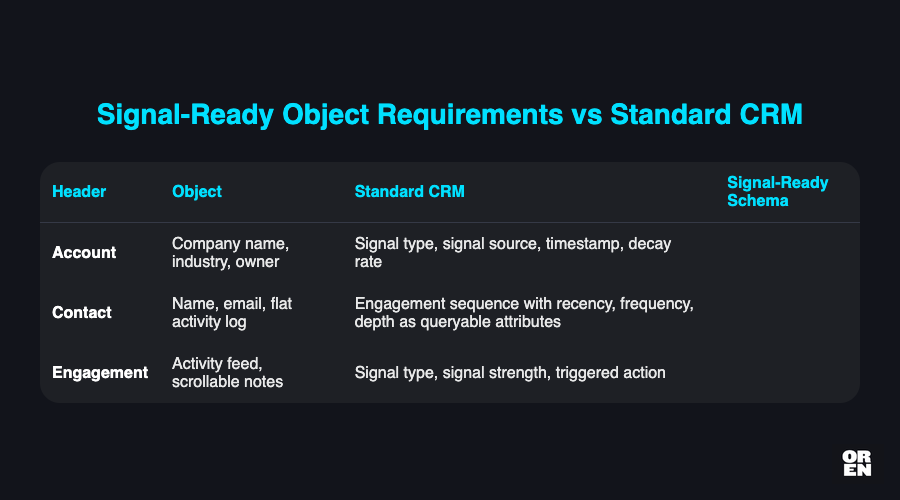
An account object designed to receive signals looks materially different from a standard CRM account record.
It needs fields that capture signal type, signal source, signal timestamp, and signal decay rate. Because a buying intent signal from Bombora's 5,000+ publisher co-operative [Autobound.ai, 2026] has a half-life. Storing it without a timestamp makes it worthless within days.
Contact objects need engagement history structured as a sequence, not a flat log.
The difference between a contact who visited your pricing page 3 times in a week and one who visited once 6 months ago is not visible in a standard activity feed. It requires a schema that stores recency, frequency, and depth of engagement as queryable attributes - not as scrollable notes.
Engagement objects are where most schemas collapse entirely.
A signal-ready engagement object distinguishes between signal type (intent, behavioural, technographic, firmographic), signal strength, and the action it should trigger. Without that structure, scoring models have nothing to score against. Routing rules have no logic to apply. Segmentation produces noise.
This is not a data enrichment problem.
It's a schema design problem.
And it almost always traces back to the same root cause: the CRM was configured by an ops team maintaining a platform, not engineered by a team building for a specific GTM motion.
---
The sequencing error teams keep making
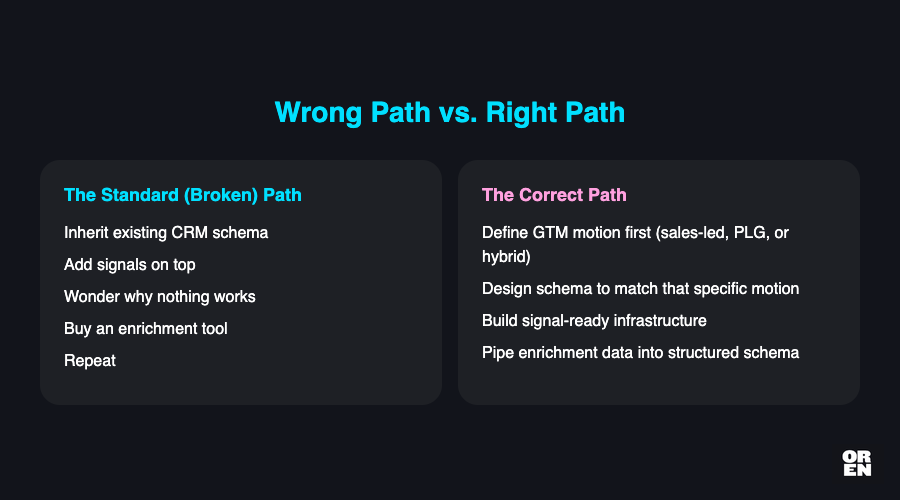
The standard path looks like this: inherit a CRM schema, add signals on top, wonder why nothing works, buy an enrichment tool, repeat.
The correct path inverts that entirely.
Define the GTM motion first - specifically whether the strategy is sales-led, product-led, or a hybrid. The account object schema for a sales-led motion, where signals feed an SDR prioritisation queue, is different from the schema required for a product-led motion, where signals feed expansion triggers for existing users.
Designing one schema and using it for both produces a model that serves neither.
This is the same logic applied to product infrastructure: GTM infrastructure built in deliberate sprints against defined outcomes outperforms infrastructure configured once and maintained as a service function.
The schema is not a CRM admin task.
It's an engineering decision with downstream consequences for every scoring model, routing rule, and segmentation query the GTM team will ever run.
"We spent $80K/year on a full-suite GTM platform when all we actually needed was the signal data piped into our existing CRM. Unbundling saved us 60%." - Director of Revenue Operations, Mid-Market SaaS
That saving only materialises if the CRM can actually receive the signal data in a structured way.
Without a signal-ready schema, piping data in creates the same problem at lower cost.
---
Retrofitting always fails downstream
Teams that retrofit signals onto an existing schema hit the same 3 failure points.
Scoring breaks. Lead and account scores are calculated against fields that exist in the schema. If signal recency, signal type, and signal frequency are not schema-level fields, they cannot be weighted. Scores end up reflecting firmographic fit and last-touch activity - the same proxy metrics the team was trying to move beyond.
Routing misfires. Signal-based routing requires conditional logic: route this account to this rep because of this signal combination. That logic depends on queryable fields. Custom text fields and activity log entries are not queryable at scale.
Segmentation drifts. Audiences built for signal-based campaigns need to update dynamically as signals change. Static list logic built on top of a schema that doesn't store signal state produces audiences that are stale by the time the campaign runs.
These are not tool failures.
They're predictable consequences of asking a schema to do work it was never designed to do.
As noted in Data and Direction, collecting data that's easy to access rather than data that's meaningful leads to wrong questions. And wrong questions produce wrong actions regardless of how much you spend on enrichment.
---
The model comes before the tools
The market currently lists 14 apps in the GTM data model category on ZoomInfo's marketplace alone. [ZoomInfo App Marketplace, 2026]
Every one of them assumes the receiving infrastructure is ready.
Most of the time, it isn't.
"If everyone sees the same customer, everyone makes smarter choices." - GTM Engine Blog
That's only possible when the schema defines what 'the customer' means across every system - what fields exist, what they store, and how signals update them over time.
The enrichment vendors are not the problem.
The sequencing is.
Schema design is not a task to schedule after the signal tools are live. It's the precondition for every signal tool working at all.
If your signal-based GTM is underperforming, audit the schema before you renew the enrichment contract.
The container is broken.
Fix that first.