Growth Hacking Course
When Your GTM Agent Breaks, What's the Recovery Plan?

Last updated: 2026-06-15
Key Takeaways
- Agentic GTM systems fail in GTM-specific ways - misclassified accounts, wrong sequences fired at existing customers, clean CRM data overwritten by bad enrichment - that vendor decks never model.
- Many agent actions are irreversible: a sent email cannot be unsent, a deleted record cannot be recovered without a backup, a suppressed account may never re-enter the pipeline correctly.
- Failure mode planning - confidence thresholds, rollback protocols, human-review triggers, write-permission scoping - is QA infrastructure that must be scoped before deployment, not retrofitted after the first incident.
- Gartner estimates that over 40% of agentic AI projects will be cancelled before the end of 2027 (Gartner, 2025), and an estimated 40% will fall short in GTM environments specifically (Wyzard.ai, 2026).
- The vendor accountability gap is real: most agentic GTM vendors do not proactively disclose failure rates, data write permissions, or rollback capabilities - and most buyers do not know to ask.
---
What actually goes wrong when a GTM agent fails?

Agentic GTM failures aren't abstract model errors.
They're operational events with real commercial consequences: a 6-figure account misclassified as mid-market, a reactivation sequence fired at your largest customer, a sales rep's manually verified contact data silently overwritten by a third-party enrichment agent at 2am.
The failure is often invisible until the damage is done.
The hype narrative treats deployment as a one-way door. Deploy the agent, accelerate the pipeline, reduce headcount cost. The vendor deck shows the upside.
It doesn't show the incident log.
That's the infrastructure gap most agentic GTM projects discover expensively, and usually too late.
---
Why does the standard framing of agent failure miss the GTM context?

It stays at the wrong layer of abstraction.
A rigorous taxonomy of agentic AI faults, drawn from analysis of 13,602 closed issues and merged pull requests across 40 open-source agentic AI repositories, identifies 5 architectural fault dimensions, 13 symptom classes, and 12 root cause categories (Characterizing Faults in Agentic AI, 2026). That taxonomy was validated by 145 practitioners, 83.8% of whom reported it covered faults they'd personally encountered. It's rigorous. It's also almost entirely abstract from a GTM operations perspective.
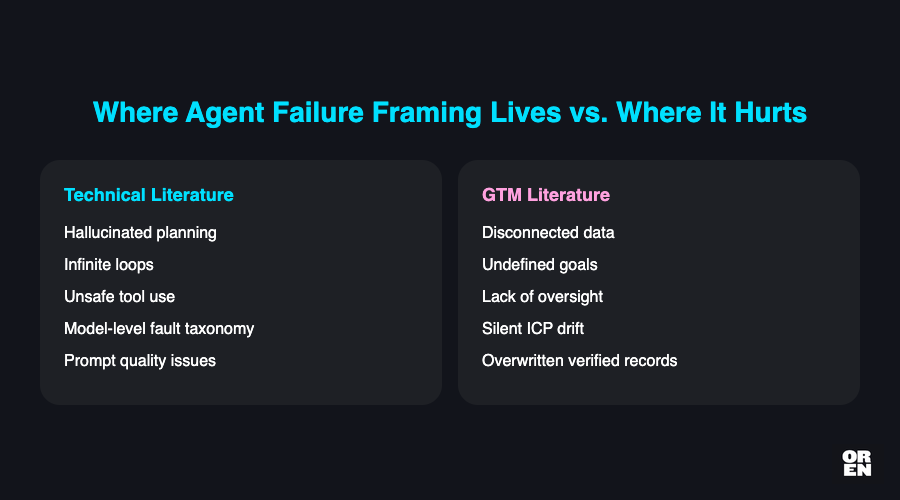
The technical literature talks about hallucinated planning, infinite loops, and unsafe tool use.
The GTM literature talks about disconnected data, undefined goals, and lack of oversight.
Neither layer talks about what it actually costs when an enrichment agent overwrites a RevOps manager's verified contact record, or when a scoring agent trained on last year's ICP silently degrades as the market shifts.
"Today, when an agentic AI system fails, it's less likely because of model failure or prompt quality. It's more likely that there are flaws in the system design." - Meenakshi Kodati, IBM Technology
"Conflating them - treating all failures as 'the model got it wrong' - leads to testing regimes that catch surface errors while missing structural ones." - Agus Sudjianto
The structural failures are the expensive ones.
And in GTM, the structure includes your CRM, your sequences, your lead routing logic, your suppression lists, and your segment definitions - all of which an agent can touch, and some of which it can permanently damage.
---
What are the GTM-specific failure modes that nobody is documenting?

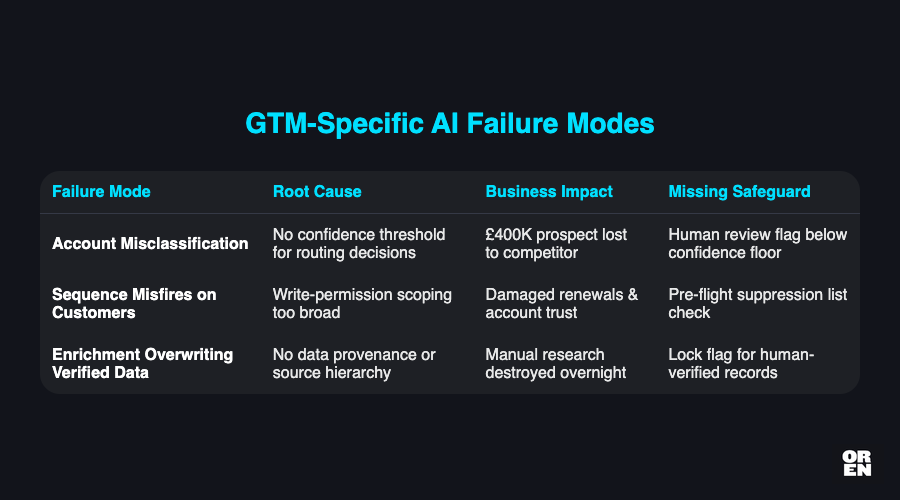
There are 4 failure categories specific to GTM operations and largely absent from both the technical taxonomies and the vendor materials.
1. Account misclassification
A scoring or segmentation agent routes a £400K ARR prospect into a low-touch nurture sequence because it matches a firmographic pattern associated with SMB accounts.
The prospect receives 3 automated touchpoints before a human notices. By then, they've already engaged with a competitor's enterprise sales team.
The failure isn't that the model hallucinated. The failure is that no confidence threshold existed below which the agent was required to flag the record for human review before taking action.
2. Sequence misfires on existing customers
An outbound prospecting agent, given access to a contact database without adequate suppression logic, fires a cold acquisition sequence at 12 existing customers. The sequence references pain points those customers already solved with your product.
2 of them forward the email to their account manager. 1 raises it in a renewal conversation.
That's not a data problem. It's a write-permission scoping problem. The agent had access it shouldn't have had, and no pre-flight check verified suppression list integrity before execution.
3. Enrichment overwriting verified data
A RevOps manager spends time manually verifying the direct dial and buying committee contacts for a strategic account. An enrichment agent, running on a nightly schedule, overwrites those records with third-party data that's 14 months out of date.
The verified data is gone. The agent has no audit log that distinguishes its writes from human writes.
Worth flagging: traditional RevOps managers already spend 30% of their time on CRM hygiene under manual operating models (Arise GTM, 2026). An enrichment agent that operates without write-permission controls and version history doesn't eliminate that problem - it compounds it, at speed, at scale, and invisibly.
4. Silent model degradation
A lead scoring agent is trained on ICP signals that were accurate 18 months ago. The market has shifted - the buyer title has changed, the company size signal has inverted, the intent data sources have drifted.
The agent continues scoring confidently. Pipeline quality degrades over 2 quarters.
By the time the board asks why conversion rates have dropped, the root cause is buried in a model that nobody thought to audit.
"Traditional model validation asks: does the model produce accurate outputs? Agentic validation must ask a broader question: does the agent behave correctly across its full operational scope?" - Agus Sudjianto
---
Why does irreversibility change the risk calculation?
Not all agent actions carry the same recovery cost.
That's the distinction agentic GTM infrastructure must encode from the start, and almost never does.
Read
- Example: Agent queries CRM for account data
- Reversible?: Yes
- Recovery cost: Zero
Write (additive)
- Example: Agent appends enrichment tag to record
- Reversible?: Partially
- Recovery cost: Low - if audit log exists
Write (overwrite)
- Example: Agent replaces verified contact data
- Reversible?: No
- Recovery cost: High - manual re-verification
Send
- Example: Agent fires email sequence
- Reversible?: No
- Recovery cost: Relationship cost, not data cost
Route
- Example: Agent assigns lead to wrong queue
- Reversible?: Partially
- Recovery cost: Depends on response time
Suppress
- Example: Agent removes account from active pipeline
- Reversible?: Partially
- Recovery cost: Account may be permanently cold
The principle that follows is straightforward: asymmetric caution thresholds based on action permanence. Reversible actions can operate with higher autonomy. Irreversible actions require higher confidence thresholds, human-review triggers, or both.
"An AI agent is not a chatbot. A chatbot generates text. An agent takes actions." - Agus Sudjianto
This matters commercially. When an agent sends the wrong sequence, you cannot unsend it. When it suppresses a high-value account, the window may have closed before anyone notices.
The architecture must treat these actions differently from the start - not as an afterthought after the first incident.
---
What does failure mode planning actually require before deployment?
Failure mode planning is not a post-deployment discipline.
It's pre-deployment QA infrastructure - the equivalent of a test suite before pushing to production.
The components aren't complicated. They're simply absent from most agentic GTM scoping conversations.
Confidence thresholds - Every agent decision that triggers an irreversible action should have a minimum confidence score below which the action is held for human review. What that threshold is depends on the action type and the commercial stakes of getting it wrong. The threshold should be documented, not assumed.
Write-permission scoping - Agents should have the minimum write access required to perform their function. An enrichment agent doesn't need permission to overwrite fields a human has manually verified. A sequencing agent doesn't need access to suppression lists it cannot validate. Permissions should be scoped at the field level, not the object level.
Audit logs that distinguish agent writes from human writes - Without this, you cannot diagnose a data integrity failure after the fact. Every agent write should be timestamped, attributed, and recoverable. This is not a nice-to-have. It's the minimum viable infrastructure for operating an agentic GTM system responsibly.
Human-review triggers - Defined conditions under which the agent pauses and escalates rather than proceeding. These should be designed before deployment, not discovered through incidents.
Sandbox and rollback environments - The ability to test agent behaviour against production-representative data before live deployment, and to roll back a batch of agent actions if a failure is detected. Most vendors don't offer this by default. Most buyers don't ask for it.
"The process documentation exercise you do before deploying agents is valuable regardless of whether you deploy agents. It forces clarity about how your revenue operations actually works and usually reveals inefficiencies that exist purely because nobody ever wrote down the official process." - Paul Sullivan, Arise GTM
This points to something broader about agentic GTM builds: the hardest part is rarely the architecture. It's the knowledge-extraction work that precedes it - getting revenue operations teams to articulate the tacit rules, edge cases, and exception-handling logic that currently lives in human judgement.
If that work isn't done before deployment, the agent inherits the gaps.
If your GTM stack already has architectural problems before you introduce agents - and most do - those problems will be automated, not solved.
---
What should you demand from an agentic GTM vendor?
Most agentic GTM vendors don't proactively disclose failure rates, data write permissions, or rollback capabilities.
The vendor accountability gap is a buyer's problem, not a vendor's problem - until it becomes a commercial incident.
Before signing, ask these questions and require documented answers:
On data permissions:
- What fields can this agent write to, and can those permissions be scoped at the field level?
- Does the agent distinguish between human-verified records and machine-generated records?
- What happens when the agent encounters a conflict between its enrichment data and an existing value?
On audit and recovery:
- Does the system maintain a full audit log of agent writes, attributable to the agent rather than a generic system user?
- Can a batch of agent actions be rolled back? Under what conditions, and how long does it take?
- What is the data retention period for agent action logs?
On confidence and escalation:
- Does the agent operate with confidence scoring on its decisions?
- What is the threshold below which an action is held for human review?
- Can those thresholds be configured by action type?
On failure history:
- What are the most common failure modes observed in production deployments of this system?
- What is the incident response process when a failure is detected?
- Have there been cases of mass sequence misfires or data overwrites in customer environments?
"None of these are AI problems. They are management problems. And they are entirely solvable with the right operating structure around your agentic stack." - Pankaj Kumar, DevCommX
The vendor who can't answer these questions isn't ready for production deployment in a revenue-critical environment.
Gartner projects that by 2028, 33% of enterprise software applications will include agentic AI - but also that over 40% of agentic AI projects will be cancelled before the end of 2027 (Gartner, 2025). McKinsey finds that 8 out of 10 organisations aren't seeing bottom-line savings from generative AI, let alone transformative outcomes (McKinsey State of AI 2025). The pattern is consistent: deployment without infrastructure produces expensive disappointment.
The upside case for agentic GTM is real. Traditional revenue teams operate 8-10 hours per day; agentic systems operate 24/7. Average lead response time drops from 2-6 hours to under 15 minutes. Error rates on repetitive tasks fall from 8-12% to under 2% by month 3 (Arise GTM, 2026). The cost to scale with traditional headcount is £50K-£80K per FTE, against £3K-£8K per agent per month. Those numbers are compelling.
They're also the numbers the vendor deck leads with.
The failure mode planning is the infrastructure that makes those numbers achievable rather than aspirational.
"This isn't a software upgrade. It's a structural shift in how revenue operations get done." - Paul Sullivan, Arise GTM
If you're commissioning a custom agentic GTM build and the scoping conversation hasn't yet covered error-handling, rollback, or confidence thresholds, that's the conversation to have before the build starts - not after the first incident. A growth audit run before deployment will surface the operational gaps that an agent will inherit and amplify. The custom AI systems work worth commissioning treats failure mode planning as a first-class deliverable, not a footnote.
---
Frequently Asked Questions
What is the most common agentic GTM failure mode in production?
Based on practitioner research covering 385 in-depth fault analyses across 40 open-source agentic repositories (Characterizing Faults in Agentic AI, 2026), the most common failure modes are flaws in system design rather than model hallucination. In GTM contexts specifically, the highest-frequency operational failures are data integrity failures from enrichment overwrites and sequence misfires from inadequate suppression logic - both of which stem from insufficient write-permission scoping at the time of deployment.
How do you build a rollback capability for agentic GTM actions?
Rollback capability requires 3 things: a complete audit log of agent writes that is attributable to the agent rather than a generic system user; a versioning system for CRM records that preserves the pre-agent state; and a defined incident response process that specifies who has authority to trigger a rollback, under what conditions, and within what time window. Most out-of-the-box agentic GTM platforms do not provide all 3 by default - this is a scoping question to raise with your vendor before deployment.
What confidence threshold should trigger human review?
There is no universal answer, but the principle is clear: thresholds should be set based on the irreversibility of the action, not the complexity of the decision. A high-confidence agent decision to overwrite a verified contact record should still require human review because the recovery cost of an error is high. A lower-confidence agent decision to append an enrichment tag can proceed autonomously because the action is additive and recoverable. Set thresholds by action type, document them, and review them quarterly as the agent's operating environment changes.
How do you detect silent model degradation in a GTM scoring agent?
Silent degradation is caught through scheduled model audits, not through monitoring outputs in real time. Set a quarterly review cadence that compares the agent's current scoring behaviour against a held-out sample of known outcomes. Track the distribution of scores over time - if the distribution shifts without a corresponding shift in pipeline quality, the model is drifting. Define a retraining trigger based on performance delta, not on calendar date.
What should be in scope for a pre-deployment agentic GTM audit?
A pre-deployment audit should cover: write-permission mapping (what fields can the agent touch, and should it be able to); suppression list integrity (are all existing customer and opted-out contacts correctly excluded from prospecting actions); confidence threshold design (what is the minimum confidence required for each action type before the agent proceeds autonomously); audit log architecture (is every agent write attributable, timestamped, and recoverable); and failure scenario testing against production-representative data in a sandbox environment. If any of these are absent from the scoping document, they should be added before the build begins.
---
[AUTHOR_BIO]