Growth Hacking Course
Ai Maturity Measurement Beyond Licence Counts
By
June 24, 2026

28% of sales reps hit quota last year. Meanwhile, most boards are measuring AI maturity by counting Copilot licences.
Those 2 facts are related.
Licence counts tell you what you spent. They tell you nothing about whether your commercial teams can do anything with AI that moves revenue. The 8-stage maturity curve has distinct, measurable outputs at every stage - workflow coverage, automation rate, decision augmentation frequency, custom system throughput - and none of them appear in a vendor dashboard. If your board KPI is still "seats activated," you're measuring the wrong thing.
The licence-count trap
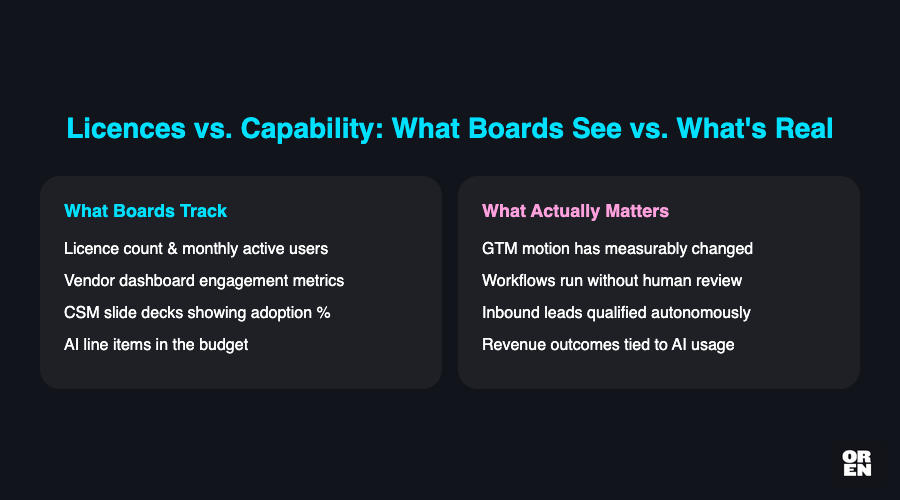
A SaaS company with 200 Copilot licences and a team that uses them to reformat emails is not more AI-mature than a 40-person company running a custom enrichment pipeline that qualifies inbound leads without human review.
Yet most boards treat the first scenario as progress.
They see a line item, a vendor dashboard showing "monthly active users," and a slide deck from the CSM. The number is real. The capability it implies is fiction.
This isn't a new problem. SaaS teams have always defaulted to tracking accessible metrics rather than meaningful ones - it's a structural failure that leads to misallocated effort. AI adoption has just given this tendency a new surface area. The vendor dashboard is optimised to show engagement with the vendor's product. It is not optimised to show whether your GTM motion has changed.
Info-Tech Research Group's research confirms the gap plainly: few organisations have had success with a unified and widespread adoption of AI technologies, and even fewer with generative AI [Info-Tech Research Group, 2026]. That finding sits alongside a market where nearly every enterprise has purchased AI tooling. The purchases happened. The capability did not follow.
What maturity actually measures
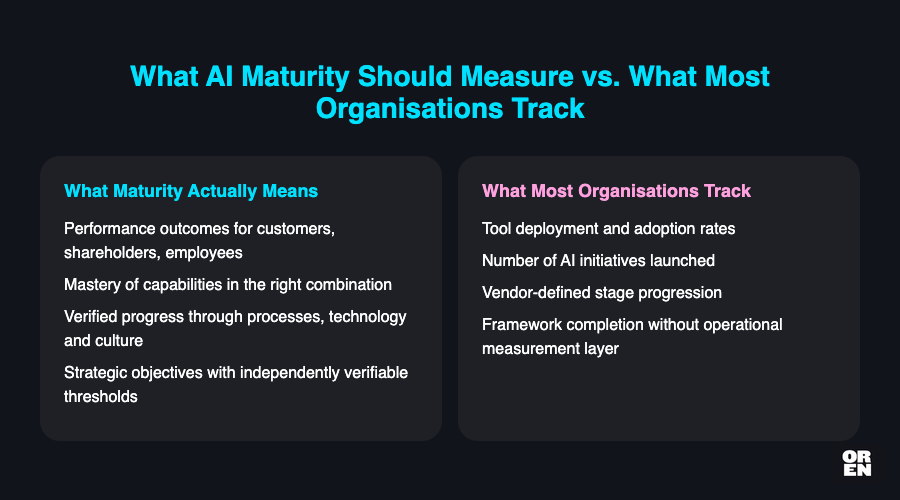
Accenture's definition is worth anchoring to: "AI maturity measures the degree to which organizations have mastered AI-related capabilities in the right combination to achieve high performance for customers, shareholders and employees."
Performance outcomes. Not tool deployment.
MIT CISR's model similarly treats maturity as a capability question - Stephanie Woerner describes it as guiding organisations through "processes, technology, and organizational culture" toward "strategic objectives through a clear, step-by-step approach." Same logic.
The problem is that most organisations stop at the framework and never build the operational measurement layer beneath it. Every major consultancy - MIT, Accenture, Gartner, MITRE - has produced a maturity model. What none of them provides is the specific threshold value that separates one stage from the next in terms your finance or strategy team can verify independently of the vendor relationship.
That gap is what your board is currently falling into.
Stage by stage: what to actually measure

Peter Weill at MIT CISR describes the early stage as "all about experimenting, preparing, and education." Fair enough. But "experimenting" is not a board metric.
Stage 1 - Prompt literacy
Measurable output: the percentage of commercial team members who can produce a first-draft deliverable - email sequence, call brief, competitive summary - using AI without manual post-editing. Not "has access to ChatGPT." Has demonstrated the output. Most teams claiming Stage 2 are actually here.
Stage 2 - Workflow integration
Measurable output: workflow coverage rate - the proportion of repeatable GTM tasks (lead research, sequence personalisation, meeting prep, pipeline notes) that have an AI step embedded in the standard operating procedure. If the answer is "it depends on the rep," you're at Stage 1.
Weill's observation about Stage 2 is pointed:
"The hardest part of Stage 2 is changing. How do we move from a command-and-control culture to a coach-and-communicate culture? AI has a lot to do with not only automating but enabling our front line to make decisions for us and enabling our customers to self-serve. You can't do that if you command and control."
Workflow coverage below 40% of repeatable tasks, combined with no documented SOPs that include AI steps, is Stage 1 regardless of what the vendor dashboard shows.
Stage 3 - Process automation
Measurable output: automation rate - the percentage of defined workflow steps that execute without human initiation. A rep triggering an AI tool manually on each lead is integration. A system that enriches, scores, and routes leads on ingestion is automation.
Weill's prescription here is direct: "You have to simplify and automate your processes. If you try to use AI on an incredibly complicated process, it'll be much harder."
The threshold question for your board: what percentage of your top-of-funnel processing requires a human to press a button? If the answer is above 60%, you're not at Stage 3.
Stage 4 - Decision augmentation
Measurable output: decision augmentation frequency - how often AI-generated signals (propensity scores, churn risk flags, deal health indicators) are the documented input to a commercial decision, rather than a rep's intuition. This is trackable in CRM if you build for it. Almost no one builds for it.
Stage 5 - Custom system deployment
Measurable output: custom model throughput - volume of commercial outputs (qualified leads processed, proposals drafted, accounts researched) passing through proprietary systems rather than off-the-shelf tools.
Clay at $0.01 per record versus ZoomInfo at $0.25 is the economic argument for custom systems - a 25x cost differential that only becomes accessible when your team has the capability to build and operate the pipeline rather than buy the dashboard [Clay / ZoomInfo pricing comparison]. Cursor reaching $1B ARR with 300 people illustrates what custom AI systems do to unit economics at the product level. Same logic applies to GTM infrastructure.
Weill calls this the "holy trinity of AI - architecture, reuse, and agents":
"Companies in the third stage are developing proprietary models, and that leads you to the holy trinity of AI - architecture, reuse, and agents. Those are the really hard parts of Stage 3." - Peter Weill, MIT CISR
Stages 6-8 - AI-native operations
Measurable outputs shift to: percentage of revenue-generating decisions made with AI as primary input, latency reduction in pipeline velocity, and - at the furthest end - new service lines built on proprietary AI capability.
Weill's description of this endpoint: "This is where you're all in for AI-enabled decision-making, deciding when you need people in the loop and when you don't. You'll develop proprietary AI, and you'll sell new services around it."
Few commercial teams in B2B SaaS will need or should target Stage 8. MITRE's model makes the point well: "not all organizations will need or want to attain a level 5 for all pillars." The question isn't how high you can climb. It's whether the stage you're targeting maps to a commercial outcome worth the investment.
The board reporting problem
Boards default to licence counts because nobody has handed them a better reporting structure. They use the one the vendor provided.
If you're a CMO or CRO walking into a board meeting, you need to replace the vendor dashboard with a capability scorecard that reports against stage-specific metrics. Four columns: the maturity stage, the specific metric that evidences it, the current measured value, and the target value with timeline. No "licences purchased." No "monthly active users."
The AI Sweden maturity assessment - developed using data from over 100 organisations - requires approximately 80 hours of participation across roughly 60 contributors and takes around 6 weeks to complete [AI Sweden / AppliedAI, 2026]. That investment signals something important: genuine maturity assessment is an operational exercise, not a vendor report. If your current AI progress update takes 20 minutes to compile from a dashboard, it's almost certainly measuring the wrong things.
I covered the structural failure of mandate-without-measurement in more detail in Your Board Just Made AI Adoption a KPI. Now What? - the short version is that 95% of enterprise AI pilots deliver no measurable ROI because companies treat adoption as a communications exercise rather than infrastructure. The measurement problem is downstream of that.
What vendor dashboards can't show
Vendor dashboards show: seats activated, monthly active users, prompts submitted, features accessed, time-in-tool.
Vendor dashboards can't show: whether workflow coverage has increased, whether automation rate has changed, whether AI-generated signals are actually influencing decisions, whether custom systems are outperforming point solutions, or whether any of this is moving pipeline velocity or conversion rate.
The first set is what vendors are incentivised to surface. The second set is what your board should be asking for. The gap between them is where AI investment quietly disappears.
Same structural problem as the broader GTM stack - architectural debt from accumulating disconnected point solutions, each with its own dashboard, none of which shows the system-level output. Swapping vendors treats symptoms. Building a measurement layer that sits above the tools treats the cause.
Building the capability scorecard
The practical output here is a reporting structure, not a framework.
First, map your current commercial workflows - every repeatable task from lead ingestion to close. This is the denominator for your workflow coverage and automation rate calculations. Most teams have never done this explicitly.
Second, assign a stage to each workflow based on where it currently sits: manual, AI-assisted (human initiates), AI-integrated (AI step in SOP), or AI-automated (executes without human initiation).
Third, define the target stage for each workflow based on commercial impact and implementation complexity. Not every workflow needs to reach automation. Some should stay at augmentation. The MITRE principle applies: "the target maturity level for a pillar is a function of organizational mission, resources, and business practices."
Fourth, instrument the measurement. Decision augmentation frequency requires a CRM field. Automation rate requires process logging. Custom system throughput requires an output counter. None of this is technically complex - all of it requires deliberate build.
Fifth, report the delta, not the absolute. Boards respond to movement. Showing that workflow coverage moved from 18% to 34% in a quarter is a board metric. Showing that you have 200 licences is a procurement metric.
If you're building this from scratch, the AI Marketing Lab covers workflow mapping and measurement instrumentation in a hands-on format. For organisations that need the capability scorecard built and embedded rather than trained, the custom projects work addresses that directly.
The measurement is the strategy
What gets measured gets resourced.
If your board is measuring licence counts, your organisation will optimise for licence counts - buying more tools, activating more seats, running more lunch-and-learns. None of that produces the workflow coverage, automation rate, or decision augmentation frequency that actually changes commercial performance.
The organisations that move fastest aren't the ones with the most tools or the biggest mandates. They're the ones that defined what "working" looks like before they started, and built measurement into the process from day one. That piece is at Seven Things I Learned Running AI Training Workshops for Businesses if you want the ground-level version.
AI maturity measurement isn't a framework exercise. It's a capital allocation discipline. The board is asking the right question - how mature is our AI capability? - and getting a wrong answer because the measurement infrastructure doesn't exist yet. Building that infrastructure is the work.