Growth Hacking Course
Agentic GTM Will Fail Without Clean Data
By
June 8, 2026
Last updated: 2026-06-18
Agents don't fail loudly.
They fail confidently - producing wrong outputs at scale, burning prospects, misrouting deals, and corrupting forecasts before anyone notices the source data was broken.
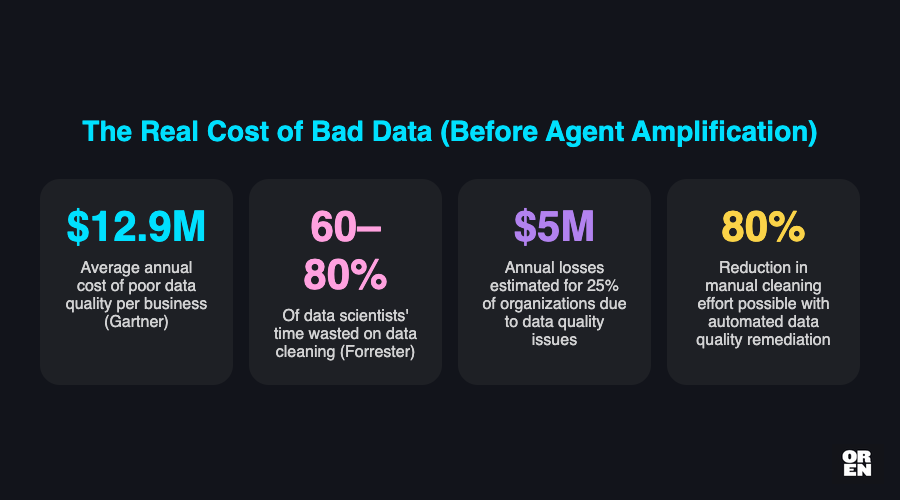
Poor data quality already costs businesses an average of $12.9 million per year [Gartner, 2026]. That's before you add an autonomous agent acting on it at speed.
Most agentic GTM content focuses on what agents can do. Almost none asks whether your CRM data is fit to power them.
That's the gap worth closing.
The failure mode nobody is naming
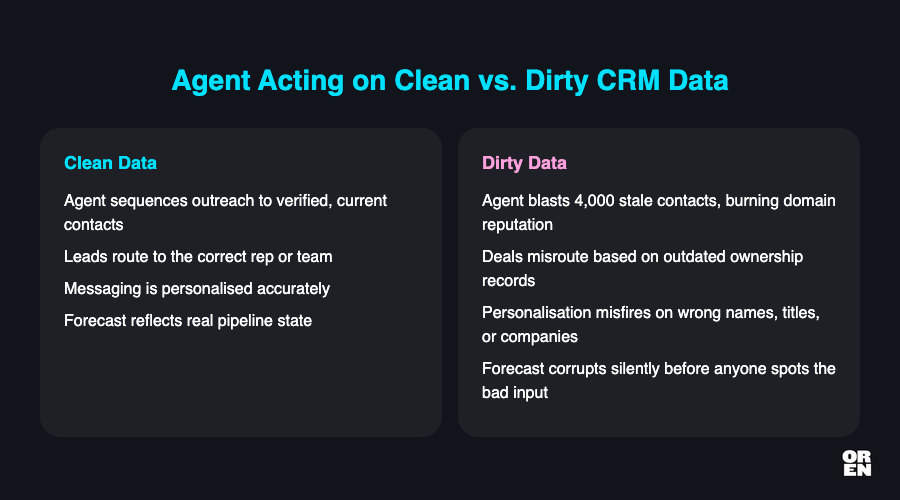
An agent operating on stale, duplicated, or incomplete CRM records doesn't produce uncertain outputs.
It produces confident ones.
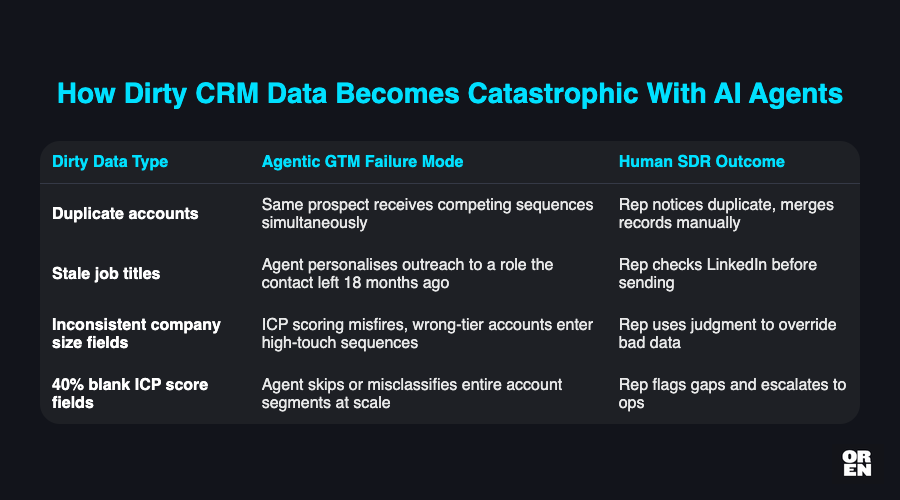
It sequences the wrong contacts. It personalises to job titles that are 18 months out of date. It scores accounts against firmographic fields that were never populated consistently.
This is categorically different from a human rep making a bad call. A human makes one bad call. An agent runs the same broken logic across your entire addressable market before Tuesday.
"Models are only as good as the data they learn from, and even small inconsistencies can have outsized impacts. A renamed column or mismatched date format can quietly skew metrics, break joins, or bias predictions." - CSIT Tech Blog
That was written about ML pipelines. It applies with equal force to any agentic GTM workflow drawing on your CRM.
Your CRM was not built for agents
CRM data was built for humans who could apply judgement to gaps.
A rep sees a missing phone number and finds it. An agent sees a missing phone number and either skips the record, hallucinates a substitute, or proceeds without flagging the gap - depending on how the workflow was designed.
The structural problems in most B2B CRMs are well-documented. Duplicate accounts created when reps enter new records rather than searching. Contact ownership that reflects who logged the deal, not who owns the relationship. Industry classifications applied inconsistently across years and sales cycles. Lead source fields that mean different things to different teams.
None of this breaks a human-run process badly.
All of it breaks an agentic process systematically.
"Data scientists can waste 60% of their time here, I've heard it as high as 80% in the traditional data management world. Organizations can lose money in terms of $5 million annually, as an estimate for 25% of organizations from Forrester." - Steve Wooledge, VP of Product Marketing, Alation
The cost of bad data at human speed is already significant. The cost at agent speed is a multiplier on top of that.
The org layer, not the tech
This is where most agentic GTM discussions go wrong.
They frame data quality as an IT or RevOps task - something to hand off before the real work begins. It isn't. It's a strategic GTM decision that determines whether your deployment succeeds or becomes an expensive regret.
The companies winning with AI in their GTM are investing 50-70% of their total AI budget in data readiness before touching automation. That's not a footnote. That's the majority of the budget, spent on work that produces no visible output until the agent runs correctly.
If you haven't done that work, you're not behind on tooling.
You're behind on foundations.
The architecture problem that breaks most GTM stacks - disconnected point solutions, inconsistent data models, no single source of truth - is the same problem that will break your agentic deployment.
What a pre-deployment audit actually covers
There's no single standard for GTM data readiness. But the failure modes are consistent enough that a practical diagnostic is possible.
Before deploying any agentic GTM workflow, you need honest answers to 5 questions.
Account deduplication. How many duplicate company records exist in your CRM? For account-based agent sequencing, a duplicate means the agent treats one target as 2 separate accounts, splits activity history, and potentially contacts the same buying group twice from different angles.
Field completeness by segment. Which fields does your agent depend on - industry, employee count, tech stack, buying stage - and what percentage of records in your ICP segment have those fields populated? Automated personalisation on 40% field completeness produces personalisation for 40% of your audience and generic fallback for the rest.
Contact-to-account mapping. Are contacts correctly associated with their parent accounts? Mismatched associations mean an agent running an account-based play will miss contacts or sequence them under the wrong account context entirely.
Ownership and routing logic. Is account and contact ownership current? Agents that route based on CRM ownership will route to reps who have left, been reassigned, or never held that territory.
Engagement history integrity. Does your CRM accurately reflect prior outreach? An agent without access to clean engagement history will re-sequence cold prospects who were already disqualified, or skip warm ones who were never logged correctly.
Automated tooling can now surface many of these issues without manual auditing. XenonStack reports up to an 80% reduction in manual data cleaning effort through automated pattern-based correction [XenonStack, 2026]. But the tooling only helps if someone with GTM authority decides the audit is a precondition, not an afterthought.
The budget question your board will ask
The data readiness phase is the hardest sell.
It costs budget, produces no visible output, and delays the deployment that everyone is excited about.
The counter-argument is simple: AI pilots that skip this step fail at a rate that makes the investment in data readiness look cheap. Burned sequences, misrouted deals, and corrupted forecasts don't just waste the AI budget - they damage the pipeline you were trying to accelerate.
The board question isn't "why are we spending on data readiness?"
It's "why didn't we do this before we built?"
For founder-led businesses without a senior marketing hire, the same logic applies with higher stakes. There's no RevOps team to catch the downstream errors. The agent's outputs become the record.
Nobody owns the definition
In most B2B SaaS companies, nobody owns a formal definition of what 'clean' means for GTM data.
Data teams define quality in terms of pipeline integrity and schema consistency. GTM teams define it in terms of whether a record feels usable. Neither definition is sufficient for agentic deployment, which requires both.
Closing that gap requires a conversation between GTM leadership and whoever owns the data infrastructure. In many companies, that conversation has never happened. If you're considering a custom AI-powered GTM build, that conversation is the first deliverable, not the platform selection.
---
Audit your data estate before you build your agentic GTM.
Not during. Not after the first deployment fails.
Before.