Growth Hacking Course
Articles
The Complete Marketing Model (And What You're Skipping)
By
January 18, 2026

Last updated: 2026-04-06
Everyone's got a marketing framework. Usually printed on a slide deck that's been collecting dust since 2019.
The problem isn't that folk don't know the steps. It's that they skip half of them and wonder why nothing's working.
I see this constantly with SaaS companies in that five to fifty million ARR range. FinTech, HR tech, B2B software. Smart people. Good products. Marketing that feels like shouting into a void.
So this is the full model. Seven parts. Each one matters (shocking, I know).
But more importantly: they're sequential. Miss one, and everything downstream starts to wobble.
The Spine Metaphor
Before we get into the steps, you need to understand why order matters.
Think of your go-to-market like a spine. When the spine is properly stacked, force moves through it efficiently. When it's misaligned, every movement costs more energy and causes pain.

Company strategy flows into brand strategy. Brand strategy flows into marketing strategy. Marketing strategy flows into execution. Each layer needs to be aligned with what came before.
Most companies? Their spine looks like a question mark. Strategy says one thing. Brand says another. Marketing does whatever's trending on LinkedIn that week.
The result isn't just inefficiency. It's confusion. For your team. For your prospects. For the market.
Step 1: Company & Brand Strategy
This is where everything starts. Not with tactics. Not with "let's run some ads."
Your company strategy sets the constraints. What are you building? For whom? Why does it exist?
Now, this is where it gets interesting. Marketing doesn't usually control this stuff. A CMO at a twenty million ARR company isn't setting the business strategy. They're inheriting it.
So why include it in the model?
Because alignment matters more than influence.
The question isn't whether marketing can change the company vision. It's whether marketing understands the company vision well enough to extend it coherently into everything downstream.
When Alignment Breaks
Let me give you two examples where misalignment destroys results.
Brand strategy misalignment: A B2B SaaS company's business strategy is built around being the low-cost, high-volume player. They want to win through efficiency and scale. But their brand strategy is all about premium positioning, thought leadership, being seen as the sophisticated choice.
What happens? Sales is trying to close deals on price and speed. Marketing is putting out white papers about enterprise-grade security architecture. Prospects get confused. Sales cycles drag out. You end up stuck in the middle, neither winning on price nor commanding premium rates.
Marketing strategy misalignment: The business strategy is geographic expansion into three new European markets over eighteen months. But marketing is still entirely focused on demand generation in their existing US market. Same channels. Same messaging. Same playbook. No localisation.
The business strategy says expand. The marketing strategy says optimise what we've got. That expansion either fails or succeeds despite marketing, not because of it.
Brand Strategy Misconceptions
Misconception one: Brand is a marketing department problem. Leaders think brand strategy is about logos, colour palettes, tone of voice. Stuff the marketing team handles while they focus on pipeline.
But brand strategy is the promise you make to the market. When your brand says one thing and your product delivers another, deals take longer to close. Churn goes up. Acquisition costs climb because you're fighting your own reputation.
Misconception two: Brand doesn't matter until you're much bigger. There's this idea that brand is for the Salesforces and HubSpots of the world. At twenty million ARR, you should just focus on performance marketing and lead gen.
Rubbish. In competitive B2B categories, brand is often the tiebreaker. If you've got no brand presence, you're losing deals you don't even know about.
Misconception three: Brand strategy equals messaging. Companies think if they've got a tagline and a positioning statement, they've done brand strategy. Brand strategy includes your values, your personality, how you want customers to experience you at every touchpoint.

Step 2: Market View
This is where you actually look at the market. Novel concept.
You need to understand: How big is the market? Who are the players? What's the competitive landscape? What trends are reshaping buyer behaviour?
But the bit folk miss: market testing beats academic research every time.
You can spend six months on a market analysis. Or you can test some messaging in three weeks and learn more.
The Research vs Testing Balance
I'm not saying research is useless. But I am saying most companies over-index on it.
Real market validation happens when you run a Meta ad to a landing page. Or a LinkedIn campaign to a specific segment. Or cold outreach to a targeted list. You get behavioural data. People vote with their clicks and their wallets, not their opinions.
But research earns its keep when you're trying to understand the _why_ behind the behaviour. Why did that segment convert better? What's the actual problem they're solving? How do they perceive your competitors?
The Right Sequence
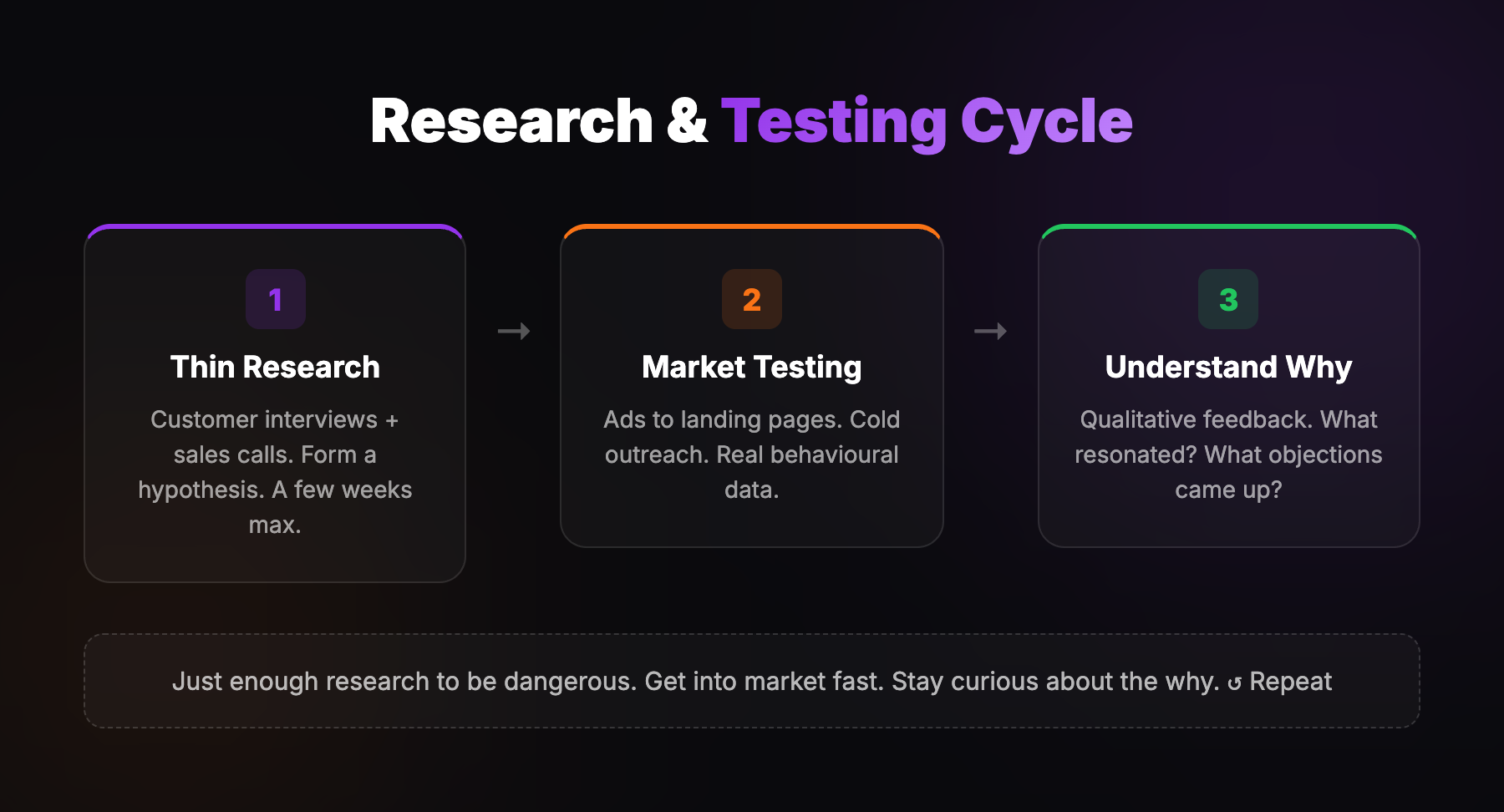
- Thin layer of research first. A few weeks, maximum. Enough customer interviews and sales call analysis to form a hypothesis.
- Move quickly into market testing. Launch campaigns. Build funnels. Start conversations.
- Keep gathering qualitative feedback. What objections come up? What messaging resonates? Where are people dropping off and why?
It's a rapid cycle. Research informs hypothesis. Testing validates or breaks it. Qualitative insight explains the why. Repeat.
Step 3: Segmentation & Positioning
This is where most companies fall apart.
And before we go further: the order matters. Segmentation first. Positioning second.
You can't effectively position until you know exactly who you're positioning to. Companies get this backwards constantly.
The Segmentation Problem
Everyone's got an ICP (Ideal Customer Profile). Usually something like "B2B SaaS companies with 50-500 employees."
Brilliant. That's only about 50,000 companies.
Real segmentation means getting specific. Which of those companies actually have the problem you solve? Which ones have budget? Which ones can make decisions quickly?

The Over-Segmentation Trap
There's a failure mode that's less obvious than the usual "we don't segment enough."
Some companies over-segment too early. Before they have product-market fit. Before they have sufficient scale.
They carve out five or six segments with detailed positioning for each. But they don't have the resources, content, or sales capacity to execute against all of them.
So they spread themselves thin. The messaging becomes inconsistent. They never build real momentum in any single segment.
This is segmentation theatre. It looks sophisticated on paper. It actually dilutes focus and slows growth.
The smarter play? Ruthlessly prioritise one, maybe two segments. Dominate there. Then expand.
Positioning That Actually Works
Positioning is not a tagline. It's the mental real estate you own in your buyer's head.
If you can't describe your positioning in one sentence without using buzzwords, you don't have positioning. You have a word salad.
The structure that works:
- One overarching position that defines your fundamental differentiation
- Segment-specific messaging that translates that position into relevance for each audience
Your core position stays consistent. Your messaging adapts to each segment's specific context and pain points.
Step 4: Market Offer
Now we get to the actual thing you're selling.
Three components:
- Value Proposition - What you deliver and why it matters
- Pricing - What you charge (and how you structure it)
- Messaging & Offer - How you communicate and package all of this
Plus a fourth that's often overlooked: Content Strategy.
The Value Prop Problem
Most companies spend 90% of their time on messaging and 10% on the value prop.
Should be the opposite.
If your value prop is weak, no amount of clever copywriting will save you. You're just polishing something nobody wants.
Pricing Confusion
Confusing product-led and enterprise models. Is it PLG? Is it mid-market? Is it enterprise? Companies try to be all three and end up with a pricing page that confuses everyone.
Pick one motion to start. Get good at it. Then expand.
Content Strategy Is Strategic
Content strategy usually gets treated tactically. "Let's write more blogs." "We need a podcast." "Everyone's doing video."
That's not content strategy. That's content tactics.
Content strategy is a strategic pillar. It determines what you create, for whom, at what stage of the journey, and how it supports your positioning.
Step 5: Channels
Right. Where do you reach these people?
PR. Social. Outbound. SEO and ASO. Paid ads. Email marketing. Partners and affiliates. Platforms like Spotify or the Chrome Store. Offline events. App stores and marketplaces. And now AI and GEO (generative engine optimisation).
The Channel Obsession Problem
The mistake here is picking channels because they're trendy, not because your buyers are there.
"Everyone's on LinkedIn." Sure. But are your specific buyers engaging on LinkedIn in a way that leads to purchase decisions?
"We should be doing TikTok." If your buyers are C-suite executives, TikTok probably isn't the play.
Start with buyer behaviour. End with channel selection. Most companies do it backwards.

Step 6: Activation
This is where most "marketing" happens. The actual campaigns. The launches. The sprints.
But notice it's step six. Not step one.
Activation without strategy is just noise. You're making content for the sake of content. Running ads for the sake of running ads.
The companies that win here have done the work in steps one through five. Their activation is:
- Targeted - they know exactly who they're reaching
- Specific - messaging tailored to segment and stage
- Connected - tied to actual business outcomes
Everyone else is just vibes.
Step 7: Retention & Advocacy
Marketing doesn't stop at the sale. (Revolutionary, I know.)
Retention is cheaper than acquisition. Always has been. Yet most marketing teams hand customers off to "success" and never think about them again.
This is the leaky bucket problem. You're pouring leads in the top while customers pour out the bottom.
Community - building connection between customers
Referral - turning customers into lead sources
Upsell and cross-sell - expanding revenue from existing accounts
Winback and churn reduction - saving customers before they leave
Advocacy is even better than retention. Happy customers who bring you more customers. But you can't fake this. If your product's rubbish, no amount of referral programmes will help.

The Uncomfortable Truth
This model isn't complicated. It's sequential.
The reason most marketing fails is that folk start at step five or six. They want to skip straight to channels and activation.
"We need more content."
"We should be on LinkedIn."
"Let's try some Google Ads."
Sure. But for whom? Saying what? Based on what positioning?
If you can't answer those questions, you're not doing marketing. You're doing guesswork with budget attached.
The Bottom Line
The full model works when you work it. All seven steps. In order.
Skip steps, and you're just hoping for the best.
Hope isn't a strategy. Never has been. Never will be.
Start with alignment. Build on research. Get specific with segmentation. Nail your positioning. Then - and only then - do you earn the right to talk about channels and campaigns.
Most companies won't do this. They'll keep starting at step five and wondering why nothing works.
That's their problem. Don't make it yours.
Frequently Asked Questions
What is a complete marketing model and why does it need to be sequential?
A complete marketing model covers all seven stages of go-to-market: company and brand strategy, market view, segmentation and positioning, market offer, channels, activation, and retention. The sequence matters because each layer builds on the one before it. Skip a step and everything downstream wobbles - like a misaligned spine where every movement costs more energy. I've seen this play out dozens of times with SaaS companies in the five to fifty million ARR range.
Why do most SaaS companies start their marketing at step five or six?
Because channels and activation feel like "doing marketing." Running ads, posting on LinkedIn, launching campaigns - that's tangible. The upstream work (strategy, positioning, segmentation) feels abstract and slow. But without it, you're just making noise. You end up with expensive guesswork that looks busy but doesn't build pipeline.
How does brand strategy affect B2B SaaS marketing performance?
Brand strategy is the promise you make to the market. When it's misaligned with your business strategy, everything breaks. I've seen companies whose business strategy was low-cost high-volume but whose brand screamed premium thought leadership. Sales cycles dragged, prospects got confused, and they ended up stuck in the middle. In competitive B2B categories, brand is often the tiebreaker - even at twenty million ARR.
What's the difference between segmentation theatre and real segmentation?
Segmentation theatre is when companies carve out five or six segments with detailed positioning for each before they have the resources to execute against any of them. Real segmentation means ruthlessly prioritising one, maybe two segments where you can dominate. It's less sophisticated on paper but far more effective in practice. Spreading thin across too many segments dilutes messaging and kills momentum.
Should marketing teams focus more on market research or market testing?
Market testing wins every time, from what I've seen. You can spend six months on analysis or test messaging in three weeks and learn more. The right approach is a thin layer of research first (customer interviews, sales call analysis), then move quickly into testing (Meta ads, LinkedIn campaigns, cold outreach). You get behavioural data - people voting with their clicks and wallets, not their opinions.
Oren Greenberg
GTM Engineering Advisor · 21+ years in growth & GTM
Oren advises B2B SaaS companies on go-to-market engineering, growth strategy, and AI-driven marketing.
Connect on LinkedIn