Growth Hacking Course
Product-Led Growth — The Narrative vs. The Numbers
By
February 27, 2026

Last updated: 2026-04-06
Someone rings you up. Wants to talk about PLG.
"We want product-led growth. That's what all the hypergrowth companies are doing."
You ask which companies they mean.
"Slack. Zoom. Figma. You know, the ones that went from zero to billions without salespeople."
Right.
Except that's not what happened. Not even close.
The PLG narrative is brilliant marketing. It's also incomplete. And if you're building your GTM strategy around it, you're probably optimising for the wrong thing.
The narrative you've heard
Product-led growth is supposed to work like this: build something people love, add a free tier, users invite their mates, usage spreads virally, companies upgrade themselves, revenue compounds whilst you sleep.
No salespeople. No cold calls. No enterprise theatre.
Just product. Just growth.
It's a lovely story. Clean. Elegant. The sort of thing that sounds right in a Medium post or a SaaS conference keynote.
And it's true... for about 15% of your revenue.
The rest comes from the bit nobody talks about.
What the numbers actually show
Let's start with Slack, because everyone loves Slack.
At IPO, Slack had 575 customers paying over $100K annually. Those customers represented 40% of total revenue.
Only 8% of Slack's revenue came from direct free-to-paid conversion.
Sales and marketing spend? $233M. That's 58% of revenue.
Sales headcount grew 66% year-over-year.
This is not what "product-led" is supposed to look like.
Zoom's even more stark. Enterprise customers now represent 59% of revenue and growing. Self-serve revenue isn't just slowing - it's declining. Down 7.9% year-over-year. They've got a 500+ person sales organisation.
Figma (the designer's darling, the poster child for PLG): 37% of ARR from customers paying over $100K. Sales efficiency of 1.0, which is best in class. But that efficiency comes from PLG feeding sales, not replacing sales.
Dropbox is the cautionary tale. 500 million registered users. Revenue now declining. Paying users contracting. The original PLG success story can't figure out how to monetise all those users.
Atlassian grew to $5 billion with zero salespeople. Brilliant. Then they hired 150+ salespeople and 120+ BDRs. Why? Because the math stopped working without them.
Ali Ghodsi, CEO of Databricks, said it plainly: "This product-led-growth thing - nice story, but in practice, it doesn't really work." Revenue flatlined on pure PLG.
Canva built what they describe as "almost a separate company" for enterprise. Poached a dedicated B2B CMO from Salesforce.
Notion's doubling their sales team every year. 90% of business comes from team usage, not individuals.
See the pattern?
The companies credited with PLG hypergrowth all have massive, sophisticated sales operations. The product gets users in the door. Sales gets the cheques.
PLG handles acquisition. Sales handles revenue.

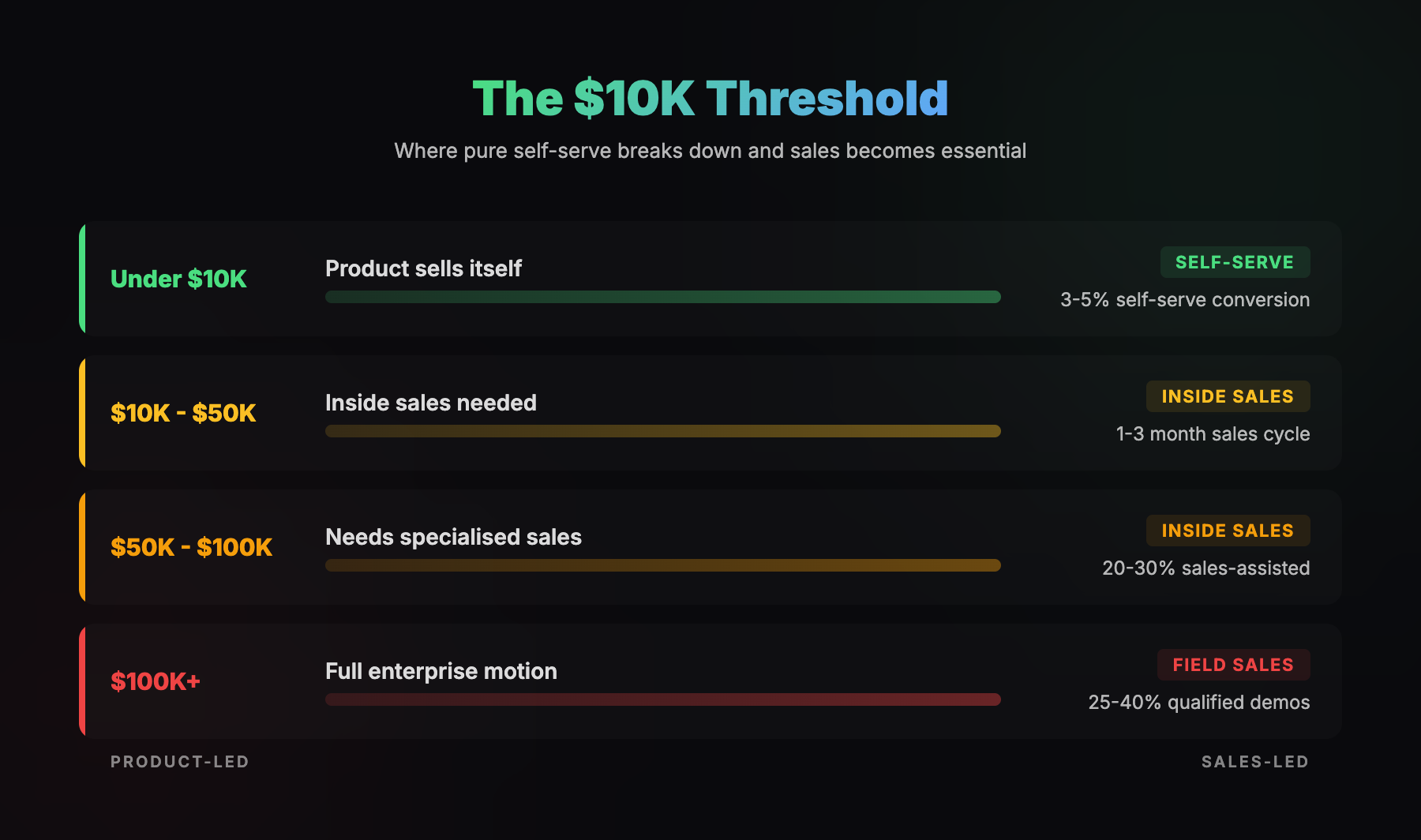
The $10K threshold nobody mentions
There's a breakpoint. Happens around $10K ACV.
Below that, product can mostly sell itself (if it's good, if the pain's obvious, if the buyer has budget authority).
$10K to $50K needs inside sales. Structured outreach, demos, a proper sales cycle of one to three months. Not enterprise-heavy, but a real sales function.
$50K to $100K needs specialised sales. Proper discovery, multi-stakeholder conversations, a bit of theatre.
Above $100K? You need field sales. Multi-month cycles. Procurement. Legal. Security reviews. The whole circus.
This isn't a bug. It's how enterprise buying works.
And if your product has enterprise features, those features typically only make sense to someone who's already used the product or has a sophisticated use case. You can't cold-call a CFO and lead with advanced functionality they've never experienced. They'll ask who you are, why they should care, and what problem this solves. If they've never heard of you, the conversation's over before it starts.
There's a reason 79% of companies with a free trial or freemium model have sales reach out within the first month. Product-qualified leads convert at 25% on average. Pure self-serve converts at 3-5%. You'd be mad not to call them.
Why the transition fails in both directions
I've got a client right now. Did well with PLG. Got to decent scale. Then decided to layer in enterprise sales.
Failed after 18 months. Pulled back to PLG. Now seeing good growth again.
Why'd it fail?
Not because enterprise sales doesn't work. Because they tried to run enterprise sales like PLG.
Hired an inexperienced sales team. Pointed them at cold outbound. Targeted hard-to-reach personas (CFOs, CIOs - folk who don't take cold calls from companies they've never heard of).
The enterprise features they built? Only make sense if you've already used the product. Can't sell them cold. Pain point's very specific, very acute, very hard to identify from outside.
No brand recognition at enterprise level. CFOs said they'd never heard of the company.
Features positioned as "nice to have" not "must have" for cold prospects.
It wasn't that sales-led growth doesn't work. It's that they didn't have the underlying capability to execute it. Wrong team, wrong motion, wrong moment.
Now they're running a hybrid. PLG for acquisition. Signal-based targeting for enterprise. Lower volume, higher quality. Reaching out when someone's already showing buying intent, not when they're cold.
That's how signal-based GTM is supposed to work.
The reverse happens too. Sales-led companies try to bolt on PLG because they reckon it'll unlock growth. Doesn't work.
Why? Because PLG isn't a feature you add. It's a different architecture. Different pricing, different onboarding, different support model, different success metrics.
You can't just add a free tier to an enterprise product and call it PLG. Calendly's sales team identified their own free version as their number one competitor. Not external products. Their own free tier.
Mad, right?
The biggest misconception: PLG is cheap
Folk reckon PLG is free or cheap because there's no sales team.
It's not.
PLG is like SEO. If you attract the wrong audience, it delivers zero value. User growth doesn't equal revenue growth. Notoriety doesn't equal pipeline.
Better to be well known for something specific to a specific audience than broadly famous in a generic way.
Evernote had 150 million users. Couldn't monetise. Survey showed only 23% of users would be disappointed if it disappeared.
150 million users. 77% wouldn't care if it vanished.
That's not a business. That's a science experiment.
SurveyMonkey IPO'd at $2.6 billion. Qualtrics (sales-led, same market) IPO'd at $16.5 billion. 6.3x difference.
Same market. Different motion. Wildly different outcomes.
What actually drives hypergrowth (hint: it's not one motion)
The companies that actually scale combine motions. They don't pick PLG or SLG. They pick both, in sequence, for different jobs.
PLG for acquisition and activation. Get users in, get them to value fast, let them spread it internally.
Sales for expansion and enterprise. Identify the high-value accounts, nurture them, close them properly.
Marketing for positioning and translation. Because different industries have completely different mental models for evaluating the same product (and nobody talks about this).
HR companies frame value as people care. Finance companies frame it as ROI. Tech companies frame it as automation and data.
PLG can't do that translation. It's one message to everyone. But a CFO and an HR director don't think about the same problem in the same way.
You need humans (salespeople, marketers) to do that translation work.
The question isn't PLG vs SLG. The question is which layer does which job.
It depends (obviously)
Copying what worked for Slack doesn't mean it'll work for you.
Different markets, different buyers, different pain points, different competitive dynamics.
Slack had timing (launched right as remote work was accelerating), network effects (chat's only useful if your team's on it), and a product that was demonstrably better than email for certain use cases.
Your product might have none of those things. Or different versions of them.
It's reductionist to say any specific GTM motion is "the way." It depends on:
- Who you're selling to
- What you're selling
- Stage of company
- Differentiation (or lack of it)
- Value creation model
- Decision-making complexity
- Buyer behaviour in your category
You need to know who your actual customers are, not who you wish they were. Behaviour beats demographics. Data beats assumptions.
And you need to be honest about what your product actually does, not what you want it to do.
If your product solves an acute, obvious pain for a specific persona who has budget authority and can buy quickly, PLG might work.
If your product solves a complex, multi-stakeholder problem that requires behaviour change and has a long consideration cycle, you need sales.
Most products are somewhere in between. Which means you need both.
The real lesson
PLG works. But not the way the narrative suggests.
It works as an acquisition layer. It works for getting users in, letting them experience value, spreading usage internally.
It doesn't work as a revenue layer (not at scale, not for enterprise deals, not for complex buying).
The hypergrowth companies everyone points to didn't grow because they avoided sales. They grew because they used product to feed sales.
Product creates demand. Sales captures value.
That's the model. Not product instead of sales. Product feeding sales.
If you're building your GTM strategy around "we're doing PLG so we don't need salespeople," you're setting yourself up for the same painful realisation every other company has had.
You'll hire sales eventually. The only question is whether you do it early enough to capitalise on the demand you're creating, or late enough that competitors with better sales motions have already taken the market.
Your call.
Frequently Asked Questions
Is product-led growth enough to scale a SaaS company?
Not on its own. Every company credited with PLG hypergrowth - Slack, Zoom, Figma, Atlassian - eventually built massive sales operations. At IPO, only 8% of Slack's revenue came from direct free-to-paid conversion. PLG handles acquisition brilliantly, but sales captures the revenue. Product creates demand, sales captures value.
What is the $10K ACV threshold?
Below $10K ACV, product can mostly sell itself if it is good and the pain is obvious. Between $10K-$50K you need inside sales. Between $50K-$100K needs specialised sales with multi-stakeholder conversations. Above $100K requires field sales, procurement, legal, and security reviews. This is not a bug - it is how enterprise buying works.
Why is PLG not actually cheap?
Folk reckon PLG is free because there is no sales team. It is not. PLG is like SEO - if you attract the wrong audience, it delivers zero value. Evernote had 150 million users but 77% would not care if it vanished. SurveyMonkey (PLG) IPO'd at $2.6B whilst Qualtrics (sales-led, same market) IPO'd at $16.5B. User growth does not equal revenue growth.
When should a company add sales to their PLG motion?
As early as you can justify it. 79% of companies with a free trial or freemium model have sales reach out within the first month. Product-qualified leads convert at 25% on average versus 3-5% for pure self-serve. The question is not PLG versus SLG - it is which layer does which job.
Why do sales-led companies fail when they try to add PLG?
Because PLG is not a feature you bolt on - it is a different architecture. Different pricing, different onboarding, different support model, different success metrics. Calendly's sales team identified their own free version as their number one competitor. You cannot just add a free tier to an enterprise product and call it PLG.


