Growth Hacking Course
GTM Engineering Is Not a RevOps Rebrand. They Are Different Jobs.
By
June 19, 2026

Last updated: 2026-06-19
Conflating these 2 roles produces the wrong hire for both.
---
The rebrand argument has a flaw
The sceptic's case is simple: new tools, same work, shinier title.
"it's mostly RevOps, rebranded by Clay influencers." - Ran Algov
Fair challenge.
But it mistakes the tool for the job. Ran Algov himself put it better elsewhere: "Using Salesforce doesn't make you a CRO. Using Clay doesn't make you a GTM leader." The tool is not the role. The structural position in the value chain is.
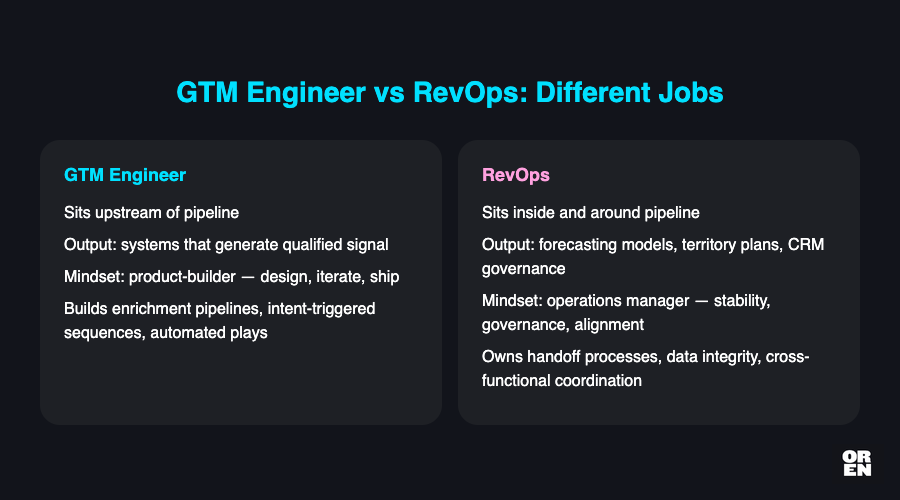
A GTM Engineer sits upstream of pipeline. Their output is a system that generates qualified signal - an enrichment pipeline, an intent-triggered sequence, an automated play that runs while reps sleep.
A RevOps professional sits inside and around pipeline. Their output is a forecasting model, a territory plan, a CRM governance framework, a handoff process between marketing and sales.
Not the same cognitive job.
One requires a product-builder's mindset - systems design, iteration loops, shipping. The other requires an operations manager's mindset - process stability, data governance, cross-functional alignment. Brendan Short, founder of The Signal, identified "8 reasons why GTM Engineer is not just RevOps rebranded" - the distinction has enough structural weight to sustain a list that long.
---
What each role actually ships

The abstraction dissolves when you look at deliverables.
A GTM Engineer ships: a Clay enrichment table that scores inbound leads against ICP fit before they reach a human; a webhook that fires a Slack alert when a target account hits a pricing page 3 times in a week; an automated outbound sequence that personalises at scale using job change signals.
Built artefacts. They did not exist before. They run without ongoing human input.
A RevOps professional ships: a clean Salesforce pipeline with defined stage criteria; a weekly forecast call cadence with a single source of truth; an attribution model the board will accept; a sales-to-CS handoff playbook that reduces churn in the first 90 days.
Governance artefacts. They create order in a system that already exists.
"A GTM Engineer is the builder. They connect systems, automate workflows, and create the technical scaffolding that makes Sales, Marketing, and CS more effective." - Eugene Levi, CEO & Co-Founder, Tabula
"RevOps is the conductor. Their job is to bring order, predictability, and governance to the revenue engine." - Eugene Levi, CEO & Co-Founder, Tabula
One role without the other produces a broken system.
GTM Engineering without RevOps gives you fast-moving infrastructure with no governance - data rot, attribution chaos, pipeline that nobody trusts. RevOps without GTM Engineering gives you a well-governed system generating insufficient pipeline. Companies aligning people, processes, and technology in their demand engine achieve 36% more revenue growth - but that alignment requires both functions, not one doing the other's job. (Apollo.io, 2026)
---
The hiring damage when you conflate them

This is where the semantic debate becomes a commercial problem.
A founder hires a "RevOps person" expecting them to build automated outbound infrastructure. The RevOps hire is excellent at what they do - they clean the CRM, build a forecasting model, document the sales process. Six months later, the founder is frustrated: "we still don't have pipeline." The RevOps hire is equally frustrated: "I was hired to run operations, not build systems from scratch."
Neither party was wrong. The job description was wrong.
The reverse is equally damaging. A company hires a GTM Engineer into a RevOps seat. They ship clever automations, build interesting workflows, iterate constantly. Three months in, the CRM is a mess, the board cannot get a clean forecast, and the VP of Sales does not trust the numbers.
The GTM Engineer was doing their job. The company needed a different job done.
In early-stage companies (sub-£8M ARR), GTM Engineers are typically a first ops engineer hire, reporting directly to a Head of Growth or COO - not into a RevOps function that may not yet exist. (Tabula Blog, 2026) That reporting line is not cosmetic. It signals mandate.
If you are about to hire and you are not certain which problem you have - too little qualified pipeline, or too little order inside existing pipeline - a growth audit will tell you which hire to make first.
The wrong sequencing is the most common and most expensive mistake.
---
One person doing both jobs
At sub-£5M ARR, you probably cannot afford to separate the functions.
One person ends up doing both. That is a legitimate constraint, not a category error - but it requires being explicit about which hat they are wearing and when.
The breaking point is predictable. The builder instinct and the governor instinct are in tension. A person who loves shipping new systems will neglect CRM hygiene. A person who loves process stability will under-invest in experimental infrastructure.
When the company reaches a point where the board demands forecast accuracy AND the pipeline is insufficient, the single-person model collapses.
The trigger for splitting the functions is not headcount or ARR. It is the moment when both problems are simultaneously urgent.
"GTM Engineering is the R&D arm for RevOps. RevOps keeps the trains running; GTM Engineering experiments with how to build faster trains." - Saad Bayezeed
The R&D analogy is exact. Nobody argues that R&D and Operations are the same function because they both work inside the same company. The confusion only persists in GTM because the tooling overlaps and the titles are new.
The GTM architecture problem most B2B SaaS companies face is not a tooling problem - it is a structural one. Buying the same tools as a GTM Engineer does not make a RevOps hire into one, any more than buying Figma makes an operations manager into a product designer.
---
The org design question
"The organizational seat of each role signals its mandate: GTM Engineers to build systems, RevOps to govern processes, and Sales Engineers to close deals." - Eugene Levi, CEO & Co-Founder, Tabula
The roles are complementary. The mistake is treating them as interchangeable.
If you are hiring for pre-pipeline creation - signal detection, enrichment, automated plays, outbound infrastructure - you need a GTM Engineer. If you are hiring for in-pipeline governance - forecast accuracy, CRM integrity, process alignment, attribution - you need RevOps.
Hire for the problem you actually have.
Not the title you have most recently heard.