Growth Hacking Course
Outcome Based Gtm Sprint Measurement
By
June 22, 2026

Boards at £15M - £100M ARR SaaS companies are getting sharper. They're asking what moved. They're getting velocity reports.
Ten campaigns shipped. Eight sprints completed. Prospecting sequences live across 3 segments. That's not a business result. That's a timesheet.
The fix isn't a better reporting template. It's defining what sprint success looks like before the sprint starts - and instrumenting for attribution on day one, not scrambling to reverse-engineer causality at the QBR.
The category error nobody names
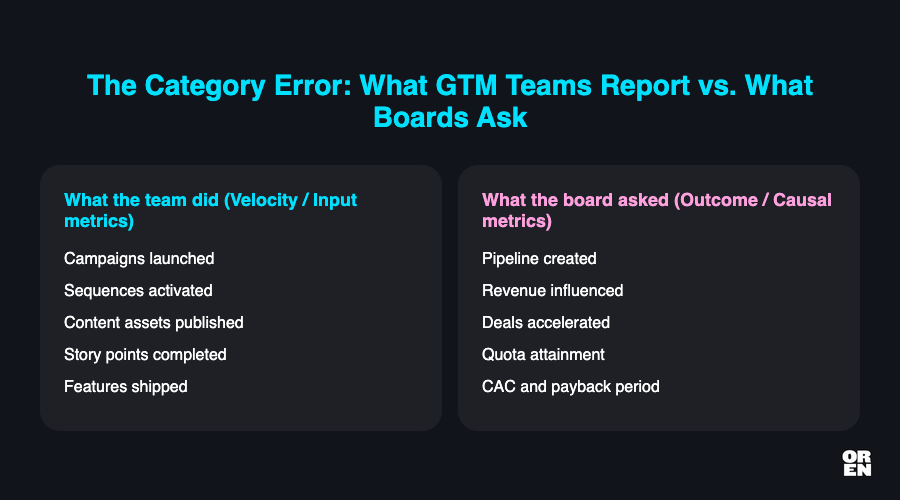
There's a structural confusion embedded in how most B2B SaaS commercial teams talk about GTM sprints, and it goes unnamed because naming it is uncomfortable.
Velocity metrics and outcome metrics aren't 2 points on the same spectrum. They're fundamentally different claims about causality.
When an engineering team reports sprint velocity, they're describing throughput - story points completed, features shipped, bugs closed. That's appropriate because software delivery is the output. When a GTM team borrows the same frame and reports campaigns launched, sequences activated, or content assets published, they're making a category error. Those are inputs to pipeline creation. The board is asking "what did this produce?" and receiving an answer to "what did this team do?"
85% of GTM professionals report frequent struggles with cross-functional misalignment [Mural GTM Alignment Gap Research Study, 2025]. That number usually gets read as a coordination problem. It's also a measurement problem - when different functions are tracking different things and calling all of them "GTM metrics," alignment is structurally impossible because there's no shared definition of what success looks like.
"Most teams are only measuring one fragment of how revenue gets created rather than the full system." - Passetto (Amber Victoria)
Measuring a fragment and presenting it as the whole. That's the gap.
What pipeline-attributed measurement actually requires

Most teams default to activity metrics not out of laziness. It's that pipeline-attributed measurement requires instrumentation decisions made before the sprint begins, not after it ends.
If you can't isolate which pipeline was created by this sprint's activities - versus ambient inbound, versus a deal already in motion - you can't make a causal claim at all. You can only describe correlation, and boards have learned to distrust correlation dressed as causation.
A GTM sprint instrumented for attribution needs 4 things in place on day one.
UTM and source tagging architecture that distinguishes sprint-specific touchpoints from always-on channels. If your sprint is targeting a new segment with a specific content sequence, those touches need to be tagged in a way that survives the journey to CRM opportunity creation.
CRM opportunity fields that capture the originating sprint, the first meaningful engagement date, and the trigger type - not just lead source. The finding is consistent across more than 200 B2B SaaS companies: hand-raisers convert to pipeline at around 27% while scored MQLs convert at less than 2% - a 10x difference in velocity. That gap is invisible unless your CRM distinguishes between the 2 at the opportunity level [Passetto, 2026].
Pipeline stage gates with timestamps so you can measure deal velocity change, not just pipeline created. A sprint that accelerates 12 existing opportunities through a stage is commercially valuable. Without timestamps, it's invisible.
A pre-defined success condition written before the sprint starts. Not "we will run a campaign targeting mid-market CFOs." Something like: "This sprint succeeds if it generates 8 net-new pipeline opportunities attributable to sprint activities within 45 days, with an average deal size above £X." That framing changes every question the team asks during execution.
"You wouldn't build features without testing technical assumptions, so why would you build your GTM strategy without regular market validation?" - Kyle Duffy, Operating Partner at Gradient
Most teams don't define the test condition up front. They ship, then look for evidence of success in whatever data is available. That's not validation. That's rationalisation.
The retrospective nobody is running

Agile-borrowed sprint retrospectives ask: what did we ship, what slowed us down, what do we do differently next time. Fine for engineering. For GTM it's the wrong set of questions entirely.
A pipeline-attributed GTM retrospective asks something different:
Which sprint activities are traceable to net-new pipeline created? Which activities moved existing opportunities - and by how much? Which produced no measurable commercial signal whatsoever? What does that distribution tell us about where to concentrate the next sprint?
The third question is the one teams avoid. Acknowledging that a significant portion of sprint activity produced no commercial signal is uncomfortable. But it's also the highest-value output of the retrospective, because it surfaces the patterns in what doesn't work.
"If you try to capture them on the opportunity after the fact, you're only seeing deals that made it through. You completely miss all the failed attempts, the effort that went nowhere, and the patterns in why things didn't convert." - Passetto (Amber Victoria)
The failure data is the signal. Most teams discard it because they're only logging what succeeded. The consequence is that each sprint inherits the same structural assumptions as the last one, slightly repackaged.
"This is the golden nugget of data that companies overlook which informs why something does not work." - Passetto (Amber Victoria)
Cold prospecting is a specific example. Across B2B SaaS, it takes an average of 7 attempts over 6 months to create an opportunity from a cold lead [Passetto, 2026]. If a sprint is measured over 4 weeks and cold outbound is part of the motion, a sprint-level retrospective will show near-zero pipeline from that channel. The team will either incorrectly conclude the channel doesn't work, or correctly conclude that cold outbound requires a different attribution window. Neither conclusion is reachable without the failure data.
Why boards are starting to notice
The pressure to defend GTM spend at board level has increased materially. Companies with strong GTM strategies achieve 27% higher profits than those without [2026]. Boards are getting more sophisticated about asking what "strong GTM" means in measurable terms.
"We ran 10 sprints and shipped forty campaigns" doesn't satisfy that question.
The board communication problem isn't primarily a slide design problem. It's a causal chain problem. A board wants to see: sprint activities → pipeline created → pipeline converted → revenue contribution. Most commercial teams can show the first and the last, with a gap in the middle filled with narrative rather than data.
This is directly connected to the architecture problem I wrote about in the GTM stack piece. Frankenstacks of disconnected point solutions make attribution structurally difficult because touchpoint data lives in different systems that don't share a common opportunity identifier. The measurement problem is downstream of an architecture problem.
It's also downstream of sequencing. Teams that buy tools and build campaigns before defining what a measurable success condition looks like are executing in the wrong order - a pattern that consistently surfaces in growth audits as the primary reason GTM engines underperform relative to spend.
"At the early stage, you need to iterate on your go-to-market (GTM) as fast, if not faster, than you're iterating on your product." - Kyle Duffy, Operating Partner at Gradient
Iteration requires a feedback loop. A feedback loop requires measurement. Measurement requires instrumentation. Most teams are iterating without a feedback loop, which means they're not iterating at all - they're running successive sprints with the same structural assumptions.
The practical shift
The operational change required is smaller than it sounds. But it requires discipline at the sprint planning stage, not the retrospective stage.
Before a sprint starts, define: the specific pipeline outcome that would constitute success, the attribution mechanism that will isolate sprint-driven activity from ambient pipeline, the CRM fields and tags that need to be in place before any execution begins, and the retrospective format that will evaluate commercial signal rather than deliverable count.
During the sprint, track trigger type at the point of first meaningful engagement. Segment by trigger - hand-raiser versus scored MQL versus cold outreach response versus event-driven - and you can see which are actually creating pipeline and which are creating activity.
"When you segment it this way, you can see which triggers are actually creating pipeline and which ones are just creating activity." - Passetto (Amber Victoria)
At the retrospective, present 3 numbers to the board: pipeline created and attributable to this sprint, pipeline accelerated (existing opportunities that moved a stage), and cost per attributed pipeline £. Everything else is context.
The board question "what moved?" gets a direct answer. "What did we do?" only gets answered if the first question is satisfied first.
This isn't a new methodology. It's the application of outcome-based measurement to a domain that's been borrowing the wrong frame from engineering. The distinction between tracking data and tracking the right metrics changes the nature of every question a team asks - which directly determines the quality of actions taken.
Reporting velocity to a board that asked for outcomes isn't a reporting problem. It's a question-quality problem that compounds sprint over sprint until the board stops trusting the commercial team's read on what's working.
The teams getting this right aren't doing more measurement. They're measuring fewer things, defined earlier, with cleaner causal chains.