Growth Hacking Course
Articles
Stop Copying Your Competitors (Probably the Wrong Ones)
By
January 25, 2026

Last updated: 2026-04-06
Everyone wants to know what their competitors are doing.
Bid on their brand terms. Scrape their LinkedIn followers. Monitor their feature releases. Reverse-engineer their pricing.
I've deployed all of these tactics. Some worked brilliantly. Some were expensive disasters.
The difference wasn't the tactic. It was understanding who your actual competitors are versus who you think they are.
The Tactics That Work (Sometimes)
Let's start with what can actually generate pipeline.
Google Ads on competitor terms. Bidding on your competitors' brand names can work. When it works, it's because someone's actively searching for an alternative. They're already in-market. They know the category.
LinkedIn follower targeting. Scraping followers of competitor company pages and running campaigns against them can work. Same logic. These people have signalled interest in the category.
Signal-based prospecting. Tools that show you when prospects engage with competitor content on social. That's intent data. That's useful.
But the thing is, I've seen all of these fail spectacularly too.
Why The Same Tactic Works for One Company and Fails for Another
We had a client bidding on competitor brand terms. The competitors they were targeting were ten to fifty times larger. More market share. More brand recognition. More revenue. More everything.
It was expensive. And it didn't convert.
Then they shifted to bidding on competitors similar to their own size. Companies at a comparable stage. Similar positioning. Overlapping customer base.
It worked.
The difference? Perceived competitors versus actual competitors.

Who you think you're competing with and who the market thinks you're competing with are often completely different things.
The Delusion Trap
I had a client who genuinely believed he was competing with Stripe.
Stripe was generating billions. His company was doing low single-digit millions. Not even close to the same scale.
But in his head? Direct competitors.
Every time Stripe updated something in their design, he'd get wound up. "I had that idea first." As if Stripe's product team was somehow watching his roadmap.
It's ludicrous. But it's more common than you'd think.
Founders confuse where they want to be with where they actually are. They pick aspirational competitors instead of actual ones. Then they waste budget trying to punch above their weight in markets where they have no credibility.
The market doesn't care about your ambitions. The market cares about what problems you solve and for whom.
The Echo Chamber Effect
The second trap is arguably worse than the first.
When you obsess over competitors, you start copying them. Their messaging. Their positioning. Their features.
I've worked in categories where you could visit ten competitor websites and genuinely struggle to tell them apart. Same hero copy. Same feature grids. Same enterprise-y stock photos. Same "AI-powered" badges.
Everyone's following everyone else. Nobody's differentiating.

The irony is that mimicking the category leader almost never works. First movers in a category capture around forty to fifty percent of the market. Second place gets maybe twenty-five percent. After that, it drops off dramatically.
The probability of toppling an established category leader is tiny. Less than fifteen percent in most studies.
So when you copy the leader's playbook, you're not competing with them. You're just making them look more legitimate by comparison. You're reinforcing their position as the category definition.
Winning Matches vs Winning the Game
The tension is real.
Competitor tactics can work. Bidding on similar-sized competitor terms, targeting their followers, monitoring their moves - these things can generate pipeline. They can close deals. They can contribute to revenue.
But they're tactical wins. You're winning matches.
Strategic differentiation is how you win the game.
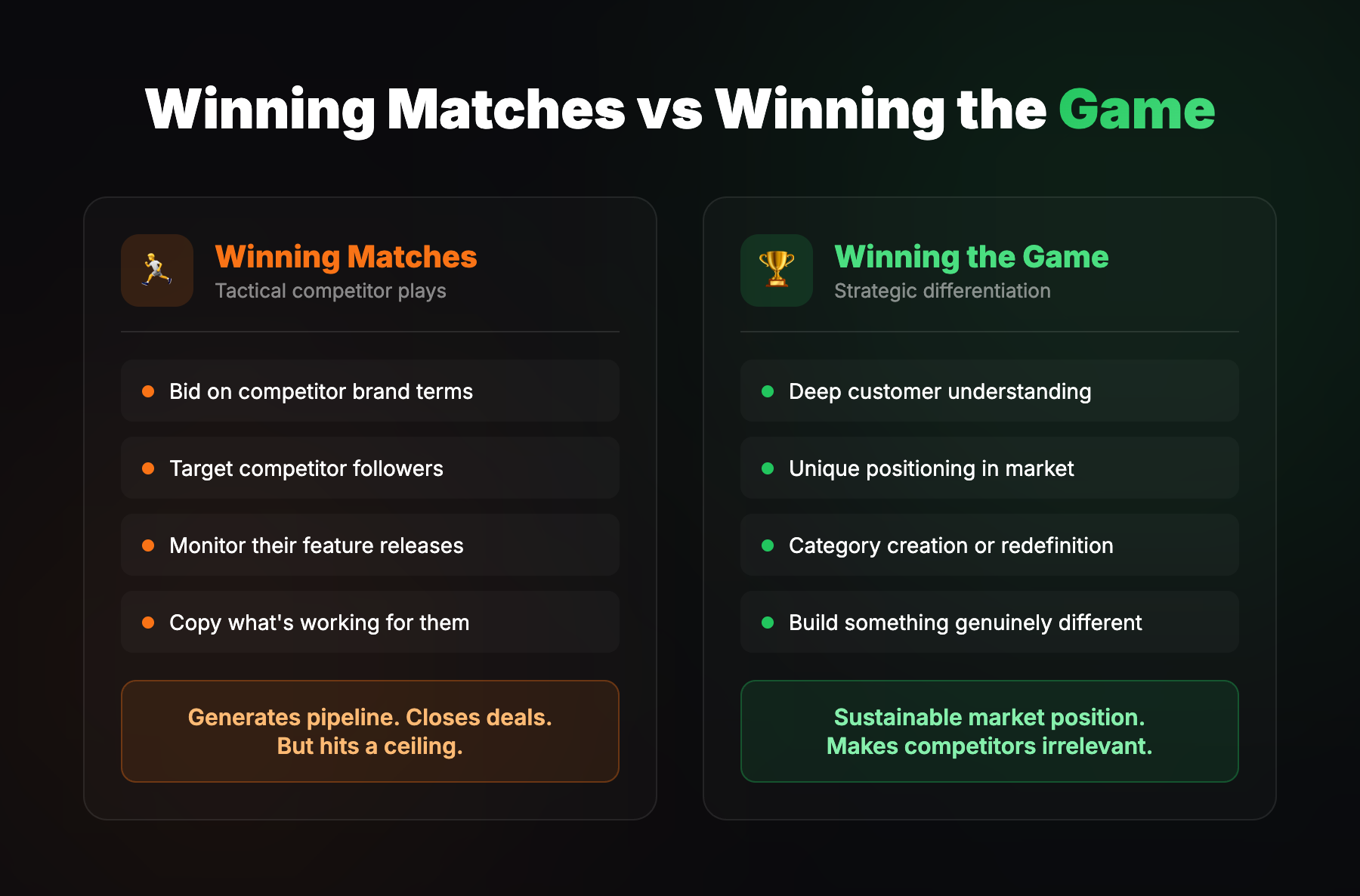
If you're so busy tracking what competitors are doing that you forget to build something genuinely different, you'll hit a ceiling. You'll become just another option in a crowded category. Interchangeable. Commoditised.
And when that happens, you compete on price. Which is a race to the bottom.
The Paradox Nobody Wants to Hear
The best way to compete isn't to obsess over competitors.
It's to obsess over customers.
Competitors tell you what the market looks like today. Customers tell you what the market needs tomorrow.
When you deeply understand your customers - their problems, their language, their buying process - you can position against something more powerful than a competitor. You can position against the status quo. Against the old way of doing things. Against the pain they're living with.
That's differentiation that actually sticks.
A Balanced Approach
I'm not saying ignore competitors. That's naive.
You need to know what they're doing. You need to track feature releases, pricing changes, messaging shifts. You need competitive intelligence.
But you need to hold it loosely.
Track competitors, but don't follow them. Understand the landscape, but carve out your own space.
Use competitor tactics selectively. Bid on terms where you actually compete. Target audiences where you have credibility. Don't waste budget on aspirational positioning.
Test and validate. These tactics work for some companies and fail for others. The only way to know is to run small tests and measure results.
Keep differentiation sacred. Every time you copy a competitor's messaging, you dilute your positioning. Every time you chase their features, you lose focus on what makes you different.
The Uncomfortable Questions
Before you run that competitor campaign, ask yourself:
Are these our actual competitors? Or are we flattering ourselves with aspirational comparisons?
Would a prospect realistically consider us alongside them? Or are we playing in different leagues?
What happens if this works? Do we win customers who are a good fit, or do we attract people expecting something we can't deliver?
Are we differentiated enough to win? Or are we just another option that looks like everyone else?
If you can't answer these honestly, the tactic will probably fail.
The Bottom Line
Competitor tactics can generate revenue. They're worth testing. But they're not a strategy.
Strategy is understanding who you actually compete with - not who you wish you competed with.
Strategy is building differentiation that matters - not copying what's already working for someone else.
Strategy is knowing your customers so well that you can create a category of one.
The companies that win long-term aren't the ones who are best at copying competitors. They're the ones who make competitors irrelevant.
That's harder. It takes more conviction. It requires saying no to obvious opportunities.
But it's the only way to win the game, not just the occasional match.
Frequently Asked Questions
Should B2B SaaS companies bid on competitor brand terms in Google Ads?
It depends entirely on which competitors you're targeting. I've seen it work brilliantly when you bid on companies at a comparable stage - similar size, overlapping customer base, same market positioning. But bidding on competitors ten to fifty times your size? Expensive disaster, nearly every time. The market needs to realistically consider you alongside them for it to convert.
How do you identify your actual competitors versus aspirational ones?
Ask yourself one question: would a prospect realistically shortlist you alongside this company? If the answer involves any wishful thinking, they're aspirational, not actual. Your real competitors are the ones your prospects are genuinely evaluating in the same buying process. Sales call recordings are gold for this - listen to who prospects mention, not who your founder wants to be compared to.
Why does copying a category leader's strategy backfire?
First movers capture around forty to fifty percent of a category. When you mimic them, you're not competing - you're reinforcing their position as the category definition. You end up looking like a lesser version of them rather than a distinct alternative. The companies that win long-term don't copy the leader's playbook. They make it irrelevant by positioning against the status quo, not against another vendor.
What's the difference between competitive intelligence and competitor obsession?
Competitive intelligence means tracking feature releases, pricing changes, and messaging shifts so you understand the landscape. Competitor obsession means letting those signals dictate your own roadmap and positioning. The first is healthy. The second leads to an echo chamber where everyone in a category ends up looking identical. Hold competitive intelligence loosely - it informs but shouldn't drive your strategy.
How should companies balance competitor tactics with strategic differentiation?
Use competitor tactics selectively where you have genuine overlap, but keep differentiation sacred. That means running small tests on competitor targeting to see what actually converts for your specific business, while investing the bulk of your energy in understanding customers deeply enough to build something genuinely different. Every time you copy a competitor's messaging, you dilute what makes you unique.