Growth Hacking Course
Is Your Organisation Actually Ready for Agentic GTM - or Just Ready to Buy It?

Last updated: 2026-06-07
Key Takeaways
- Agentic GTM fails at the organisational layer, not the technical one - most companies are attempting to automate processes that have never been defined, using data that nobody owns.
- The 3 structural prerequisites are process definition, data hygiene, and cross-functional alignment on what "good" looks like - stack selection is irrelevant until all 3 are in place.
- Nearly half of vendor-provided agents fail to meet performance promises without proper governance and data maturity (Apollo.io Insights, 2026).
- Core CRM fields should be populated on 80%+ of records before any agent deployment is attempted (Arise GTM Blog, 2026).
- The diagnostic sequence matters more than the tech decision: assess process clarity first, data ownership second, alignment third - then, and only then, evaluate tooling.
---
What does agentic GTM readiness actually mean?

Agentic GTM readiness is the degree to which your revenue organisation's processes, data, and cross-functional alignment are structured well enough for autonomous AI agents to execute reliably without creating expensive downstream errors.
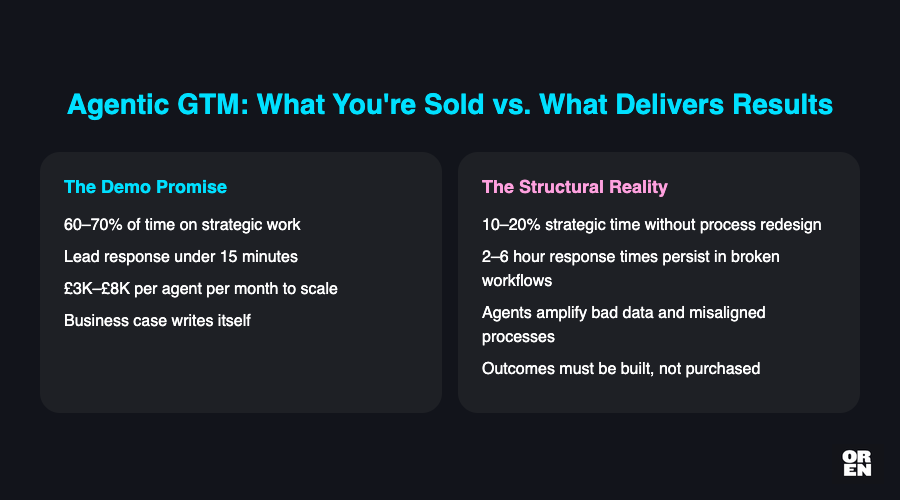
A vendor has shown you a compelling demo. The numbers look transformative. Traditional teams dedicate only 10-20% of their time to strategic work - agentic teams reportedly hit 60-70% (Arise GTM Blog, 2026). Lead response times drop from 2-6 hours to under 15 minutes (Arise GTM Blog, 2026). The cost to scale with traditional headcount runs £50K-£80K per FTE versus £3K-£8K per agent per month (Arise GTM Blog, 2026). The business case practically writes itself.
But those numbers are outputs from organisations that did the structural work first.
They are not outcomes you can purchase.
"The tools are smarter. The operating model is the same." - Paul Sullivan, Arise GTM
That gap - between smarter tools and an unchanged operating model - is precisely where agentic GTM projects go to die. And it's not a technology gap. It's a structural one.
---
Why do most agentic GTM implementations fail?

Companies are trying to automate processes that were never defined, using data that nobody owns, across teams that don't agree on what success looks like.
76% of organisations are either deploying agentic AI or actively implementing it (RevSure/Ascend2, 2026). Yet 96% of leaders believe AI agents with full-funnel context would significantly improve execution (RevSure/Ascend2, 2026).
That second number tells you something important.
If the execution were already working, near-universal belief that full-funnel context would help wouldn't exist. It would be the experience of the majority. It isn't.
The structural failure modes are specific and diagnosable.
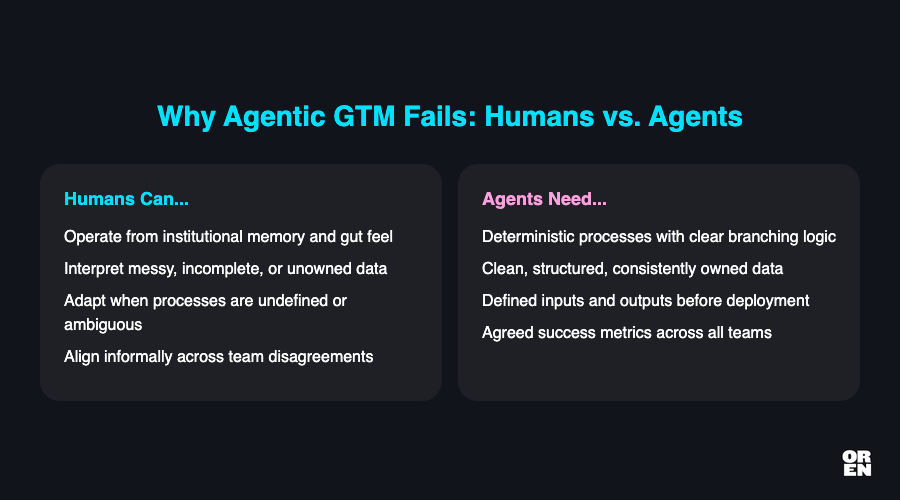
Undefined processes. An agent needs a deterministic process to follow. Branching logic, clear inputs, defined outputs. Most GTM processes exist as institutional memory - inside the heads of your best AEs, your most experienced SDR, the RevOps manager who's been there since the beginning. Hand that to an agent and you're not automating a process. You're asking the agent to invent one. Which it will do inconsistently, and at scale.
Dirty or unowned data. Agents don't interpret a mess the way humans do. As the RevSure team puts it:
"AI can't 'feel its way through' fragmented execution. Humans can. Humans can interpret a mess and still operate. Agents need structure." - RevSure Team
A RevOps manager currently spends 30% of their time on CRM hygiene alone (Arise GTM Blog, 2026). That time is a continuous patching operation on a data foundation that was never built properly. Agents fed from that foundation will replicate and accelerate its errors. Core CRM fields need to be populated on 80%+ of records before effective agent deployment is possible (Arise GTM Blog, 2026). Most companies commissioning agentic builds today are nowhere near that threshold.
Cross-functional disagreement on ground truth. Put your Sales, Marketing, and RevOps leads in a room. Ask them to define a qualified lead. Time how long before they disagree. That disagreement - about ICP, pipeline stage definitions, what constitutes a conversion - isn't a communication problem. It's a governance problem. Agents don't negotiate. They execute against whichever definition they were given, making the disagreement invisible until the pipeline numbers stop making sense.
"The companies that struggle most with AI adoption aren't struggling because they picked the wrong software. They're struggling because their processes are fragmented, their data is a mess, and their oversight structures were never designed with autonomous systems in mind." - Alan Cecil and Kristen Oshiro, BPM
---
What are the 3 structural prerequisites for agentic GTM?

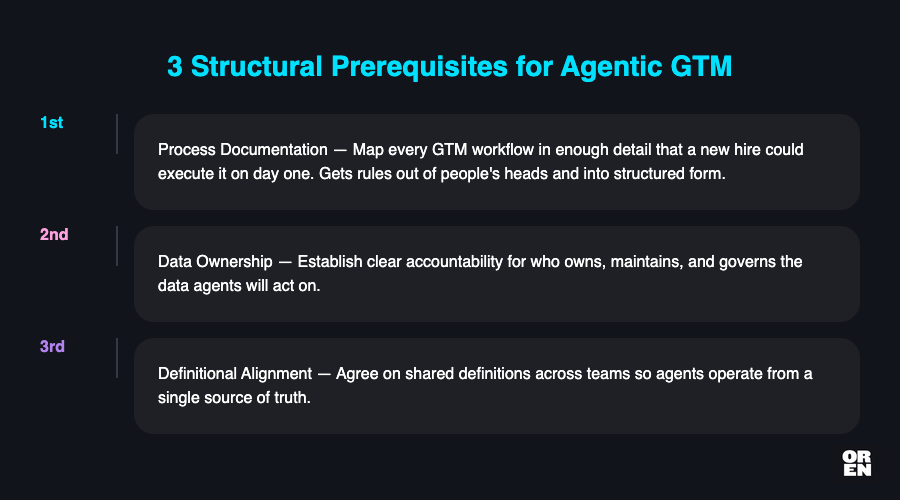
Process documentation, data ownership, and definitional alignment - in that order, because each one depends on the previous.
This isn't a checklist to complete once and file. It's a diagnostic sequence that tells you where your failure risk actually lives before you spend a pound on tooling or an hour briefing a vendor.
Prerequisite 1: Process documentation
You can't automate what you can't describe.
Before any agent is deployed, every GTM workflow that agent will touch needs to be written down in enough detail that a new hire with no context could execute it correctly on day one.
This exercise has value regardless of whether you ever deploy agents. As Paul Sullivan at Arise GTM observes:
"The process documentation exercise you do before deploying agents is valuable regardless of whether you deploy agents. It forces clarity about how your revenue operations actually works and usually reveals inefficiencies that exist purely because nobody ever wrote down the official process."
The documentation process will surface something uncomfortable. Many of your highest-leverage workflows aren't repeatable processes. They're skilled judgements made by experienced people who've never been asked to articulate the rules they follow. Getting those rules out of people's heads and into structured documentation is the hardest part of building agentic systems. Not the architecture. Not the stack selection.
Worth sitting with that.
Traditional revenue team members already spend 50-70% of their time on execution work that doesn't require their expertise (Arise GTM Blog, 2026). The goal of agentic GTM is to redirect that time toward judgement-intensive work that genuinely requires human expertise. But you can't make that distinction until you've mapped which parts of the work are routine and which parts require tacit knowledge.
Prerequisite 2: Data ownership
Every data object an agent will read from or write to needs a named owner. A person who is accountable for its accuracy, its definition, and its governance. Not a team. A person.
This is where the political dimension of agentic readiness becomes unavoidable.
Data ownership disputes between Sales, Marketing, and RevOps are endemic in mid-market B2B SaaS. They persist because, in a human-operated system, ambiguity is tolerable - people negotiate, escalate, work around it. In an agent-operated system, ambiguity is a defect. The agent makes a decision based on whatever it finds, and it makes that decision thousands of times before anyone notices the pattern.
The data readiness question isn't "is our data clean enough?" It's "do we have named owners for every data object, agreed definitions for every field, and a process for resolving conflicts when the data contradicts itself?" If the answer to any part of that is no, you're not ready to deploy agents against that data.
Prerequisite 3: Definitional alignment
The third prerequisite is the one most companies skip entirely. Because it requires cross-functional negotiation rather than technical work.
Before agents are deployed, your GTM leadership needs written, agreed definitions for:
| Definition | Why it matters for agents |
|---|---|
| Ideal Customer Profile | Determines which prospects agents pursue and which they discard |
| Marketing Qualified Lead | Controls the volume and quality of leads agents hand to sales |
| Sales Qualified Lead | Sets the threshold for agent-triggered sales engagement |
| Pipeline stage criteria | Defines when agents move, stall, or escalate opportunities |
| Conversion event | Determines what agents optimise toward |
Without these agreed and documented, different agents - or the same agent across different contexts - will execute against different assumptions. The result isn't just inefficiency. It's a system that's actively misleading you about your pipeline health.
"This isn't a software upgrade. It's a structural shift in how revenue operations get done." - Paul Sullivan, Arise GTM
---
How do you diagnose where your readiness gap actually is?
Run this diagnostic sequence before you engage any vendor or commission any build.
Step 1: Process audit. Pick your 5 highest-volume GTM workflows. Ask the people who run them to document each one in enough detail that an agent could follow it. Where they can't - where the answer is "it depends" or "we use judgement" - you've found an undefined process. That's your first failure risk.
Step 2: Data ownership audit. For each data object those workflows touch, identify the named owner. No named owner, or more than one person claiming ownership, means a governance gap. Check field population rates on your core CRM objects. Below 80% on critical fields means a data quality problem that will corrupt agent outputs from day one.
Step 3: Alignment audit. Bring your Sales, Marketing, and RevOps leads together. Ask each person, independently, to write down the definition of your ICP, your MQL, and your SQL. Compare the answers. Where they diverge, you've got an alignment gap that agents will execute against at scale.
The output is a ranked view of your failure risk: process-layer, data-layer, or alignment-layer. That ranking - not your vendor shortlist - should determine where your first investment goes.
This is consistent with what a growth audit surfaces more broadly. Growth engines underperform because companies execute in the wrong order, buying tools and hiring people before the structural foundations are in place. Same pattern plays out in agentic GTM, just with higher velocity and higher cost.
---
What does "ready" actually look like in practice?
A company that's genuinely ready for agentic GTM doesn't necessarily have the most sophisticated stack.
It has 3 things: documented processes, owned data, and agreed definitions.
"Most revenue teams are running a 2015 operating model with 2026 tools." - Paul Sullivan, Arise GTM
Readiness looks like a RevOps function that's moved beyond CRM hygiene as a full-time occupation. It looks like a single, written ICP that Sales and Marketing have both signed off on. It looks like pipeline stage criteria that are enforced consistently, not negotiated deal by deal. It looks like a CRM where 80%+ of core fields are populated not because someone is manually cleaning it, but because the data entry process makes incomplete records structurally difficult.
It also looks like leadership that's engaged directly with the operational reality of agentic systems - not just reviewed vendor presentations. Leaders who delegate the entire evaluation to a technical team, without understanding what agents can and cannot do, aren't positioned to make the governance decisions that agentic deployment requires. The GTM architecture problem isn't solved by buying better tools. It's solved by leaders who understand the system well enough to redesign it.
The companies getting results with agentic GTM - lower error rates, faster response times, better strategic focus - invested in the structural layer first. The error rate on repetitive tasks drops from 8-12% with traditional teams to under 2% by month 3 with agentic teams (Arise GTM Blog, 2026). But that improvement assumes agents were deployed against clean data and defined processes. Deploy against a broken foundation and you get 2% error rates on a process that was wrong to begin with.
Deloitte projects that 50% of companies using generative AI will have piloted agent-based automation by 2027 (Deloitte, 2026). The question isn't whether your organisation will eventually engage with agentic GTM. The question is whether you'll be in the half that gets results, or the half that runs an expensive pilot and concludes the technology "wasn't ready."
The technology is ready.
The question is whether you are.
"The most successful teams treat agents as teammates: who are trained, monitored, and assigned meaningful work." - Swetha Sirupa
If you're at the stage of evaluating vendors or scoping a build, it's worth pausing to run the diagnostic sequence above before any commercial conversation. The AI Advisory work I do with GTM teams almost always starts here - not with stack selection, but with an honest assessment of whether the structural prerequisites are in place. What that assessment surfaces is what determines whether an agentic build will deliver value or just surface existing dysfunction faster.
---
Frequently Asked Questions
What is the single biggest reason agentic GTM projects fail?
Undefined processes handed to agents that have no choice but to invent their own logic. When a workflow has never been documented - when it exists only as institutional knowledge in the heads of experienced team members - an agent can't execute it consistently. It will make decisions based on whatever signals it can find, and it will make them at scale before anyone identifies the pattern. Process documentation is the prerequisite most companies skip because it's unglamorous, and it's the reason most pilots underdeliver.
How clean does our CRM data need to be before we can deploy agents?
Core CRM fields should be populated on 80%+ of records as a baseline for effective agent deployment (Arise GTM Blog, 2026). Below that threshold, agents are making decisions based on incomplete information, and the errors compound quickly. More important than the percentage, though, is data ownership: every field an agent reads from or writes to needs a named human owner who is accountable for its accuracy. Without ownership, data quality deteriorates the moment the cleaning sprint ends.
Should we resolve our internal alignment issues before or during the agentic build?
Before. Cross-functional disagreements about ICP, lead definitions, and pipeline stage criteria aren't problems that a build process will resolve - they're problems that a build process will embed into your agent logic and execute against at scale. The alignment work needs to happen at the leadership level, with written and agreed definitions, before any technical scoping begins. Running both in parallel is a common mistake that results in agents built against one team's assumptions being rejected by another.
What is the difference between agentic GTM readiness and general AI readiness?
General AI readiness typically covers tool access, training, and governance frameworks. Agentic GTM readiness is more specific: it's about whether your revenue operations are structured well enough for autonomous agents to execute GTM workflows reliably. You can be broadly AI-ready - licences deployed, training completed, policies in place - and still be entirely unready for agentic GTM if your processes are undocumented and your data is unowned. The SaaSpocalypse article covers why the hype around AI disruption often obscures the structural requirements that actually determine outcomes.
How long does it take to reach agentic GTM readiness from a standing start?
It depends entirely on which layer your gap is in. A data quality problem with clear ownership can be addressed in 6-12 weeks with focused effort. A process documentation gap across 5-10 core workflows typically takes 4-8 weeks if the right people are made available. An alignment gap - where Sales, Marketing, and RevOps have genuinely different views of the ICP and funnel definitions - can take 3-6 months if the leadership team hasn't previously been forced to reach written agreement. Most companies have gaps at all 3 layers, which means the realistic timeline to genuine readiness is 6-12 months, not the 4-6 weeks that vendor implementation timelines typically suggest.
---
[AUTHOR_BIO]