Growth Hacking Course
Are You Paying for Intent Data You Already Own?
By
June 17, 2026

Last updated: 2026-06-17
Key Takeaways
- Most B2B SaaS companies are paying for third-party intent subscriptions while sitting on richer, more accurate first-party signal data they have never engineered into their GTM motion.
- Third-party intent data is a proxy for buying behaviour - not a substitute for it. It tells you someone read an article; your product tells you someone used a feature 12 times this week.
- First-party signal GTM requires infrastructure built with a product mindset - shipped in sprints, measured on outcomes - not configured once by a RevOps team and left to decay.
- A single signal is never sufficient justification for outreach. Overlapping, validated signals are what separate strategic GTM from expensive noise.
- Companies that build first-party signal capture infrastructure stop renting someone else's behavioural data and start owning a compounding GTM asset.
---
What is first-party signal GTM and why does it matter right now?
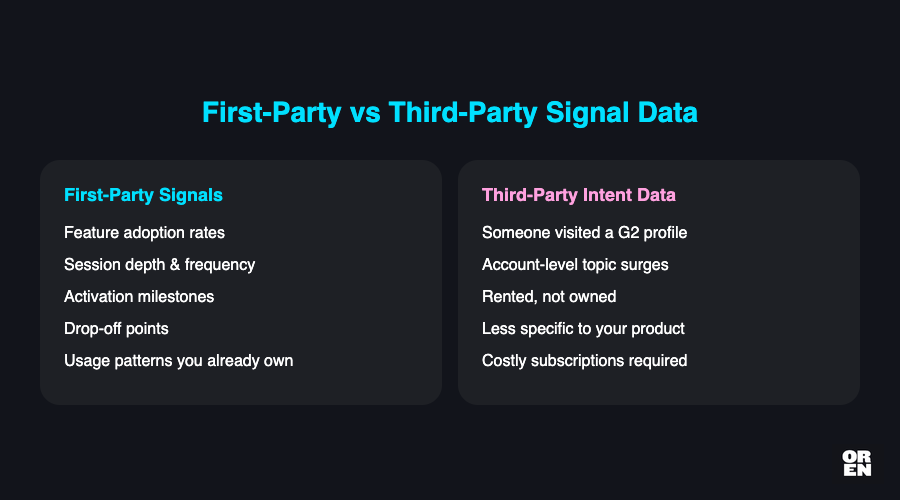
First-party signal GTM is the practice of capturing behavioural data generated by your own product, website, and customer interactions - then engineering that data into the triggers, plays, and sequences that drive your go-to-market motion.
It matters now because the data you already own is almost always more predictive than the data you're paying to rent.
Most B2B SaaS companies are running 2 parallel systems that have never been connected.
On one side: a product generating thousands of behavioural events every day - feature adoption rates, session depth, activation milestones, usage frequency, drop-off points. On the other: a commercial team paying for third-party intent subscriptions that tell them someone at a target account visited a competitor's G2 profile.
The irony is that the product data is richer, more specific, and more predictive of actual buying intent.
It just hasn't been engineered into anything useful.
This isn't a data problem. It's an infrastructure problem - and it's solvable.
---
Why is third-party intent data so widely used if it is less accurate?
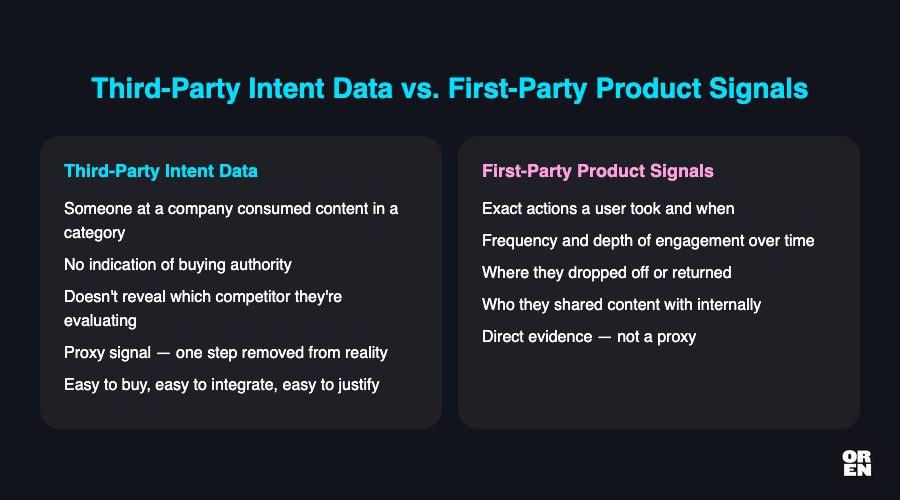
Because it's easy to buy and easy to justify.
It arrives pre-packaged, integrates with existing CRM and marketing automation platforms, and gives commercial teams something that looks like signal without requiring any internal engineering work.
The gap in how this topic gets covered is telling. Most content ranking for 'first-party signal GTM' focuses on cookie deprecation as the forcing function, then pivots to connecting CRM data to ad platforms. That framing misses the deeper issue entirely.
Cookie deprecation is a compliance problem. What we're talking about is a GTM architecture problem. Those require different solutions.
The honest case against third-party intent data isn't that it's worthless. It's that it's a proxy.
It tells you someone at a company consumed content in a category. It doesn't tell you whether that person has authority to buy, whether your product solves their specific problem, or whether they're evaluating you or your competitor.
Your product telemetry, by contrast, tells you exactly what a user did, when they did it, how often they returned, and where they stopped.
That's not a proxy. That's evidence.
But acting on any single signal - first-party or third-party - is still not enough. A user hitting a paywall once isn't a buying signal. A user hitting a paywall 6 times in a fortnight, sharing a report with 3 colleagues, then landing on your pricing page is a very different conversation.
The signal is in the overlap, not in any individual data point.
As I've written in The Concentric Circle Approach to Signal-Based GTM, the companies that win with signal-based GTM start with their warmest audiences - existing customers showing expansion signals, active users approaching limits, churned accounts re-engaging - not cold prospects who read a blog post.
---
What does first-party signal infrastructure actually look like?
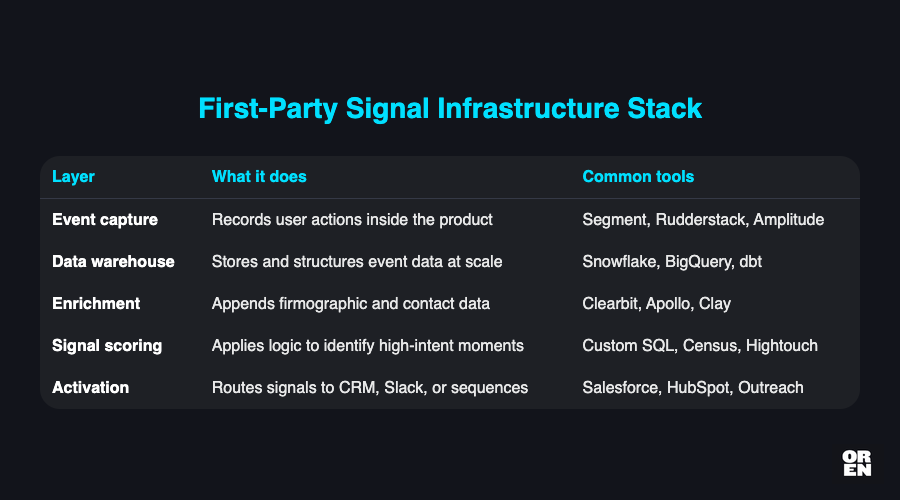
It's the combination of event capture, data routing, enrichment, and activation logic that transforms raw product and behavioural data into GTM plays.
Not a single tool. An engineered system.
The components that matter:
Event capture
- What it does: Records user actions inside the product
- Common tools: Segment, Rudderstack, Amplitude
Data warehouse
- What it does: Stores and structures event data at scale
- Common tools: Snowflake, BigQuery, dbt
Enrichment
- What it does: Appends firmographic and contact data
- Common tools: Clearbit, Apollo, Clay
Signal scoring
- What it does: Applies logic to identify high-intent moments
- Common tools: Custom SQL, Census, Hightouch
Activation
- What it does: Routes signals to CRM, Slack, or sequences
- Common tools: Salesforce, HubSpot, Outreach
The failure mode most companies hit is buying tools at every layer without connecting them.
You end up with what I've called a GTM stack that's an expensive mess - each platform doing its job in isolation while the commercial team keeps working from gut feel and third-party intent subscriptions, because the internal data never surfaces anywhere actionable.
The fix isn't buying more tools.
It's treating GTM infrastructure the way engineering teams treat product infrastructure - built and shipped in sprints, with defined outcomes, tested against real conversion data, and iterated on when the results don't hold.
A RevOps team that configures a platform once and maintains it as a service function isn't the same thing as a team that ships signal infrastructure as a product.
---
How do you validate which first-party signals actually predict revenue?
You trace them backwards through closed-won data.
Not by assuming a behavioural event is meaningful because it feels relevant.
This is where most signal strategies fail before they start. A team spots a product event - say, a user exporting data for the first time - and immediately builds an outreach sequence triggered by that event. The assumption is that export behaviour signals intent to buy.
That assumption may be right. It may also be completely wrong.
Without validation against actual customer journey data, you're automating noise at scale.
The validation process is straightforward in principle, harder in practice:
- Pull your closed-won accounts from the last 12-24 months.
- Map their product behaviour in the 30, 60, and 90 days before conversion.
- Identify which events cluster consistently before purchase - not occasionally, consistently.
- Cross-reference against accounts that showed the same events but didn't convert, to control for false positives.
- Only then build GTM plays around the events that survive that filter.
This matters especially for ICP construction. Most ICPs are built at the deal level without controlling for correlated variables - what looks like 3 independent buying signals often turns out to be 3 proxies for a single underlying dimension like company size or funding stage.
External enrichment data is essential for surfacing the signals that are genuinely predictive versus the ones that are just correlated with the accounts you happened to close.
---
What does a validated first-party signal play look like in practice?
It combines multiple overlapping signals, routes them to the right human at the right moment, and opens with value delivery - not a pitch.
A concrete example. A mid-market B2B SaaS company has product telemetry showing:
- A user at a target account has hit the team collaboration limit 4 times in 10 days
- 2 additional users from the same domain registered free accounts in the same period
- The account owner visited the pricing page twice but didn't initiate an upgrade
Each of those signals alone is interesting. Together, they're a genuine buying moment.
The right play isn't an automated sequence firing an "I noticed you've been using our product" email. The right play is a sales rep or CSM reaching out with something genuinely useful - a case study from a similar company that solved the same scaling problem, or an offer to walk through the team plan with no pressure attached.
The commercial conversation emerges from that. It's not the opening move.
That's the difference between signal-based GTM and signal-triggered spam. The signal tells you when and why to reach out. It doesn't write the outreach for you, and it doesn't replace the judgement call about what that person actually needs to hear.
For companies earlier in the journey - particularly founder-led businesses where the founder is still owning commercial decisions - the sequencing question is critical. A growth audit will almost always surface the same finding: companies are executing in the wrong order, activating outreach before they've validated what signals actually precede a close.
---
How does first-party signal GTM interact with product-led growth?
It's the infrastructure layer that makes PLG commercially viable at scale.
PLG as an acquisition model works. PLG as a complete revenue strategy doesn't - every company celebrated for PLG hypergrowth built substantial sales operations running alongside the product motion. As I've argued in Product-Led Growth: The Narrative vs. The Numbers, the real model is that the product creates demand and surfaces intent, while sales converts it.
First-party signal infrastructure is the connective tissue between those 2 functions.
Without it, PLG companies hit a specific failure mode: free users activate, engage, and hit limits - but no one in the commercial team knows it's happening in time to act. The product is generating buying signals continuously.
They're just not going anywhere.
With first-party signal infrastructure in place, every meaningful product event becomes a potential commercial trigger - routed to the right person, enriched with firmographic context, and prioritised by the overlap of signals that have been validated against actual conversion data.
The product stops being a black box for the revenue team and becomes the most reliable signal source they have.
---
Frequently Asked Questions
What is the difference between first-party data and first-party signals?
First-party data is the raw information your company collects directly - product events, CRM records, website visits, support tickets. First-party signals are the patterns within that data that have been validated as predictive of a specific commercial outcome. Data is the input. Signals are what you engineer from it. Most companies have plenty of the former and almost none of the latter.
Do we need a data engineering team to build first-party signal infrastructure?
Not necessarily, but you do need someone who can think about GTM infrastructure with a product mindset - defining outcomes, building in sprints, and measuring against conversion data rather than activity metrics. Modern tooling (Segment, Census, Hightouch, Clay) has reduced the technical barrier significantly. The harder requirement is strategic: knowing which signals to chase before you build anything.
How long does it take to see results from first-party signal GTM?
The validation phase - tracing signals back through closed-won data - typically takes 4 to 8 weeks if your data is reasonably clean. The first activated plays can go live within a sprint or 2 after that. Meaningful conversion data from those plays usually takes another 60 to 90 days to accumulate. Companies that try to compress this timeline by skipping validation tend to automate noise rather than signal.
Should we cancel our third-party intent subscriptions?
Not immediately, and possibly not at all. Third-party intent data can be useful as a supplementary layer - particularly for identifying accounts in a buying cycle that haven't yet engaged with your product. The issue is using it as a primary signal source when you have richer first-party data available and unengineered. The goal is to make first-party signals the foundation and use third-party data to fill gaps, not the reverse.
What is the biggest mistake companies make when starting with first-party signal GTM?
Building outreach sequences before validating which signals actually predict revenue. The temptation is to identify a plausible product event, wire it to a sales sequence, and call it signal-based GTM. Without validation against closed-won data, you're automating assumptions. The infrastructure comes second. The validation work comes first.
---
[AUTHOR_BIO]


