Growth Hacking Course
Is Your AI GTM Strategy Fixing a Real Problem - or Just Accelerating a Broken One?
Last updated: 2026-05-26
Key Takeaways
- AI does not create a go-to-market strategy - it executes one, and if the underlying strategy is flawed, AI will make it fail faster and more expensively.
- Before layering AI onto your GTM motion, you need 3 prerequisites in place: precise ICP definition, differentiated positioning, and channel-market fit.
- GTM is increasingly an engineering problem - requiring testable hypotheses, instrumentation, and feedback loops, not intuition and playbooks.
- Companies using advanced AI strategies gain 5X revenue growth, 89% higher profits, and 2.5X greater valuation - but only when AI is applied to a sound foundation ([ZoomInfo Go-to-Market Intelligence Report, 2025]).
- The most dangerous GTM failure mode right now is not failing to adopt AI - it is adopting AI before your strategy can survive scrutiny.
---
What does AI GTM strategy actually mean - and what does it not mean?
AI GTM strategy is the deliberate application of artificial intelligence across your go-to-market motion - pipeline generation, buyer engagement, revenue operations - coordinated by a single strategic logic, not a pile of disconnected tools.
It does not mean handing your sales team an AI writing assistant and calling it transformation.
It does not mean automating outbound sequences that were already underperforming.
And it does not mean deploying agents across marketing, sales, and customer success without first working out what those functions are supposed to achieve together.
"If my approach to an AI transformation is to give all of my employees access to ChatGPT... you're probably going to be let down." - Kyle Colan, CopyAI
Most content on AI-powered GTM treats this as a tooling and workflow problem. Pick the right platforms, connect your data, deploy your agents, measure your efficiency gains. That framing is not wrong - but it is dangerously incomplete.
It assumes the underlying strategy is sound.
For most founder-led B2B SaaS companies at the 10-200 employee stage, that assumption does not hold.
---
Why does AI expose strategic weakness rather than compensate for it?
AI accelerates execution. That is its primary value in a GTM context.
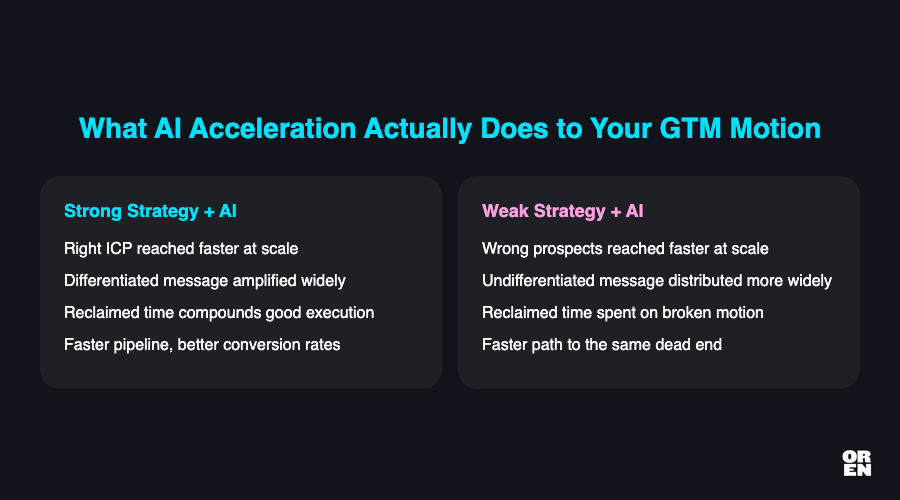
The problem is that acceleration is directionally neutral. It makes good strategy compound faster. And it makes bad strategy fail faster and more expensively.
Think about what AI actually does when applied to outbound. It enriches contact data at scale, personalises sequences across thousands of prospects simultaneously, and optimises send timing based on engagement signals.
If your ICP is wrong - if you are targeting the wrong company profile, the wrong buyer persona, or the wrong pain point - AI does not correct that.
It just ensures you reach more of the wrong people, faster, with better-crafted messages they still do not care about.
Sales teams already waste 70% of their time on admin work ([Salesforce State of the Connected Customer]). AI can reclaim a big chunk of that. But reclaimed time spent executing a broken motion is not a win - it is a more efficient route to the same dead end.
The same logic applies to content and demand generation. Buyers now complete 70% of their research before they ever speak to a sales rep ([WBResearch]). That means your positioning, your messaging, and your content have to do enormous strategic work before any human conversation begins.
If your positioning is undifferentiated - if you sound like every other tool in your category - AI-generated content at scale will simply distribute that undifferentiated message more widely.
"AI is NOT the golden ticket solution many are making it out to be." - Clay University, AI-Powered GTM Automation Course
---
What does strategic readiness actually look like before you apply AI?
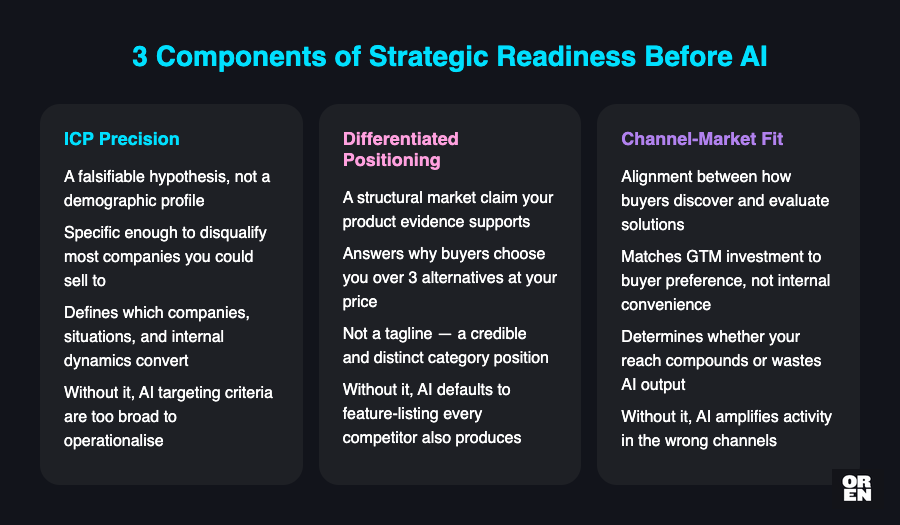
Strategic readiness has 3 structural components. These are not philosophical prerequisites - they are practical requirements that determine whether AI will compound your advantage or compound your dysfunction.
1. ICP precision
A precise ICP is not a demographic profile.
It is a falsifiable hypothesis about which companies, in which situations, with which internal dynamics, will buy your product, expand their usage, and refer others. Specific enough to disqualify the majority of companies you could theoretically sell to.
If your ICP is "mid-market SaaS companies," that is not an ICP - it is a market segment. AI cannot make targeting decisions on your behalf when the targeting criteria are too broad to operationalise.
2. Differentiated positioning
Differentiated positioning means your product occupies a category position that is both credible and distinct. It answers the question: why would a buyer who is already evaluating 3 alternatives choose you, and why would they pay your price to do so?
Positioning is not a tagline.
It is a structural claim about the market that your product evidence supports. Without it, AI-generated personalisation has nothing meaningful to personalise around - it defaults to feature-listing and social proof, which every competitor is also producing.
3. Channel-market fit
Channel-market fit is the alignment between how your buyers prefer to discover and evaluate solutions and how you are investing your GTM resources.
A product with strong PLG signals being pushed through an enterprise outbound motion is a channel-market fit problem. AI cannot resolve that misalignment - it can only make the misaligned motion more active.
"A true AI-driven GTM strategy rebuilds your entire revenue engine around unified intelligence. It creates a central system that connects all your GTM data, outlines opportunities across the full buyer journey, and automatically coordinates every team's response." - Emir Atli, CRO at HockeyStack
The operative word there is 'rebuilds.' You cannot rebuild around intelligence you do not have. And you cannot unify data that reflects a fragmented strategic reality.
---
Why is GTM now an engineering problem - and what does that mean in practice?
The framing of GTM as an engineering problem is not a metaphor. It is a structural shift in how go-to-market motions are built, tested, and iterated.
Engineering thinking applied to GTM means:
| Traditional GTM thinking | GTM engineering thinking |
|---|---|
| Intuition-driven ICP selection | Hypothesis-driven ICP with falsifiability criteria |
| Playbooks as fixed processes | Playbooks as versioned, testable experiments |
| Quarterly strategy reviews | Continuous instrumentation and feedback loops |
| Siloed team metrics (MQL, pipeline, NRR) | Unified revenue model with leading indicators |
| AI as a tool layer | AI as an execution layer within a designed system |
"Many go to market people and myself included have been somewhat conditioned to think about the world of go to market through the siloed lens of what we were raised through or what we got exposure to." - Kyle Colan, CopyAI
That siloed conditioning is exactly what makes GTM engineering hard to adopt.
Founders who come from product or engineering backgrounds often find this framing intuitive - they already think in systems, feedback loops, and instrumentation. The challenge is applying that thinking to a domain that has historically rewarded relationship-building and gut feel over measurement and iteration.
Companies that adopt AI-powered automation reduce operational costs by 20-30% while improving efficiency by more than 40% ([McKinsey via ARDEM, 2026]). Those numbers reflect what happens when AI is applied to a system designed to receive it - not when it is bolted onto a legacy motion.
The data layer is where engineering thinking becomes non-negotiable. 42% of surveyed go-to-market professionals said indecisive buyers are their toughest challenge ([ZoomInfo LinkedIn Audience Survey, 2025]).
Indecision is often a symptom of unclear positioning and poor qualification - problems that show up in the data before they show up in the pipeline. A GTM system built with engineering rigour surfaces those signals early. A traditional GTM motion surfaces them at the end of a lost deal.
"When you have messy data, you have ineffective AI agents." - Kris Billmaier, EVP and GM, Sales Cloud and Growth, Salesforce
---
How do you stress-test your GTM strategy before you automate it?
Before investing further in AI tooling, run your current GTM motion through 4 diagnostic questions. These are designed to surface the structural problems that AI will amplify if left unaddressed.
1. Can you articulate your ICP in falsifiable terms?
Write down the specific firmographic, technographic, and situational criteria that define your best-fit customer. Then identify the criteria that would disqualify a company that superficially resembles that profile. If you cannot disqualify, your ICP is not precise enough to automate against.
2. Is your positioning differentiated by evidence or by aspiration?
List the 3 claims your positioning makes about your product. For each claim, identify the customer evidence that supports it. If the evidence is thin or generic, your positioning is aspirational - and AI will scale that aspiration into noise.
3. Do your GTM metrics form a coherent model?
Map your current metrics from top-of-funnel to expansion revenue. Identify where the model breaks - where conversion rates are unexplained, where leading indicators do not predict lagging ones. Those breaks are the points where AI will produce the most misleading signals if you automate before fixing them.
4. Are your GTM teams operating from a unified revenue model or from siloed targets?
If marketing is optimising for MQLs, sales for new ARR, and customer success for NRR in isolation, AI coordination will surface the dysfunction rather than resolve it. Unification has to precede automation.
"If you can unify all that and ensure that your go to market engine really is humming as one then you're going to make that experience a lot better for your buyers and that's going to make your company much more profitable." - Kyle Colan, CopyAI
The unification Kyle describes is not a technical achievement - it is a strategic one.
The technology follows the design, not the other way around.
---
What is the right role for AI once your strategy is sound?
Once the strategic foundation is in place, AI's role becomes genuinely transformative rather than superficially impressive.
It operates as an execution layer that removes the friction between strategic intent and buyer experience.
Specifically, AI earns its place in a sound GTM motion by:
- Enriching and qualifying accounts against a precise ICP at a scale no human team can match
- Personalising outreach and content at the individual buyer level, drawing on unified data rather than generic signals
- Surfacing buying intent signals earlier in the research cycle - critical given that buyers complete 70% of their research before engaging ([WBResearch])
- Coordinating cross-functional responses to buyer behaviour in real time, replacing the lag that exists between marketing signals and sales action
- Generating the 'good enough' content - follow-up sequences, meeting summaries, objection responses - that frees human energy for the work that genuinely requires strategic judgment
"AI is not about replacing human creativity or strategic thinking for our best work. What it's doing is producing good-enough work orders of magnitude faster." - Clay University, AI-Powered GTM Automation Course
"With AI handling the 'good,' human energy must shift to finding and creating the great." - Clay University, AI-Powered GTM Automation Course
The companies achieving 5X revenue growth and 89% higher profits from advanced AI strategies ([ZoomInfo Go-to-Market Intelligence Report, 2025]) are not doing so because they adopted AI earlier than their competitors.
They are doing so because they applied AI to a motion that was already designed to scale.
---
Frequently Asked Questions
What is an AI GTM strategy?
An AI GTM strategy is a go-to-market approach in which artificial intelligence is integrated across the full revenue motion - pipeline generation, buyer engagement, and customer expansion - within a unified strategic system. It is distinct from simply using AI tools in individual functions. The defining characteristic is that AI operates from a shared data layer and a coherent strategic logic, rather than as a collection of disconnected automations.
Can AI fix a broken go-to-market strategy?
No. AI accelerates execution, which means it compounds both the strengths and the weaknesses of the strategy it is executing. A broken GTM motion - one with an imprecise ICP, undifferentiated positioning, or poor channel-market fit - will fail faster and more expensively when AI is applied to it. The strategic foundation must be sound before automation adds value.
What should a B2B SaaS founder do before investing in AI GTM tools?
Audit the 3 structural prerequisites: ICP precision, differentiated positioning, and channel-market fit. Run the 4 diagnostic questions outlined above to identify where your current motion has breaks. Resolve those breaks at the strategic level before selecting or expanding your AI tooling. The sequence matters - strategy first, then system design, then automation.
How is GTM engineering different from traditional go-to-market?
GTM engineering applies systems thinking to revenue operations - treating GTM as a designed system with testable hypotheses, instrumentation, feedback loops, and versioned processes rather than a set of playbooks driven by intuition and experience. It is particularly well-suited to founder-led B2B SaaS companies where the founding team already thinks in product and engineering terms and can apply that rigour to commercial motion.
What results can a B2B SaaS company realistically expect from an AI GTM strategy?
Results vary significantly based on strategic readiness. Companies that apply AI to a sound, unified GTM motion report 5X revenue growth, 89% higher profits, and 2.5X greater valuation compared to peers ([ZoomInfo Go-to-Market Intelligence Report, 2025]). Companies that apply AI to a fragmented or underdeveloped motion typically report efficiency gains in isolated functions without corresponding revenue impact - and often discover that AI has surfaced strategic problems that were previously masked by slower execution.
---
[AUTHOR_BIO]