Growth Hacking Course
Your Vendor Intent Score Was Never Trained on Your Pipeline
By
June 18, 2026

Last updated: 2026-06-18
Vendor intent scores are built on aggregate behavioural data from thousands of companies.
They have no knowledge of your ICP, your sales cycle, or which signals actually preceded closed-won deals in your CRM.
79% of B2B leads never convert to sales, and poor scoring is one of the most cited causes [Cognism, 2026].
The fix is not a better vendor. It is a model trained on your own closed-won and closed-lost data.
---
The vendor model knows nothing about your deals
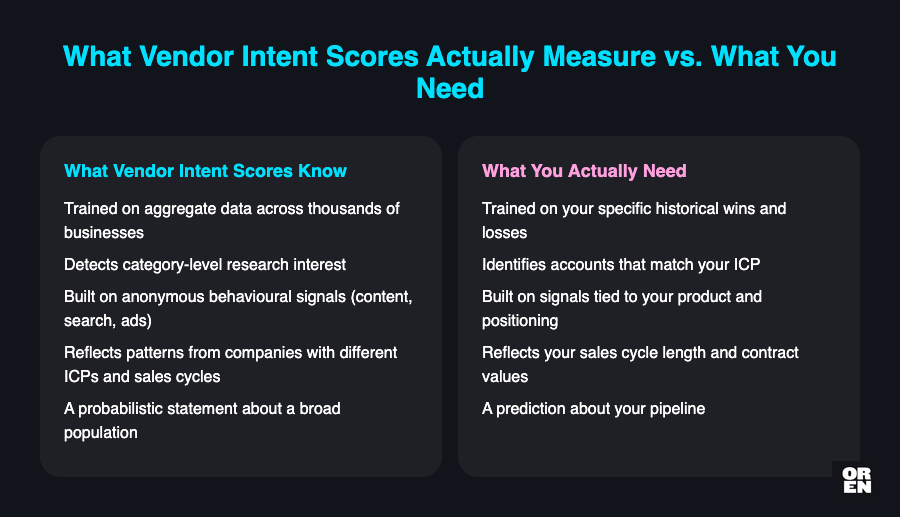
Third-party intent platforms are trained on aggregate, anonymised signals pooled across thousands of companies.
That data has no visibility into your ICP definition, your average sales cycle length, or the specific combination of signals that preceded your last 50 closed-won deals.
"Most lead and account scores miss out on key buying signals. Even worse, they leave sales reps in the dark about why an opportunity is 'good' or 'bad' in the first place." - Common Room Playbook
This is not a configuration problem. It is an epistemological one.
A vendor score is a proxy built on someone else's pipeline reality. When it fails to correlate with your revenue, that is the expected outcome - not a bug.
80% of B2B buyers initiate first contact only after completing 70% of their purchasing journey [Salespanel, 2025].
If your scoring model cannot identify where a buyer is in that journey relative to your specific product and sales motion, the score is decorative.
---
What custom signal scoring actually means

Custom signal scoring means using your own historical CRM data - closed-won records, closed-lost records, deal velocity, firmographic attributes, engagement sequences - as the training set for a predictive model.
Instead of asking a vendor what a high-intent account looks like in aggregate, you ask your own pipeline what it looked like in the 90 days before your last 40 deals closed.
The features that matter vary significantly by company.
A funding round announcement may be a strong signal for a compliance SaaS targeting Series B companies. It may be irrelevant noise for a mid-market HR platform. A pricing page visit may predict conversion in a short-cycle product and mean almost nothing in a 9-month enterprise deal.
Vendor models cannot know this. Your closed-won data can.
This is the core argument for a custom GTM build over off-the-shelf intent scoring: the signal weights should reflect your pipeline reality, not an aggregate benchmark. (For a broader look at why most GTM stacks fail at the architecture level before scoring is even introduced, this piece on GTM architecture problems is worth reading first.)
---
The compounding advantage
A custom model is not a one-time build. It is an asset that retrains on new pipeline outcomes as your GTM matures.
Every closed deal - won or lost - adds signal fidelity. Vendor intent scores remain static relative to your specific context. Your model improves with your business.
Companies that implement lead scoring well see up to a 77% increase in lead generation ROI [Belkins / LLCBuddy, 2026]. One team reallocated 40% of SDR time away from dead-end leads to high-potential contacts without a single new hire.
The compounding effect is not just predictive accuracy. It is sales capacity recovered without headcount cost.
Reaching out within 5 minutes of an MQL trigger is 100x more effective than waiting just 30 minutes [The Small Business Expo, 2026].
A model that surfaces the right account at the right moment - based on signals that actually correlate with your revenue - makes that timing advantage accessible. A generic intent score that fires on irrelevant behavioural proxies wastes it.
---
The org problem is harder than the technical one
The hardest part of building a custom scoring model is not the data engineering.
It is getting your commercial team to articulate what a good deal actually looked like before it was obviously good. What did the account do in week 3 of the sales cycle? Which firmographic combinations closed fastest? Which engagement sequences preceded stalled deals?
This tacit knowledge lives in the heads of your best sales reps and your most experienced AEs. Extracting it into a structured feature set is a knowledge problem, not a tooling problem.
"Salespeople are forever seeing whales in every lead and generally terrible at spotting tire-kickers." - McGaw.io
Predictive lead scoring disciplines that optimism.
It replaces "I have a good feeling about this one" with a model trained on the deals where that feeling was right - and the ones where it was not.
71% of organisations are now using generative AI in their sales and marketing workflows [McKinsey, 2026]. Most are applying it to content and outreach.
Very few are applying it to the underlying scoring logic that determines which accounts get worked at all. That is where the leverage is.
---
What to bring to the board conversation
A vendor intent score is a black-box dependency.
When a board member or CFO asks why pipeline is soft, "our intent data provider's model scored these accounts highly" is not an answer that survives scrutiny.
A custom signal scoring model built on your own historical data is auditable. You can show which features carry the most weight, how the model was trained, what the precision and recall looked like on held-out deals, and how it has improved over successive retraining cycles.
That is a conversation about a proprietary commercial asset - not a vendor contract renewal.
"A CRM score that sales ignores is not a score. It is a number no one asked for." - Pintel.AI
The test is simple: can your sales team explain, in plain terms, why a given account has the score it has?
If not, the model is not working for them. Custom signal scoring built transparently on your own pipeline data passes that test. Most vendor scores do not.
For teams who have the signal infrastructure but are not yet prioritising warm audiences correctly, the concentric circle approach to signal-based GTM addresses sequencing before you scale outbound.
---
This is not a small project - do it anyway
AI GTM engineering at this level requires CRM data extraction, feature engineering, model selection, and a feedback loop tied to actual pipeline outcomes.
Not a weekend build.
But the upfront cost amortises across every sales cycle that follows. And the alternative - renewing a vendor score you cannot explain or defend - compounds in the wrong direction.
If your current intent score is not correlated with your pipeline, the problem is not the vendor's execution. It is that the model was never trained on your data in the first place.
Build the one that was.