Growth Hacking Course
GTM Engineer vs RevOps: The Line Most Org Charts Draw Wrong
By
June 18, 2026

Last updated: 2026-06-18
The confusion isn't about titles.
It's about where pre-pipeline work stops and in-pipeline work starts.
Most B2B SaaS companies draw that boundary at the wrong stage, then wonder why neither function performs.
The debate is a distraction
LinkedIn has spent 2 years arguing about whether GTM Engineering is RevOps with Python skills, or RevOps is a collection of glorified spreadsheet jockeys.
Neither framing is useful.
"The real transformation happening right now isn't about title inflation - it's about a fundamental shift in how we approach revenue operations." - Spencer Tahil, Business Consultant & Fractional Marketing Operations Director
The structural question - where does one function's mandate end and the other's begin - is the one nobody is answering.
Every article defines the roles.
None of them draw the line.
Two different positions in the value chain
Think about this sequentially, not hierarchically.
"GTM Engineering is the R&D arm for RevOps. RevOps keeps the trains running; GTM Engineering experiments with how to build faster trains." - Saad Bayezeed
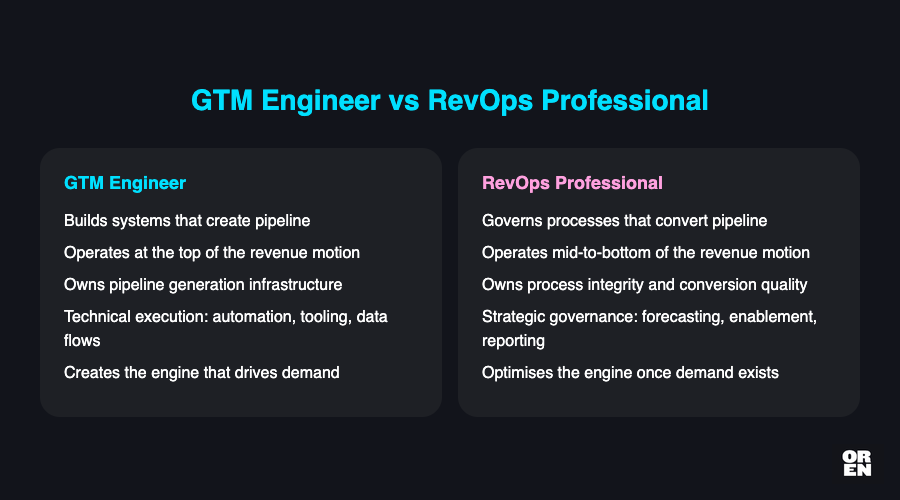
GTM Engineers work upstream.
They build the systems that surface buying signals, enrich data, automate outbound sequences, and route qualified accounts into pipeline.
Their output is pipeline entry.
RevOps works downstream.
They govern what happens to that pipeline once it exists - stage progression, conversion rates, forecast accuracy, tooling governance.
"The organizational seat of each role signals its mandate: GTM Engineers to build systems, RevOps to govern processes, and Sales Engineers to close deals." - Eugene Levi, CEO & Co-Founder, Tabula.io
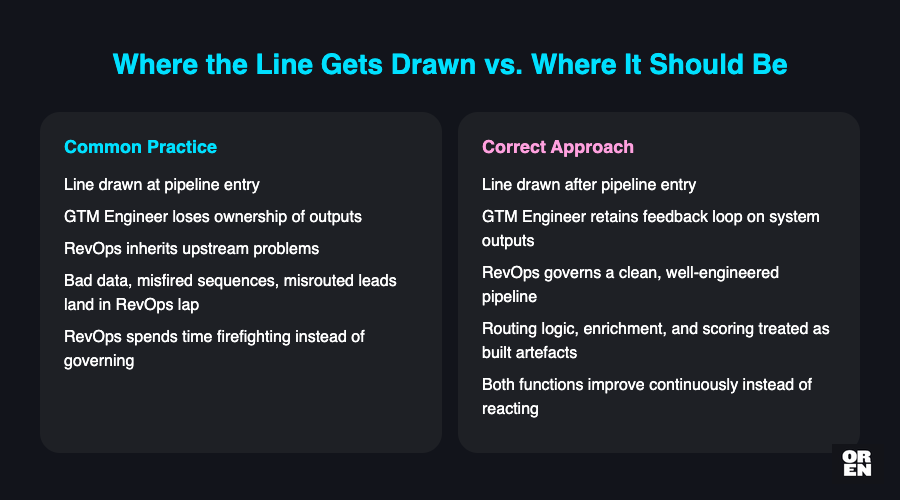
The moment a company treats pipeline entry as an operational concern rather than an engineering concern, it has drawn the line in the wrong place.
GTM Engineers own everything up to and including the moment a qualified account enters a sales motion.
RevOps owns everything after.
What breaks when the boundary is wrong
The failure mode is predictable.
A company hires a RevOps manager first, loads them with both system-building and process-governance work, then wonders why neither gets done properly.
Or they hire a GTM Engineer without clear handoff criteria, and that person rebuilds infrastructure RevOps already maintains - creating 2 versions of the same workflow with no single owner.
One documented case makes the cost concrete: a flawed lead routing system caused an SDR to quit within 90 days, resulting in $385,000 in lost pipeline [Revenue Operations Alliance, 2025].
That is not a RevOps failure or a GTM Engineering failure in isolation.
It is a boundary failure.
The routing system was built by one function and governed by neither.
By contrast, companies that implement a systems-first approach with clear ownership see 42% faster sales cycles, 37% higher response rates, and SDR turnover dropping from 25% to zero [Revenue Operations Alliance, 2025].
The variable is not headcount.
It is structural clarity about who owns what and when.
The org chart problem nobody is fixing
Most B2B SaaS companies at the 50-500 person stage make one of 2 mistakes.
They either hire RevOps first and ask that person to do GTM Engineering work they were never scoped or compensated for - RevOps managers earn an average of $97,749 annually versus $131,000-$180,000+ for GTM Engineers [Databar.ai, 2025].
Or they hire a GTM Engineer into a team with no RevOps governance, and the systems they build have no operational owner once they ship.
In early-stage companies below $10M ARR, a GTM Engineer typically reports to a Head of Growth or COO as a first ops-engineering hire [Tabula.io, 2026].
That is sensible sequencing.
The error comes when the company scales past that stage and never separates the 2 mandates.
One person accountable for both building and running means neither gets full attention.
The diagnostic is straightforward.
Ask your current team: who owns the decision to change how an account enters pipeline?
If the answer is unclear - or if the same person owns that decision and owns forecast reporting - the boundary is wrong.
The data readiness problem underneath both roles
Neither function performs well on dirty data.
Automating GTM workflows before achieving clean data, defined processes, and a validated ICP is one of the primary reasons commercial AI pilots fail.
The GTM Engineer cannot build reliable signal-capture systems on a CRM with no consistent account ownership.
RevOps cannot produce accurate forecasts from a pipeline populated by inconsistent routing logic.
This is why a growth audit so often surfaces structural problems that were invisible to the people inside the org.
The tooling looks fine.
The headcount looks reasonable.
The problem is sequencing and ownership - specifically, who was responsible for data integrity before the automation was switched on.
The same logic applies to GTM architecture more broadly.
As I've argued elsewhere, the failure of most B2B sales motions is not a tooling problem.
It is an architecture problem.
GTM Engineering and RevOps are both architectural decisions, and drawing the boundary between them incorrectly is as damaging as buying the wrong stack.
RevOps is not threatened by GTM Engineering
Companies that invest in RevOps see 36% more revenue growth [Databar.ai, 2025].
That number does not go down when you add a GTM Engineer.
It goes up - because the RevOps function finally has clean, consistently generated pipeline to govern.
"We're moving away from sales-led growth toward operations-led growth. Features can be copied; unique operational processes are the real differentiator." - Saad Bayezeed
The 2 functions are not competing for the same budget or the same mandate.
They are sequential owners of different stages in the same revenue motion.
Companies that treat them as competing titles will keep hiring one to do the job of both.
And keep wondering why the pipeline is inconsistent.
Where to draw the line
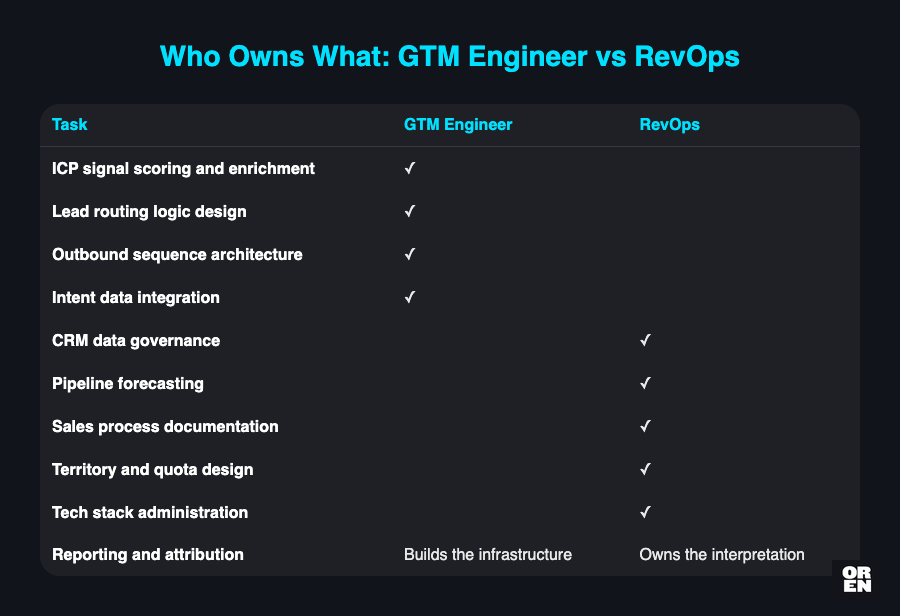
GTM Engineers own the work that creates pipeline entry.
RevOps owns the work that governs pipeline progression.
If your org chart has one person doing both, you do not have role overlap.
You have an unfilled role.
Decide which one it is, then hire or restructure accordingly.
If you are not sure which boundary you have drawn, that is your answer.