Trusted by over 68k marketers (LinkedIn & TikTok)

Thank you! Your submission has been received!
Oops! Something went wrong while submitting the form.

© Copyright 2025. All rights reserved

What Is GTM Engineering - and Why Is It a System, Not a Hire?

By
Oren Greenberg
May 28, 2026

Last updated: 2026-05-26

Key Takeaways

  • GTM engineering is an organisational capability built around measurable systems - not a job title to recruit for or a playbook to copy.
  • The discipline sits at the intersection of data enrichment, scoring logic, automation workflows, and activation - each layer with defined inputs, outputs, and failure modes.
  • Code matters: SQL or Python appears in roughly 38% of GTM engineer job postings (ZoomInfo Pipeline, 2025), which means the discipline has a technical floor most companies are ignoring.
  • GTM engineering job listings grew roughly 205% between 2024 and 2025 (Bloomberry, 2025), yet most organisations are still treating it as a single hire rather than a repeatable system.
  • 95% of organisations are getting zero measurable P&L impact from their generative AI pilots (MIT NANDA, 2025) - the same pattern will repeat in GTM if automation is layered on top of broken data and undefined metrics.

---

What does GTM engineering actually mean?

GTM engineering is the practice of building, measuring, and iterating on the technical systems that convert market signals into revenue pipeline - combining data enrichment, scoring models, automation logic, and activation workflows into a single engineered stack.

"GTM engineering automates sales and marketing workflows using AI, data, and systems thinking, turning buyer intent into real pipeline." - Factors.ai

The term itself is recent.

As next play documents, "Clay formulated 'GTM engineering' in 2023 in an internal Slack discussion about how to describe the AI-meets-automation-meets-GTM wizardry that their team was doing." (next play, 2025). The label stuck because it named something that was already happening at high-performing B2B companies: the convergence of sales strategy and technical execution into a single, measurable loop.

What most definitions miss is the system framing.

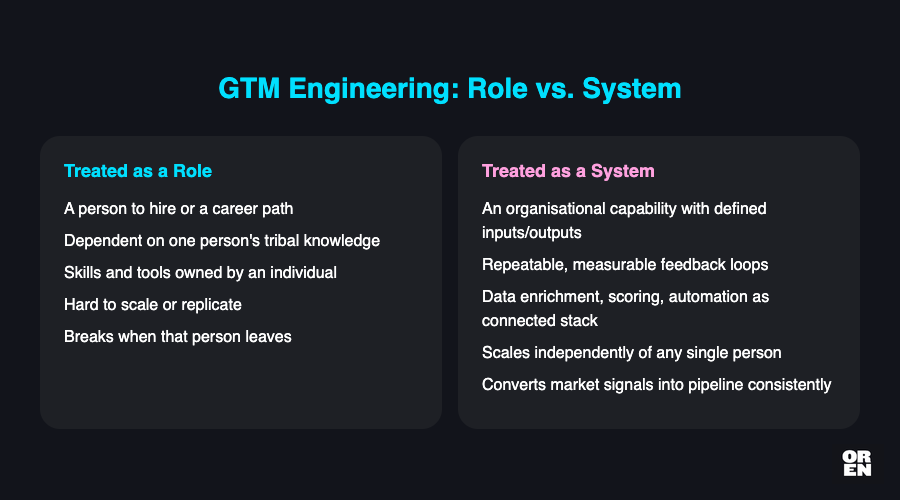
Every article in the top 10 search results describes GTM engineering as a role - a person to hire, a career to pursue, a skill set to develop. Almost none of them describe it as an organisational capability with defined inputs, outputs, and feedback loops.

That distinction is not semantic. It determines whether your GTM motion is repeatable or entirely dependent on one person's tribal knowledge.

---

How is GTM engineering different from RevOps?

GTM engineering builds new systems from scratch. RevOps optimises systems that already exist.

The 2 disciplines are complementary but not interchangeable, and conflating them is one of the most common structural mistakes founder-led SaaS teams make.

"Where Revenue Operations (RevOps) manages and optimizes what already exists, GTM engineering builds what's missing." - Florin Tatulea, GTM Engineer in Residence at ZoomInfo
"RevOps improves the output. GTM engineers build the machine." - Florin Tatulea, GTM Engineer in Residence at ZoomInfo

The practical difference shows up in the questions each function asks:

| Dimension | RevOps | GTM Engineering |

|---|---|---|

| Primary question | Why is conversion dropping? | What signals predict conversion? |

| Primary input | CRM data, pipeline reports | Intent data, enrichment APIs, behavioural signals |

| Primary output | Process improvement, reporting | New workflows, scoring models, automation logic |

| Failure mode | Slow iteration on existing flows | Building automation on bad data |

| Code requirement | Low (mostly config) | Medium to high (SQL, Python, webhooks) |

| Metric ownership | Win rate, cycle length, forecast accuracy | Signal-to-pipeline rate, workflow yield, automation coverage |

The historical predecessor to GTM engineering is the growth engineer.

As HyperGrowth Partners describes it: "Growth engineers were the technical counterpart to growth marketers - building technical solutions to solve GTM use cases in an efficient and scalable manner." (HyperGrowth Partners, 2025). What changed is the accessibility of the tooling: "Suddenly, you could do the advanced work of a growth engineer with just a few lines of code - and you could actually code the rest by just prompting ChatGPT." (HyperGrowth Partners, 2025).

That accessibility is precisely what makes the discipline easy to misapply.

---

What does a GTM engineering system actually look like?

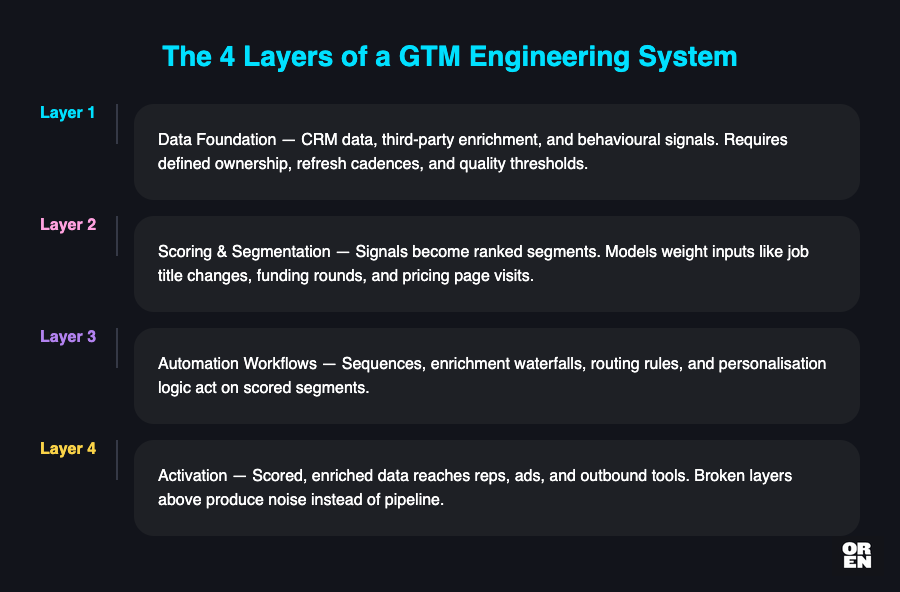
A mature GTM engineering system has 4 distinct layers - data, scoring, automation, and activation - each with its own logic, dependencies, and failure modes.

When any layer is broken, the layers above it produce noise rather than pipeline.

Layer 1 - Data foundation

This is the enrichment layer: the combination of first-party CRM data, third-party enrichment (firmographics, technographics, contact data), and behavioural signals (intent, web visits, product usage). Most companies use over 100 SaaS apps across the business (GTM Monday, 2025), which means data is fragmented by default. Before any automation is built, the data layer needs defined ownership, refresh cadences, and quality thresholds.

"Teams are automating chaos rather than fixing the data underneath it." - Florin Tatulea, GTM Engineer in Residence at ZoomInfo

Layer 2 - Scoring and segmentation logic

This is where signals become segments. A scoring model assigns weight to data inputs - job title change, funding round, technology stack, visit to pricing page - and produces a ranked list of accounts or contacts. The model is only as reliable as the data feeding it and must be validated against closed-won data on a defined cadence.

Layer 3 - Automation workflows

This is the execution layer: the sequences, enrichment waterfalls, routing rules, and personalisation logic that act on scored segments. This is where code becomes meaningful. SQL-based segmentation, Python scripts for custom enrichment, and API integrations between tools are not optional at scale. SQL or Python appears in roughly 38% of GTM engineer job postings (ZoomInfo Pipeline, 2025), which signals that the no-code layer alone does not cover the full surface area of the discipline.

Layer 4 - Activation and measurement

This is the output layer: the actual outreach, ad targeting, or sales trigger that reaches a prospect. It is also where most GTM engineering measurement stops - which is the wrong place to stop. The relevant metrics are upstream: signal-to-pipeline conversion rate, workflow yield per segment, and automation coverage ratio.

The compounding effect of a well-built stack is real. One documented case reduced cost-per-lead from $250 to $25 using programmatic ad suppression built in Clay (The GTM Engineer by Clay, 2025) - a 90% reduction driven entirely by better data logic at the targeting layer, not by changing the ad creative.

---

What breaks when GTM engineering is treated as a playbook or a single hire?

GTM engineering fails in predictable ways when it is treated as a template to copy or a person to recruit rather than a system to build.

Understanding these failure modes is more operationally useful than any list of tools.

Failure mode 1 - Playbook copying without data parity

A workflow built for a company with 3 years of clean CRM data, a validated ICP, and a mature enrichment stack will not transfer to a company with 18 months of inconsistent data and no scoring model. The automation layer is the visible part. The data layer is the load-bearing part. Copying the automation without the data foundation produces high-volume noise, not pipeline.

Failure mode 2 - Single-hire dependency

The market framing of GTM engineering as a job title encourages founders to make one hire and expect the system to appear. GTM engineering job listings grew roughly 205% between 2024 and 2025 (Bloomberry, 2025), and median compensation sits around $127,500 per year, with senior practitioners clearing $180,000 to $220,000 including equity (ZoomInfo Pipeline, 2025). That is a significant investment in a single point of failure.

The capability should be documented, version-controlled, and transferable - not locked in one person's Notion workspace.

"One individual can now be responsible for the revenue impact that used to take a team of 10." - next play (next play, 2025)

That leverage is real. But it cuts both ways. When that individual leaves, so does the system - unless the system has been externalised into documented logic, maintained code, and defined metrics.

Failure mode 3 - Automating without measuring

The pattern destroying the value of enterprise AI investment applies directly here. 95% of organisations are getting zero measurable P&L impact from their generative AI pilots (MIT NANDA, 2025). The mechanism is the same: tools are deployed, workflows are built, activity metrics go up, and revenue impact is never traced back to the automation.

GTM engineering without defined output metrics - signal-to-pipeline rate, workflow yield, automation coverage - is activity theatre.

Failure mode 4 - Skipping the code layer

No-code tools lower the barrier to entry. They do not lower the ceiling of what is required to build a defensible, scalable GTM system. Custom scoring logic, multi-source enrichment waterfalls, and segment-specific routing rules eventually require SQL, Python, or direct API work.

Companies that cap their GTM engineering practice at no-code tools will hit a complexity ceiling that cannot be resolved by adding more tools.

"Learn to sell, learn to build. If you can do both, you will be unstoppable." - Naval Ravikant (via Navalmanack)

The 'build' half of that equation is not metaphorical in GTM engineering. It refers to actual technical construction.

---

What metrics define GTM engineering performance?

GTM engineering performance is defined by system-level metrics that connect data inputs to revenue outputs - not by activity metrics like emails sent or sequences enrolled.

The 3 metrics that matter most for a founder-led B2B SaaS team scaling toward repeatable revenue:

Signal-to-pipeline conversion rate - Of all the intent signals, enrichment triggers, or scoring events that enter your GTM system in a given period, what percentage result in qualified pipeline? This metric surfaces whether your scoring model is calibrated to your actual ICP or producing false positives at scale.

Workflow yield per segment - For each automated workflow targeting a defined segment, what is the pipeline value generated per 100 accounts touched? This metric identifies which segments are worth automating and which are producing cost without return.

Automation coverage ratio - What percentage of your total addressable ICP is currently touched by a systematic, documented workflow - versus ad-hoc outreach by individual reps? A low ratio (below 40%) in a company with defined ICP criteria indicates the GTM engineering system is not yet operating at scale.

The proof of a working system is not the elegance of the automation.

As next play puts it, the standard is simple: "I literally made our company money and here is proof." (next play, 2025).

---

Frequently Asked Questions

What is GTM engineering in simple terms?

GTM engineering is the practice of building technical systems - data pipelines, scoring models, automation workflows, and activation logic - that convert market signals into sales pipeline. It differs from traditional sales and marketing operations in that it treats go-to-market as an engineered system with measurable inputs and outputs, not a set of manual processes or a playbook.

Do you need to know how to code to do GTM engineering?

Not at entry level, but coding becomes necessary at scale. SQL or Python appears in roughly 38% of GTM engineer job postings (ZoomInfo Pipeline, 2025). No-code tools like Clay handle a significant portion of enrichment and automation workflows, but custom scoring logic, multi-source API integrations, and segment-specific routing rules eventually require code. Companies that treat GTM engineering as a no-code discipline will hit a complexity ceiling.

How is GTM engineering different from demand generation?

Demand generation focuses on creating awareness and inbound interest - content, paid media, events, and SEO. GTM engineering focuses on converting signals (including those generated by demand gen) into pipeline through technical systems. The 2 functions are complementary: demand gen creates the signals, GTM engineering processes them. The distinction matters for hiring, measurement, and organisational design.

When should a founder-led SaaS company start building GTM engineering capability?

Before the first sales hire, not after. The data foundation - clean CRM structure, defined ICP criteria, enrichment logic - needs to exist before a sales rep can use it. Waiting until you have a sales team to think about GTM engineering means your first reps are operating on bad data and manual processes for their first 6 to 12 months, which corrupts your early pipeline data and makes it harder to build accurate scoring models later.

What is the difference between GTM engineering and RevOps?

RevOps manages and optimises existing revenue processes - forecasting, pipeline hygiene, tool administration, and reporting. GTM engineering builds new systems where none exist - scoring models, enrichment workflows, automation logic, and signal-to-pipeline infrastructure. Both are necessary. Neither replaces the other. In a founder-led SaaS company, GTM engineering typically precedes RevOps because there are no mature processes to optimise yet.

---

[AUTHOR_BIO]

Article by

Oren Greenberg

A fractional CMO who specialises in turning marketing chaos into strategic success. Featured in over 110 marketing publications, including Open view partners, Forbes, Econsultancy, and Hubspot's blogs. You can follow here on LinkedIn.

Spread the word

Sign up to my newsletter

Get my 6-part free diagnostic email series.

Thank you! Your submission has been received!
Oops! Something went wrong while submitting the form.

Get my 6-part free diagnostic email series.

Send it Over