Growth Hacking Course
Is Sales-Marketing Alignment a Technical Dependency for Agentic GTM - or Just a Cultural Nice-to-Have?
By
June 11, 2026

Last updated: 2026-06-11
Key Takeaways
- Agentic GTM systems qualify, route, sequence, and hand off leads autonomously - which means any disagreement between sales and marketing about what a qualified signal looks like gets encoded into the system and executed at scale.
- Misaligned MQL definitions, inconsistent ICP signals, and ambiguous handoff criteria are not soft process problems - they are hard system faults when an agent must act on them without human arbitration.
- The alignment audit is a pre-build engineering step, not a post-deployment cultural initiative.
- Shared KPIs and cross-functional collaboration documents do not constitute alignment - single-ownership decisions about qualification logic do.
- Teams that complete the definitional work before configuring agents gain a secondary benefit: they expose operational inefficiencies that exist purely because nobody ever wrote the process down.
---
What is the actual relationship between sales-marketing alignment and agentic GTM?
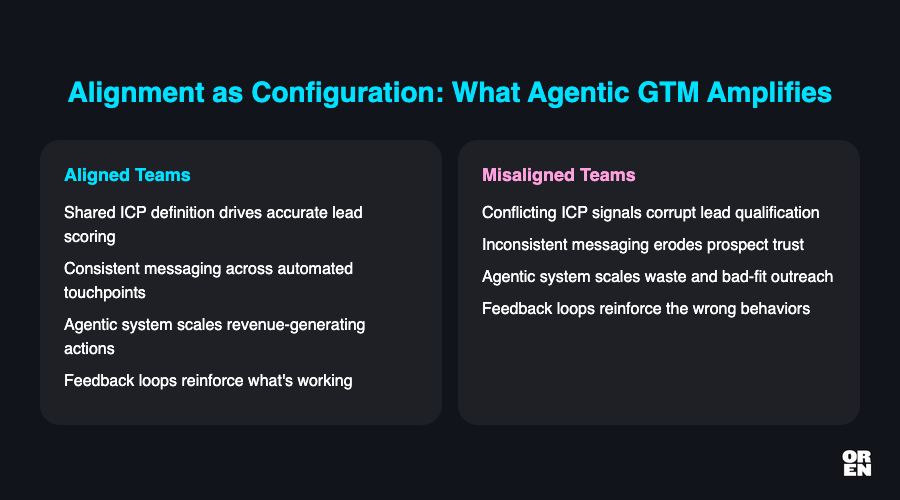
Agentic GTM systems cannot execute on ambiguity.
When sales and marketing disagree about what a qualified lead looks like, an agentic system does not pause and ask for clarification. It picks a path and runs it at scale.
Alignment is not a cultural prerequisite that nice teams do before the fun technical work. It is a configuration dependency that determines whether the system amplifies revenue or amplifies waste.
---
Why does the agentic GTM promise matter to revenue leaders right now?
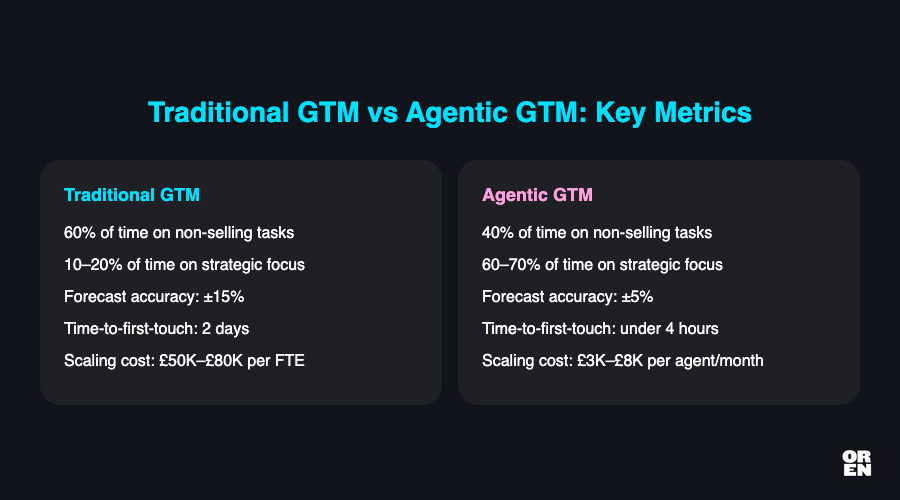
The efficiency case is substantial. And the numbers are difficult to ignore.
Sales teams spend 60% of their time on non-selling tasks - manual forecasts, email sequences, data entry, pipeline reviews (Salesforce, 2025). Revenue Operations Managers spend 30% of their time on CRM hygiene, 25% on report building, and 20% on lead routing alone, leaving only 10% for strategic projects (Arise GTM Blog, 2026). Traditional teams dedicate 10-20% of total time to strategic focus. Agentic teams reach 60-70% (Arise GTM Blog, 2026).
The performance improvements compound. Pipeline velocity accelerates 15-20%, meetings booked per SDR increase 25-40%, and forecast accuracy improves from ±15% to ±5% (Aviso, 2025). Time-to-first-touch drops from 2 days to under 4 hours (Aviso, 2025). Scaling with traditional headcount costs £50K-£80K per FTE versus £3K-£8K per agent per month (Arise GTM Blog, 2026).
"Agentic GTM is an orchestrated system of autonomous AI agents that manages complex go-to-market workflows without constant human input." - Anikesh Gaurav, Aviso
These numbers explain why CMOs and CROs at B2B SaaS companies are moving fast.
They do not explain why so many implementations will fail to deliver them.
"Most revenue teams are running a 2015 operating model with 2026 tools." - Paul Sullivan, Arise GTM
The operating model problem Paul Sullivan identifies is real. But it has a specific cause that most agentic GTM content skips past entirely.
---
What does an agentic system actually do at the sales-marketing boundary?
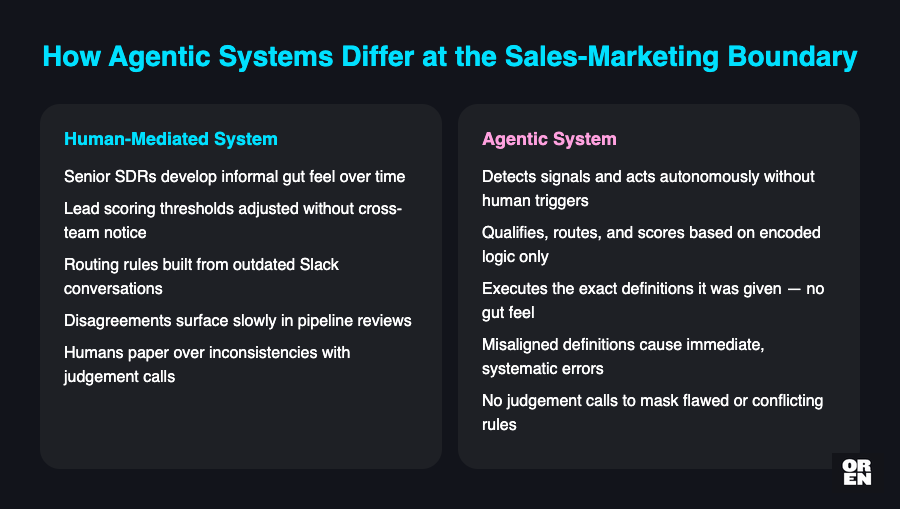
Agentic systems cross the sales-marketing boundary constantly. That is the point of them.
"Traditional automation tools require humans to trigger workflows. Agentic GTM platforms run autonomous AI agents that detect signals, decide on the next action, and execute across the GTM stack on their own. The shift is from waiting for input to acting on it." - Tapistro FAQ
Every action an agent takes at that boundary - qualifying a lead, routing it to a rep, triggering a sequence, scoring intent, deciding when to hand off - depends on a set of definitions.
What counts as a qualified signal? Which firmographic and behavioural combinations constitute a genuine ICP fit? At what point does a marketing-qualified lead become a sales-accepted lead? What disqualifies a prospect entirely?
In a human-mediated system, these questions get answered informally, inconsistently, and often in real time. A senior SDR develops a gut feel. A marketing manager adjusts lead scoring thresholds without telling sales. A RevOps analyst builds a routing rule based on a Slack conversation from 8 months ago.
The disagreements surface slowly - in pipeline reviews and attribution arguments - and humans paper over them with judgement calls.
An agentic system has no gut feel.
It executes the logic it was given. If that logic encodes a disagreement - if the MQL threshold marketing set does not match the qualification bar sales actually uses - the system will route leads that sales will reject, trigger sequences on contacts that are not ready, and report pipeline numbers that neither function trusts.
"They automate the coordination layer, routing, enrichment, sequencing, and scoring, so teams can focus on strategy, messaging, and customer relationships. The teams stay. The manual coordination work goes away." - Tapistro FAQ
The coordination layer only disappears cleanly when the logic underneath it is unambiguous.
When it is not, the coordination work does not go away. It reappears as debugging, firefighting, and escalation.
---
What specific alignment failures become system faults at scale?
There are 4 categories of definitional disagreement that translate directly into agentic system failures.
| Alignment Gap | Human-Mediated Consequence | Agentic Consequence |
|---|---|---|
| Conflicting MQL definitions | SDRs reject leads; marketing blames sales | Agent routes unqualified leads at volume; rejection rate spikes |
| Inconsistent ICP signals | Reps cherry-pick; pipeline quality varies | Agent applies one signal set uniformly; wrong prospects get sequenced |
| Ambiguous handoff criteria | Leads sit in limbo; response time degrades | Agent triggers handoff on wrong condition; reps receive cold contacts |
| Undefined disqualification logic | Leads recycle indefinitely; CRM pollutes | Agent re-engages disqualified contacts; list quality deteriorates |
Traditional teams already have an average lead response time of 2-6 hours (Arise GTM Blog, 2026). An agentic system can respond in under 15 minutes.
But speed applied to the wrong contact, based on a misaligned signal, is not an improvement. It is faster waste.
The error rate on repetitive tasks drops from 8-12% to under 2% by month 3 with agentic teams (Arise GTM Blog, 2026). That improvement assumes the task definition is correct. An agent executing a flawed qualification rule with 98% accuracy is executing the wrong thing reliably.
This is why treating alignment as a cultural outcome - something that improves over time as teams work together - is the wrong frame for agentic builds.
Culture can tolerate ambiguity. Code cannot.
---
How should teams run an alignment audit before configuring agents?
The alignment audit is a pre-build engineering step. It produces a qualification contract - a documented, version-controlled set of definitions that becomes the actual configuration input for agent workflows.
"The process documentation exercise you do before deploying agents is valuable regardless of whether you deploy agents. It forces clarity about how your revenue operations actually works and usually reveals inefficiencies that exist purely because nobody ever wrote down the official process." - Paul Sullivan, Arise GTM
The audit has 5 components.
1. Signal inventory. List every behavioural and firmographic signal that either function currently uses to assess lead quality. Do not assume the lists match. In most B2B SaaS companies at the 50-200 employee stage, they do not.
2. Definition stress-test. Take the top 10 leads from the last quarter that sales rejected. Ask marketing why they were qualified. Ask sales why they were rejected. The gap between those 2 answers is the alignment deficit you are encoding into your agent.
3. Handoff criteria documentation. Define the exact conditions - not principles, conditions - under which a lead moves from marketing-owned to sales-owned. This is not an SLA document. It is agent configuration input. Every ambiguous word in that document becomes a decision the agent will make without you.
4. Disqualification logic. Define what removes a lead from active sequences permanently. This is the most commonly skipped step and the one that most reliably pollutes CRM data at scale. Core fields should be populated on 80%+ of CRM records before deploying agents effectively (Arise GTM Blog, 2026) - which means the disqualification logic has to exist before the data standard can be enforced.
5. Single-ownership assignment. For each definition, assign one owner - not a committee, not a shared responsibility between sales and marketing. Shared accountability is accountability theatre. It creates process gaps. One person owns the MQL definition. One person owns the handoff trigger. One person owns the ICP signal set. That person's name goes into the version history alongside the definition.
This connects to a broader point about how agentic GTM builds actually fail.
The hardest part is not the architecture. It is getting commercial teams to articulate the tacit knowledge they have been using informally for years - what counts as a genuine intent signal versus noise, what makes a contact worth sequencing versus worth parking, where the brand voice edge cases live. That extraction work is organisational, not technical. (This is explored in more depth in the GTM stack architecture post, which looks at why most GTM failures are structural rather than tooling problems.)
---
Why do most teams skip the alignment audit and what does it cost them?
Most teams skip the alignment audit because it is slow, politically uncomfortable, and produces no visible output that looks like progress.
Configuring an agent feels like building. Running a qualification definition workshop feels like a meeting.
"This isn't a software upgrade. It's a structural shift in how revenue operations get done." - Paul Sullivan, Arise GTM
The cost of skipping it is not immediately visible. That is part of why it keeps happening.
Agentic systems that inherit misaligned definitions will produce pipeline numbers that look plausible for the first 4-6 weeks. The failure mode surfaces in the conversion metrics - leads that do not progress, sequences that generate activity but not meetings, routing decisions that reps override manually until they stop trusting the system entirely.
"If content isn't in their workflow, reps won't use it." - Michael Nelson, Sr. Manager of Revenue Enablement at Highspot
Same with agent outputs. If reps do not trust the qualification logic the agent is using, they will route around it.
The agentic efficiency gains disappear. The manual coordination work comes back. And the company has spent the implementation budget without changing the operating model.
This is the specific failure mode that the growth audit framework is built to surface - companies executing in the wrong order, buying tools and configuring systems before the definitional work is done. The audit forces the sequencing question: what has to be true before the next step can work?
For teams building signal-based workflows specifically, the concentric circle approach to signal-based GTM is worth reading alongside this - because the warmest signals are also the ones where qualification disagreements between sales and marketing are most costly.
---
What does good alignment governance look like once agents are running?
Alignment governance in an agentic context is not the same as compliance governance.
Most enterprise governance content focuses on data security, escalation policies, and model oversight. That matters. But it is not the layer that determines whether the system amplifies revenue.
Definitional governance is the layer that matters for revenue outcomes. It has 3 elements.
Version control for qualification logic. Every change to an MQL definition, ICP signal set, or handoff criterion should be logged with a date, an owner, and a reason. When agent performance degrades, the first diagnostic question is whether a definition changed. Without version history, that question cannot be answered.
Scheduled definition reviews. Market conditions change. ICP profiles shift. Competitive positioning evolves. Qualification logic that was accurate 6 months ago may be generating false positives today. Quarterly reviews with single-owner accountability stop definition drift from becoming invisible system drift.
Agent output auditing. Sample the leads the agent qualified and the leads it disqualified. Review them with both sales and marketing present. Disagreements about the sample are signals that the underlying definition needs updating. This is the feedback loop that keeps the qualification contract accurate over time.
"savvy enterprises will invest in AI governance and AI fluency training to mitigate risk and slowly chart their AI voyage" - Forrester
The governance investment is not optional. It is the mechanism that keeps the alignment work done in the pre-build audit from degrading the moment the system goes live.
---
Frequently Asked Questions
What is the difference between sales-marketing alignment and a qualification contract?
Sales-marketing alignment is a general term for the 2 functions sharing goals, language, and process. A qualification contract is the specific, documented output of that alignment work - a version-controlled set of definitions covering MQL criteria, ICP signals, handoff conditions, and disqualification logic. The qualification contract is what an agent actually runs on. General alignment without a qualification contract produces no usable configuration input.
Can we run an agentic GTM build and fix the alignment issues in parallel?
Technically yes. Practically, no. An agent configured on ambiguous definitions will generate outputs that sales and marketing will disagree about from day one. The disagreements will consume the time that was supposed to be freed up by automation. The more common outcome is that the build stalls, the agent gets turned off or ignored, and the team concludes that agentic GTM does not work - when the actual problem was sequencing.
How long does the alignment audit take for a 50-200 person B2B SaaS company?
For most companies in that range, the signal inventory and definition stress-test can be completed in 2-3 focused sessions. The political work - getting sales and marketing to agree on single-owner definitions rather than committee compromises - takes longer and depends heavily on whether leadership is willing to make the ownership calls. Companies where the CEO or CRO is actively involved complete the audit in 2-4 weeks. Companies where it is delegated to RevOps tend to stall.
What is the minimum CRM data quality required before deploying agents?
Core fields should be populated on 80%+ of CRM records before deploying agents effectively (Arise GTM Blog, 2026). Below that threshold, enrichment agents will spend the majority of their cycles filling gaps rather than acting on signals, and routing agents will make decisions on incomplete data. The data quality floor is a pre-build requirement, not a post-deployment improvement project.
Does this apply to founder-led companies without a dedicated marketing function?
Yes - and in some ways more acutely. When a founder owns both the marketing positioning and the sales qualification logic, the alignment problem is internal rather than cross-functional. The risk is that the definitions live entirely in the founder's head and have never been articulated explicitly. An agent cannot run on tacit knowledge. The pre-build audit forces the externalisation of that knowledge, which is valuable regardless of whether the company ever deploys agents.
---
[AUTHOR_BIO]