Growth Hacking Course
The Build-vs-Buy Question Has a Threshold
By
June 24, 2026
Last updated: 2026-06-24
60% of companies report little to no meaningful ROI from their AI investments. Only 5% report significant financial benefits [Boston Consulting Group, 2025].
That gap is almost entirely explained by what kind of AI they're building.
Off-the-shelf AI features give you parity with every competitor who opened the same vendor's pricing page this morning. Custom-built AI capability gives you an asymmetric edge that compounds. The real question isn't cost. It's whether you've crossed the maturity threshold where buying AI actively caps your competitive ceiling.
Most £20M-£80M ARR B2B SaaS companies have crossed it without realising it.
The parity trap
When Salesforce ships an Einstein feature, every Salesforce customer gets it simultaneously. When HubSpot releases AI-generated email sequences, every HubSpot customer turns it on by Tuesday afternoon.
That's the structural problem nobody in this conversation wants to say plainly.
A feature available to your entire competitive set is not a competitive advantage. It's a new baseline.
"Build custom AI solutions for business and the AI reflects how your organization actually operates. Subscribe to a SaaS platform and your organization adapts to how the platform operates." - AlphaNext
At £5M ARR, adapting to the platform is fine - you probably should. At £50M ARR, the platform's assumptions about how a business like yours operates are increasingly wrong, and the cost of conforming to them shows up in your conversion rates, your CAC, and your retention curves.
88% of organisations now use AI in at least one business function [McKinsey State of AI, 2025]. That number tells you almost nothing useful. It's the equivalent of counting software licences activated - a vanity metric that measures spending, not capability. The question isn't whether your team is using AI. It's whether the AI you're using is doing something your competitors cannot replicate by opening a browser tab.
The maturity curve and where Stage 4 lives
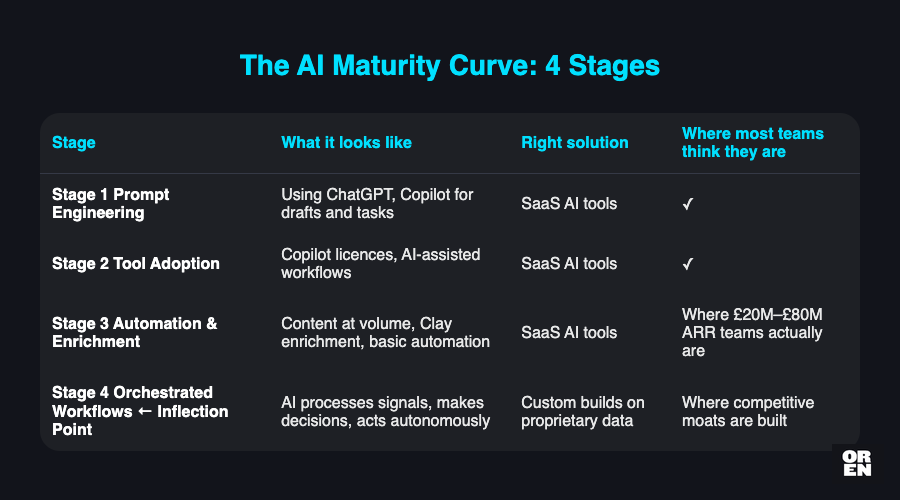
AI fluency runs on a progressive maturity curve. Stage 1 is prompt engineering. The higher stages are about building genuine functional systems. Most enterprise teams are stuck between Stages 1 and 2 whilst reporting to their boards that they're "adopting AI." What they mean is: they have Copilot licences and someone on the marketing team uses ChatGPT to draft first-pass copy.
Stage 4 is the inflection point.
It's where teams move from using AI tools to orchestrating AI workflows - where the output isn't a better email draft but a system that processes signals, makes decisions, and acts on them with minimal human intervention. The difference between using Cursor to write a function and building a lead-scoring engine trained on your proprietary conversion data.
Below Stage 4, SaaS AI is genuinely the right answer. The overhead of custom builds outweighs the benefit, and your needs are generic enough that vendor solutions fit. Above it, the inverse becomes true. Your data is differentiated. Your workflows are specific. Your competitive moat, if you're building one, lives in the logic that no vendor will ever productise because it only makes sense for your business.
Most CROs and CMOs I speak to at companies in the £20M-£80M ARR range are operating at Stage 3 to 4 without having named it. They've built some automation. They're using AI for content at volume. They're experimenting with enrichment workflows using tools like Clay. They've crossed the threshold. They just haven't made the strategic decision that follows from crossing it.
The architecture problem
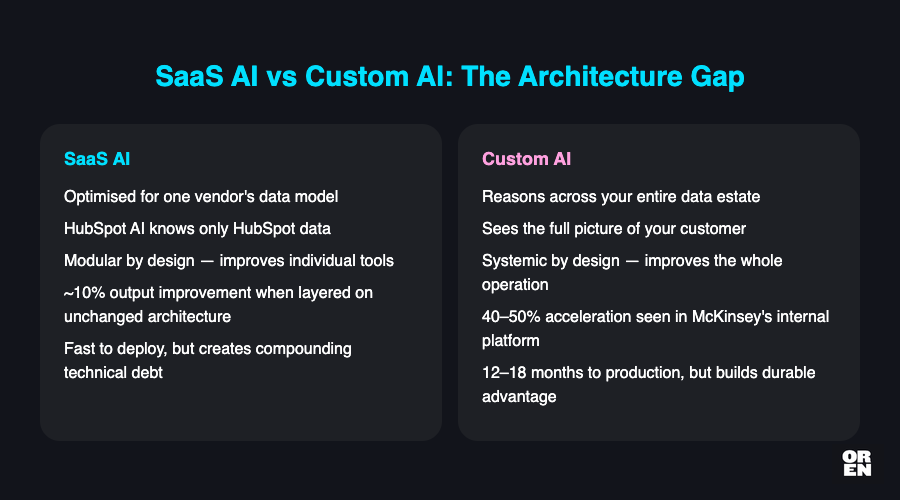
The Frankenstack problem I've written about before (Your GTM Stack Is an Expensive Mess) gets worse, not better, when you layer SaaS AI onto it. Each vendor's AI feature is optimised for that vendor's data model. HubSpot's AI knows HubSpot data. Gong's AI knows Gong data. Neither knows the full picture of your customer, and neither is designed to reason across both simultaneously.
"AI acts as a systemic catalyst. It reshapes enterprise operating models across the stack rather than just making individual tasks faster." - Hexaware
SaaS AI is modular by design - it improves individual tools. Custom AI is systemic by design - it improves the whole.
When McKinsey's internal agentic AI platform accelerated modernisation efforts by 40-50% whilst reducing costs, that wasn't because they bought a better SaaS tool. It was because they built something that reasoned across their entire operation [McKinsey, 2025].
Enterprises layering AI onto unchanged SaaS architectures often improve output by only 10% or less [Gartner, 2025]. That's not an AI problem. That's an architecture problem.
The counter-argument is timeline. Traditional in-house AI deployment often takes 12 to 18 months before production-ready AI is operational [SymphonyAI, 2026]. Real cost. But it needs to be weighed against the compounding cost of not building - every quarter you spend buying parity, your AI-native competitors are widening the gap.
The Retool misread
35% of enterprises have replaced SaaS tools with custom builds. Widely cited. Technically accurate. Deeply misleading.
The tools being replaced are integration layers - Zapier, lightweight workflow automation, thin UI wrappers. Not Salesforce. Not your data warehouse. Not your analytics infrastructure. I've written about this directly in The SaaSpocalypse Is Real. It's Also Mostly Wrong.
The correct read on that data: companies are replacing the connective tissue between SaaS tools with custom logic. That's a meaningful distinction. The build-vs-buy question at Stage 4 isn't about replacing your CRM. It's about building the intelligence layer that sits on top of your CRM and makes it actually work for your specific motion.
"Where SaaS is structured around the right features, AI-native software is structured around outcomes." - Hexaware
That's the practical guide for where to build. If you're buying a feature, buy it. If you're trying to achieve an outcome that requires reasoning across your proprietary data, your customer history, your market signals, and your brand logic simultaneously - you're not getting there from a feature roadmap.
The knowledge problem nobody mentions
The hardest part of building custom AI systems for GTM isn't the engineering. It's getting your best marketers and sales operators to articulate tacit knowledge they've never had to make explicit.
What does a good lead actually look like in your pipeline, beyond the firmographic filters? What are the brand voice edge cases your AI-generated content keeps getting wrong? What signals distinguish a customer who's about to expand from one who's about to churn, given your specific product and motion?
No vendor answers those questions. They require your people to surface knowledge they didn't know they had.
That knowledge extraction process is genuinely hard, and it's why custom AI projects fail more often from organisational friction than from technical failure. A growth audit that maps your actual GTM logic before you try to encode it into a system isn't optional overhead - it's the prerequisite.
When to buy, when to build
The decision isn't permanent and it isn't binary. It's stage-dependent.
Buy SaaS AI when you're at Stages 1-3. Your needs are generic. The workflow you're trying to improve isn't a source of competitive differentiation. Speed of deployment matters more than precision of fit. Your team doesn't yet have the AI literacy to maintain a custom system.
Build custom AI when you're at Stage 4 or above. You have proprietary data that no vendor has access to. The workflow you're trying to improve is directly connected to how you win deals or retain customers. You've identified a specific capability gap that SaaS vendors won't close because it only makes sense for your business.
"Choosing whether to create your own AI or to purchase SaaS technologies is not merely a question of technology, but rather of the future." - Shivlab blog (Aakash Modh)
Future-built organisations allocate a 64% larger share of their IT budget specifically to AI and carry 120% higher overall AI investment than lagging organisations [Boston Consulting Group, 2025]. That's not reckless spending. That's a deliberate bet on the asymmetric edge that custom capability creates.
If you're a CRO or CMO at a £20M-£80M ARR B2B SaaS company and you're still primarily buying AI features from your existing vendors, the question worth sitting with isn't whether custom AI is right for you. It's whether you've already crossed the threshold where it became necessary - and whether your competitors noticed before you did.