Growth Hacking Course
Your GTM Platform's AI Features Won't Win You Pipeline
By
June 27, 2026
87% of B2B marketers now use generative AI in at least one workflow [arisegtm.com, 2026]. Only around 6% of organisations are extracting bottom-line value from it [arisegtm.com, 2026].
That gap is not an adoption problem. It's a design problem - and the design was never yours to control.
The AI features embedded in your GTM platforms were architected to reduce your churn probability, not to maximise your pipeline conversion. Understanding the difference between those 2 objectives is the most commercially important question a CRO or VP Revenue can ask right now.
The retention motive is the product roadmap
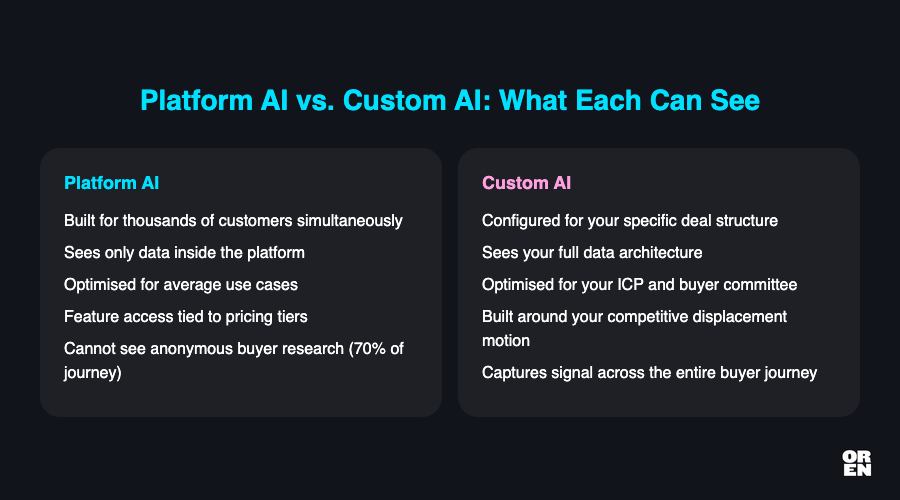
Every major GTM platform - Salesforce, HubSpot, Outreach, Gong, 6sense - has spent the last 18 months announcing AI features. The pattern is recognisable: capability tied to pricing tier upgrades, and product marketing that equates feature access with competitive advantage.
That's not cynicism. That's product strategy, and it's entirely rational from the vendor's perspective.
A platform serving thousands of B2B companies simultaneously cannot build AI optimised for your specific deal structure, your buyer committee dynamics, or the particular way your ICP researches before they ever speak to sales. The average B2B buyer spends 70% of their journey researching anonymously before reaching out [WBResearch, 2026]. Platform AI cannot see that journey the way a system built around your data architecture can. It sees the data you've chosen to put inside the platform - which is, by definition, a fraction of the signal that matters.
The commercial ceiling is structural. No amount of disciplined prompting closes that distance, because the constraint isn't how you use the feature. It's what the feature was designed to do.
"Almost everyone has adopted AI. Almost nobody has gained an edge from it. That gap is the real story of 2026." - Paul Sullivan, Arise GTM
The parity trap
When Salesforce ships an Einstein feature, every Salesforce customer gets it at the same moment.
When HubSpot releases AI-generated sequences, every HubSpot customer switches them on by Tuesday afternoon.
A capability your whole competitive set can turn on that fast is not an advantage.
It's a new baseline.
At £5M ARR, running on the baseline is fine - you probably should. At £50M ARR, the platform's assumptions about how a business like yours operates are increasingly wrong, and the cost of conforming to them shows up in your conversion rates, your CAC, and your retention curves.
The pricing signal nobody is reading

The deepest AI functionality is tied to the higher pricing tiers. This is not coincidental.
AI features are the most defensible mechanism for per-seat price increases the SaaS industry has seen in a decade. The feature exists, in part, to justify the renewal conversation and to make the cost of switching feel larger.
B2B companies already rely on an average of 15+ dedicated GTM tools spanning sales intelligence, CRM, marketing automation, and ABM platforms [HG Insights, 2026]. Each of those vendors is now adding AI capability. Each is pricing it upward. The aggregate effect on a mid-market budget is significant, and the value is almost impossible to isolate cleanly enough to present to a board.
This is the pain point I hear repeatedly from CROs in the UK and Western Europe: "We're spending but I can't prove the value."
The inability to prove value is not a measurement failure. It's a consequence of buying AI features designed to deepen platform stickiness rather than produce a measurable, attributable commercial output.
I've written about the architecture problem sitting underneath this in Your GTM Stack Is an Expensive Mess. AI-Native Companies Figured Out Why. - decades of buying disconnected point solutions created Frankenstacks where data never properly connects, and AI features layered on top inherit all of those structural weaknesses.
What 'custom' actually means here

The alternative to platform AI features is not vibe coding your own CRM.
AI coding tools like Claude Code and Cursor are genuinely useful for ad-hoc tasks. But the hidden costs of maintaining custom-built systems - debugging, updating models, managing integrations as third-party APIs change - make the "just build it yourself" argument questionable for anything mission-critical.
Custom AI capability here means something specific and more modest: AI-powered workflows that sit alongside your existing platforms, trained on your data, configured around your commercial motion, and owned by you rather than rented at an increasing price per seat.
The distinction matters practically. A custom signal-to-sequence workflow that pulls anonymous intent from your target accounts, cross-references it against your win/loss data, and surfaces prioritised outreach triggers is not something any platform vendor will build for you. It requires knowing your ICP at a level of specificity that is commercially unviable to productise. When Notion launched their AI-native product, they had around 2 million people on the waiting list within a couple of weeks [Máire O'Herlihy, OpenAI GTM team, 2025] - which is exactly why Notion's AI is built for the broadest use case, not yours.
The Retool misread
35% of enterprises have replaced SaaS tools with custom builds. Widely cited. Technically accurate. Deeply misleading.
The tools being replaced are integration layers - Zapier, lightweight workflow automation, thin UI wrappers.
Not Salesforce. Not your data warehouse. Not your analytics infrastructure with proprietary network effects.
I've written about this directly in The SaaSpocalypse Is Real. It's Also Mostly Wrong.
The correct read on that data: companies are replacing the connective tissue between SaaS tools with custom logic.
The build decision at this stage isn't about ripping out your CRM. It's about building the intelligence layer that sits on top of it and makes it work for your specific motion.
The maturity threshold
AI fluency runs on a curve.
Stage 1 is prompt engineering - someone on the marketing team drafting first-pass copy in ChatGPT.
Stage 4 is the inflection point: the shift from using AI tools to orchestrating AI workflows.
The difference between using Cursor to write a function and building a lead-scoring engine trained on your proprietary conversion data.
Below Stage 4, SaaS AI is genuinely the right answer - the overhead of a custom build outweighs the benefit, and your needs are generic enough that vendor solutions fit. Above it, the inverse holds.
Most CROs and CMOs I speak to at £20M-£80M ARR companies are operating at Stage 3 to 4 without having named it - some automation built, AI used for content at volume, enrichment workflows running in tools like Clay.
They've crossed the threshold - they just haven't made the strategic decision that follows from crossing it.
60% of companies report little to no meaningful ROI from their AI investments, and only 5% report significant financial benefit [Boston Consulting Group, 2025]. That gap tracks almost exactly with what kind of AI they're building.
The timeline objection is real: in-house AI deployment often takes 12 to 18 months before it's production-ready [SymphonyAI, 2026]. But weigh that against the compounding cost of not building - every quarter you spend buying parity, your AI-native competitors widen the gap.
The median customer problem
There's a reason you've evaluated 3 or 4 AI tools and none of them quite fit.
It's not the pricing tiers. It's not the integrations list.
It's that the tools are built for the median customer, and your competitive advantage - if you have one - is definitionally not median.
Which reframes the whole decision.
Build vs buy is a cost question. The question that actually matters is a moat question: does your edge in pipeline generation depend on data combinations no vendor serving 2,000 other customers can replicate?
If it does, buying isn't saving you money. It's permanently capping your ceiling.
The proprietary data test
Run a test before you decide.
Ask your team to list every data source that is genuinely unique to your company - not data you can buy, but data you have because of the business you've built:
- Closed-lost CRM notes with qualitative detail going back 3+ years
- Product usage telemetry tied to account-level firmographics
- Customer success interaction logs correlated with expansion or churn outcomes
- Niche vertical intelligence your team has accumulated that no data provider maps
- Behavioural patterns from your own community, events, or content ecosystem
- Signal combinations from your warmest audiences - existing customers, churned accounts, ex-customers now in new roles
That last category matters more than most GTM teams acknowledge.
Starting with concentric circles - warmest to coldest - rather than defaulting to cold outreach is where the unit economics are most compelling.
Only 27% of B2B leads are sales-ready when first generated, and 79% of marketing leads never convert to sales [Prospeo, 2026].
Your warmest audiences are the exception to both numbers - and a vendor tool treats them the same as everyone else.
If your list runs long, no vendor tool can operationalise it.
If it's thin - if you're working with the same signals as your competitors - buying is rational, and the question answers itself.
The compounding returns argument
This is the part that gets underweighted in every build-vs-buy analysis I've seen.
Vendor tools optimise toward a benchmark.
Teams reach roughly 50% of the value early in deployment, rising to around 90% automation after multiple rounds of tuning [Matillion, 2025].
A real efficiency gain - but against the median GTM motion as the baseline.
A custom system trained on your proprietary data doesn't just automate your existing motion. It compounds toward your buyers, your signals, your language with every iteration.
SaaS AI is modular by design - it improves individual tools. Custom AI is systemic by design - it improves the whole.
When McKinsey's internal agentic platform accelerated modernisation by 40-50% whilst cutting costs, that wasn't a better SaaS tool. It was a system reasoning across their entire operation [McKinsey, 2025].
Enterprises layering AI onto unchanged architectures often improve output by 10% or less [Gartner, 2025].
Teams using AI weekly already report 81% shorter deal cycles, 73% larger deals, and 80% higher win rates than infrequent users [ZoomInfo, 2025].
Those numbers reflect frequency of use, not sophistication of the system.
The gap widens over time rather than closing.
The audit you should run before the next renewal
Before you sign the next platform AI upgrade, run a simple stress-test against your actual commercial motion. Four questions.
Whose data trained this feature? Platform AI reflects average patterns across industries, deal sizes, and buyer types that may have nothing to do with your segment. Ask the vendor what data underpins the model and whether it can be fine-tuned on your historical data. Most cannot.
What is the feature optimising for? Lead scoring features optimise for engagement signals that correlate with conversion across the vendor's entire customer base. Your conversion drivers may be entirely different - a specific content sequence, a firmographic combination, a displacement trigger. If the objective doesn't match your motion, the output is noise dressed as signal.
Can you measure it independently? If the AI feature lives entirely inside the platform and its output is only measurable using the platform's own reporting, you have a measurement dependency that makes objective evaluation impossible. This is not an accident.
What happens to this capability if you churn? It disappears. Any GTM edge you built on top of a vendor's AI feature is not yours - it's a licence you're renting. Platform AI capability resets to zero the moment the contract ends.
The 6% and what they are actually doing
The 6% of organisations extracting bottom-line value from AI are not using better tools [arisegtm.com, 2026]. They're using AI differently - workflows built around specific commercial outcomes, human judgment retained at the decision points that matter, measurement frameworks that connect AI activity to revenue rather than to activity metrics.
"AI-native, human-first is not a slogan; it is the difference between the 6% who get value and the rest." - Paul Sullivan, Arise GTM
The human judgment point is not peripheral. 67% of B2B buyers say they can spot unedited AI content, and 58% say it reduces their trust in the brand that published it [arisegtm.com, 2026]. The AI features your vendors are selling produce exactly this output - generic, unedited, trust-eroding content at scale.
81% of B2B buyers who are happy with AI-assisted content require it to be accurate, specific, and carry original thinking [arisegtm.com, 2026]. Specificity and original thinking are not things a platform AI feature can supply. They come from your commercial context, your category expertise, your understanding of your buyer - none of which lives inside the vendor's model.
The build vs. extend decision
The practical question for a CRO or VP Revenue is not "should we use AI?" - that's settled. It's "where does the platform's ceiling sit relative to our commercial ambition, and what does it cost us to stay below it?"
For most mid-market B2B SaaS and FinTech companies in the £10M-£100M ARR range, the ceiling is already visible. The specific cases that differentiate your pipeline are precisely what the platform will not build, because building them for you makes the feature unviable to sell to everyone else.
Stripped back, it's three questions.
Is your pipeline edge data-dependent? If your best accounts are identifiable through signals that only exist inside your company, buying caps your ceiling at whatever the vendor's data model allows.
Do you have the internal capability to own a custom build strategically? Not technically - strategically. If the answer is no, sequence the capability build first.
What's the compounding trajectory? A vendor tool delivers efficiency now but plateaus at the vendor's roadmap. A custom system built on proprietary data improves asymmetrically. The question is whether your business operates on a timescale where that compounding matters.
"This high prioritization underscores the strategic importance that leaders are placing in AI technologies for future growth and also to have a competitive advantage." - Abhilash Mula, Senior Manager, Product Management, Informatica
If you're working through this decision, the growth audit framework I use with clients starts with the commercial motion before it touches tooling - because buying AI capability before you've defined what you're trying to achieve with it is how you end up with an expensive stack and a board presentation you cannot defend.
The vendors are not your adversaries. But their product roadmap serves their retention economics first. Knowing that, and building your AI capability strategy around it, is the starting point for being in the 6% rather than the 94%.


