Growth Hacking Course
Signal-Based GTM Fails at the Architecture Layer, Not the Tool Layer
By
June 17, 2026

Last updated: 2026-06-18
The tool isn't the problem.
The system around it is.
Most B2B SaaS companies buy intent data, watch pipeline stay flat, and blame the vendor. But the real failure is that nobody engineered what happens after the signal fires.
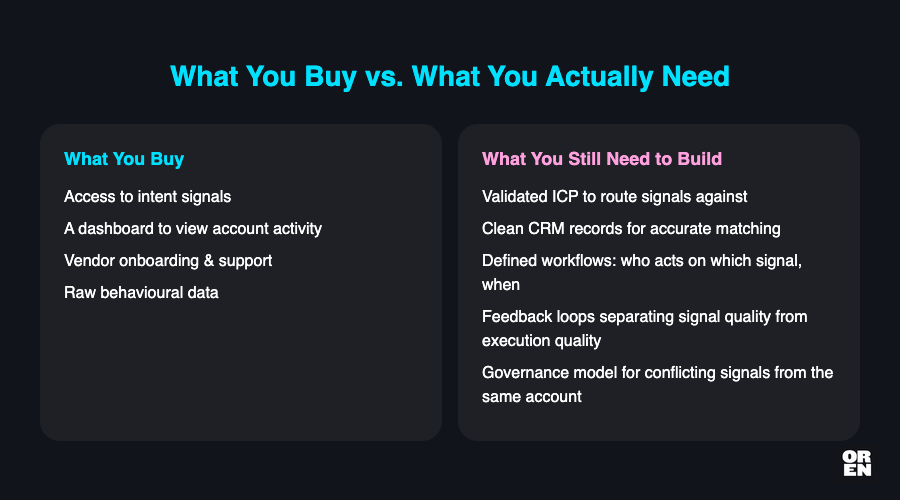
The tool category is not the system

ZoomInfo, 6sense, Bombora - these are inputs, not architectures.
The dominant framing in signal-based GTM treats tool selection as the primary decision.
It isn't.
The primary decision is what your organisation does in the 4 hours after a signal fires, who owns it, and what feedback loop tells you whether the response worked.
"Signals alone don't create pipeline. You need workflows that turn signals into action." - Christian Kletzl, Co-founder & CEO, UserGems
Most companies have the signals.
They lack the system.
Signal decay is destroying your conversion rate
Signals have a half-life.
A company researching your category on Monday is not the same buying opportunity on Thursday.
68% of B2B marketers are increasing investment in intent data [Demand Gen Report, 2026].
That spend is largely wasted if the infrastructure processing those signals adds days of lag.
The distinction almost nobody draws: signal freshness at capture is not the same as signal freshness at point of action.
A valid signal at T=0 ages across every handoff - enrichment API call, list upload, CRM sync, routing-rule evaluation, SDR queue assignment.
By the time a rep opens the task, the buying moment has moved on.
Architectural lag - the gap between signal capture and sales action - is one of the least-discussed failure modes in B2B pipeline design. And it's endemic.
The typical pattern: intent data fires into a marketing automation platform, gets scored, waits for a sync cycle, lands in CRM, sits in a queue, and reaches an SDR 3 days later.
By then, the signal is cold.
The problem isn't data quality. It's the latency built into the workflow architecture.
Designing for signal half-life means treating routing speed as a performance variable, not an ops afterthought.
Nobody owns the signal after it fires
The accountability layer is where most signal-based GTM programmes quietly collapse.
A signal fires. Marketing automation records it. Sales doesn't act. Both teams believe the other is responsible. No feedback loop exists to diagnose whether the failure was signal quality or execution quality.
This is an organisational problem dressed up as a data problem.
Until you define - explicitly, in writing - who owns a signal at each stage, what the expected response time is, and how handoff failures are surfaced, the architecture is incomplete regardless of which tools sit inside it.
GTM infrastructure should be treated the way engineering teams treat product infrastructure: built in sprints, with outcome-based measurement, not configured once and handed to an ops team to maintain.
If your signal workflows aren't being iterated against closed-won data, they're drifting.
Static signal weighting is a slow leak
Most teams set signal weights once - during onboarding or implementation - and leave them.
Third-party intent gets over-indexed because it's high-volume and easy to report on. First-party behavioural signals, which typically convert at a higher rate, get underweighted because they're harder to aggregate.
"Unfortunately, there's no universal signal 'strength' barometer, it will vary from company to company. Once again, it is only by analyzing and measuring signals against business outcomes that businesses can decide which activities are uniquely 'strong' to them." - Jeremy Sacramento, Dreamdata
Signal weighting should be a continuous calibration exercise, not a one-time configuration.
Closed-won data should feed back into your scoring model on a defined cadence. Conflicting signals from the same account - high intent score, but no engagement with any content - need adjudication logic, not a default assumption.
"Vague signals that don't translate to clear actions just add noise." - Christian Kletzl, Co-founder & CEO, UserGems
Noise is not a vendor problem.
It's a governance problem.
The ICP problem underneath the signal problem
There's a deeper issue that signal-based programmes rarely surface.
If the ICP is methodologically flawed, the signals are being applied to the wrong target set. Most ICPs are built at the deal level without controlling for correlated variables - what appear to be multiple independent buying signals are often proxies for a single underlying dimension like company size or funding stage.
Signals applied to a flawed ICP produce high-volume, low-conversion outreach.
Less than 5% of your target market is in-market at any given time [LinkedIn Business Marketing Blog, 2026].
And a single B2B purchase pulls in 6 to 10 stakeholders, each researching independently across channels you can't see [2X Marketing Blog, 2026].
That makes high-confidence signals a scarce resource - and a flawed ICP burns them at volume.
The tool gets blamed. The ICP is never revisited.
External enrichment data - firmographic, technographic, and intent layered together - surfaces dimensions invisible inside a CRM. Without that enrichment, the ICP is a guess dressed as a framework, and the signal architecture is optimising for the wrong accounts.
This is the same underlying failure pattern I covered in the GTM architecture piece: the tools aren't the problem, the system design is.
When the architecture works, the numbers move
The case for getting this right is not abstract.
OpenPhone is the cleanest proof point available.
After integrating intent signals and automating routing, they cut speed-to-lead by 67% - average time-to-demo dropped from 2.5 days to hours. Inbound conversion lifted 17%. Misrouted leads fell 5x [Default Case Study - OpenPhone, 2026].
None of that came from coaching reps to respond faster.
It came from removing the structural delay between signal capture and sales action.
PageUp restructured their signal-based programme with a defined architecture and saw a 161% increase in sales and SDR engagement, 15 new influenced opportunities, and 5 6-figure closed deals within 6 months - representing over 11% of annual pipeline. Their account list grew 30% [Demandbase / PageUp case study, 2026].
GoCardless reported 11× pipeline ROI on campaign investment using a comparable approach [Demandbase / GoCardless case study, 2026].
These results are not a function of which intent platform was selected.
They reflect what happens when signal capture, routing logic, ownership accountability, and ICP definition are treated as a connected system.
The concentric circle approach to signal-based GTM makes the same point from a prioritisation angle: start with your warmest audiences first, because the architecture is simpler to validate and the feedback loops are tighter.
The processing layer nobody audits
When signal-based GTM underperforms, the audit looks at signal quality and sales execution.
Almost nobody audits the processing and routing layer as its own failure mode.
Three questions surface it:
- What is the average age of a signal when a rep first sees it?
- How many systems does a signal traverse between capture and CRM task creation?
- Are routing rules evaluated in real-time, or on a batch cadence?
The answers are almost always worse than expected.
"Data is insufficient… the power of AI is to make context out of all that data. That's the superpower." - Gary Survis, Operating Partner, Insight Partners
But AI layered on slow routing infrastructure does not fix the latency.
It just produces faster analysis of stale signals.
The architecture has to change first.
The architectural checklist nobody is running
Before adding another signal source, run this instead:
- Latency audit: how many hours between signal capture and sales action, by signal type?
- Ownership map: who receives each signal category, and what is the defined SLA?
- Feedback loop: does closed-won and closed-lost data feed back into signal weighting on a defined cadence?
- ICP validation: has the ICP been tested against external enrichment data, or is it a CRM-derived assumption?
- Conflict logic: when an account shows contradictory signals, what rule governs the response?
If any of these are unanswered, the signal infrastructure is incomplete - regardless of the tools in the stack.
If you're working through this and need a structured way in, a growth audit is often where the real failure point surfaces.
---
Buying signal intelligence is not the same as engineering a signal-based GTM system.
If your team cannot describe - precisely - what happens in the 2 hours after a high-intent signal fires, the architecture is the problem.
Fix that before you renew the tool contract.