Growth Hacking Course
Your Signal-Based GTM Is Running on an Unvalidated Hypothesis
By
June 17, 2026

Last updated: 2026-06-18
Every signal in your GTM stack is a bet.
A bet that a specific behaviour predicts buying intent.
Most teams never find out if that bet pays off.
Without a closed-loop feedback mechanism connecting signal to revenue outcome, you are not running a strategy. You are running the same flawed hypothesis on repeat, at scale, while the cost compounds.
Signal selection is hypothesis formation
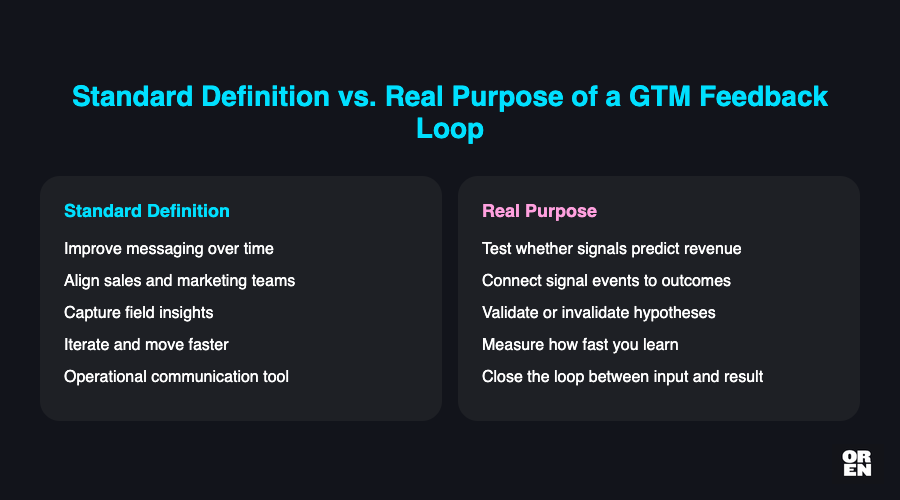
When you configure a trigger - job change, G2 category visit, pricing page hit, technographic match - you are making a causal claim.
This behaviour precedes a purchase decision.
That claim may be true. It may also be completely wrong for your specific ICP, segment, or deal size.
The problem is that most teams treat deployment as validation. The signal fires, a sequence launches, some deals close, and the motion gets labelled "working."
But correlation at low volume, in a short window, with no control, is not evidence. It is noise dressed up as signal.
"Most founders treat go-to-market like a launch plan. But GTM isn't an event. It's a way to learn." - Juan Bell Jr
The same logic applies to signal-based GTM at any stage.
The motion is not the strategy. The learning loop is the strategy.
The set-and-run failure mode
Vendors selling signal-based GTM tools - intent platforms, data enrichment layers, sequencing infrastructure - have a commercial incentive to position their product as a set-and-run motion.
Configure the triggers. Build the sequences. Watch the pipeline fill.
The implicit promise is that the hard work is architectural, not ongoing.
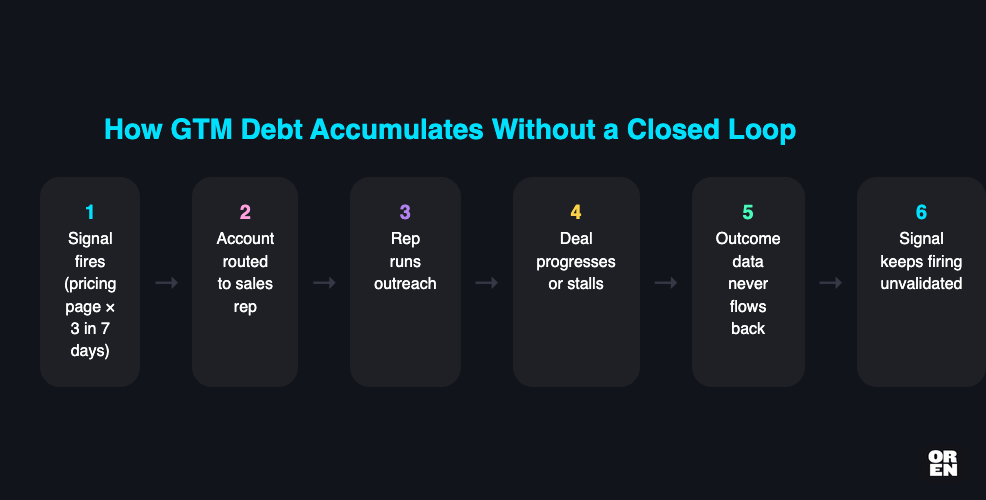
That framing is the source of most GTM debt accumulating inside revenue teams right now.
56% of B2B marketing teams report receiving no feedback from sales on lead quality or customer insights. A further 56% cite data silos from non-integrated technology stacks as a top GTM execution barrier [The Think Tank, 2025].
Those 2 numbers describe the same problem from opposite ends. Signals fire into a void. Outcomes never travel back to the people who set the triggers.
B2B purchases now involve 11-person buying committees over cycles that stretch nearly a year [Apollo.io, 2026]. A signal that looks predictive in month 2 of a 10-month cycle may have zero causal relationship to the eventual close.
Without instrumenting the full journey, you cannot know.
"The question is not: Are we aligned? It is: How fast do we learn?" - Sara Kleinman, Senior Director of GTM Enablement, Automation Anywhere
Signal decay is a real cost
Signals decay.
A job-change trigger that predicted intent 18 months ago may now be so widely acted upon that it has become noise. Every vendor in your category is running the same sequence to the same hire within 48 hours.
The signal has not disappeared. It has lost predictive value through saturation.
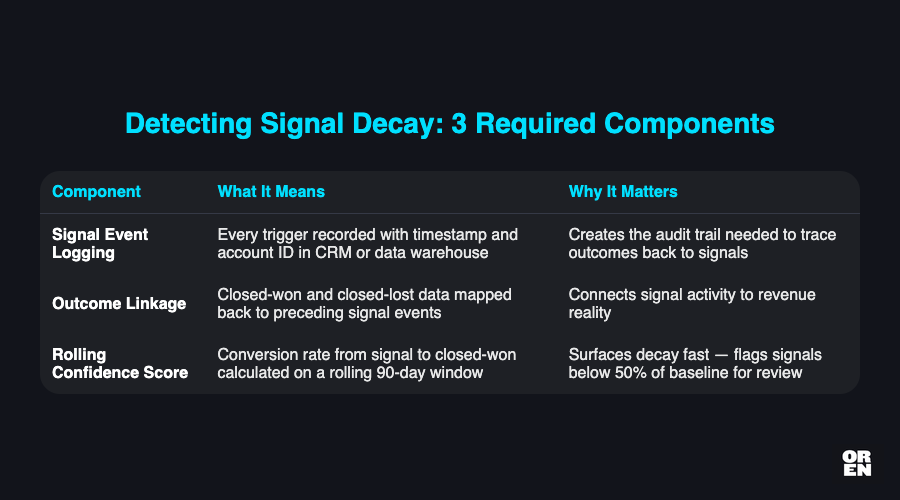
Without a feedback loop connecting signal-fired events to closed-won and closed-lost data, you have no mechanism to detect that decay. You will keep investing in a trigger that stopped working months ago, because the pipeline activity looks healthy even as the conversion rate quietly erodes.
The companies that pull ahead are those that learn fastest about what is working and what is not. Almost no company has a clear, structured answer to how they accelerate that learning loop.
Signal decay is precisely where the cost of that gap becomes measurable.
What a closed-loop GTM actually requires
A genuine GTM feedback loop is not a weekly sales-marketing sync.
It is an instrumentation problem.
Specifically, it requires 3 things that most teams have not built.
1. Signal event logging with outcome linkage. Every signal event that triggers a GTM action needs a persistent record in your CRM or data warehouse - timestamped, tagged to the contact and account, and linked to the eventual deal outcome. Closed-won, closed-lost, no-decision. Without this, you cannot run the correlation analysis that tells you whether the signal is actually predictive.
2. A signal registry with explicit confidence scores. Each signal in your GTM stack should carry a validation status: hypothesis (no outcome data yet), tested (outcome data exists, sample small), validated (statistically meaningful correlation to revenue), or deprecated (tested and failed). This is not a complex artefact. It is a shared document that forces your RevOps function to treat signal selection as an ongoing discipline rather than a one-time configuration decision. It also gives you a defensible answer when the board asks why you are investing in a particular motion.
3. A feedback cadence that routes outcome data back to signal owners. Closed-loop GTM requires someone to own the connection between what the signal predicted and what actually happened. That is a RevOps function, not a sales function. By 2025, 75% of the world's highest-growth companies were expected to have adopted a RevOps model to unify GTM execution [Industry research, 2025]. The ones doing it well are using RevOps to close the signal-to-outcome loop, not just to produce pipeline dashboards.
If you have not already read the piece on GTM architecture problems, the instrumentation failure described there is the same root cause - disconnected point solutions that make it structurally impossible to connect signal to outcome across the full buyer journey.
The org layer blocks the loop
Even teams that understand the instrumentation requirement often fail to close the loop.
Because of an organisational problem, not a technical one.
The hardest part of building AI marketing systems is not the architecture - it is getting marketing experts to articulate tacit knowledge about governance, signal versus noise, and edge cases. The same dynamic applies here.
The people who understand which signals feel meaningful are often not the people with CRM access to validate them. And the people with CRM access are not asking the hypothesis question.
This is why signal-based GTM motions drift. Nobody owns the definition of what "this signal is working" actually means. The motion runs, the sequences fire, and the hypothesis ages - unvalidated, unfalsified, and increasingly expensive.
"You don't need more campaigns. You need faster insight-to-execution loops." - Kalpana Sha Iyer
That is the reframe.
The loop is not a reporting exercise. It is the mechanism by which your GTM motion earns the right to scale.
For teams working on signal-based GTM from the warmest audiences outward, this is doubly true. The closer the audience, the faster you can close the loop. And the faster you learn whether your hypothesis holds.
The compounding argument for getting this right
One case study reported pipeline doubling in 90 days with a 22% jump in conversion after repositioning pitch and introducing a compliance-focused thought leadership campaign [Kalpana Sha Iyer, LinkedIn Pulse, 2025].
The mechanism was not a better signal. It was a tighter feedback loop that identified what was resonating and what was not, then acted on it quickly.
The compounding logic runs in both directions.
A validated signal, scaled with confidence, produces compounding returns. An unvalidated signal, scaled without feedback, produces compounding waste.
Run the audit before you scale
If you launched a signal-based GTM motion 6 to 12 months ago and cannot answer the following questions, you do not have a validated motion.
You have a hypothesis in production.
- Which signals in your current stack have closed-won outcome data attached to them?
- What is the conversion rate from signal-fired to closed-won, by signal type?
- Which signals have you deprecated based on outcome data?
If the answer to all 3 is "we don't track it that way," the feedback loop does not exist.
You are scaling a guess.
Build the loop before you scale the motion.