Growth Hacking Course
Signal Routing GTM: The 90 Seconds Where Your Pipeline Disappears
By
June 15, 2026

Last updated: 2026-06-18
Most B2B signal strategies fail at the routing layer, not the signal layer.
Teams obsess over intent data quality and signal sources. Then send the fired signal to the wrong rep, a stale queue, or nowhere at all.
That gap - the 90 seconds after a signal fires - is where pipeline value evaporates.
---
The signal fires. Nothing coherent happens.
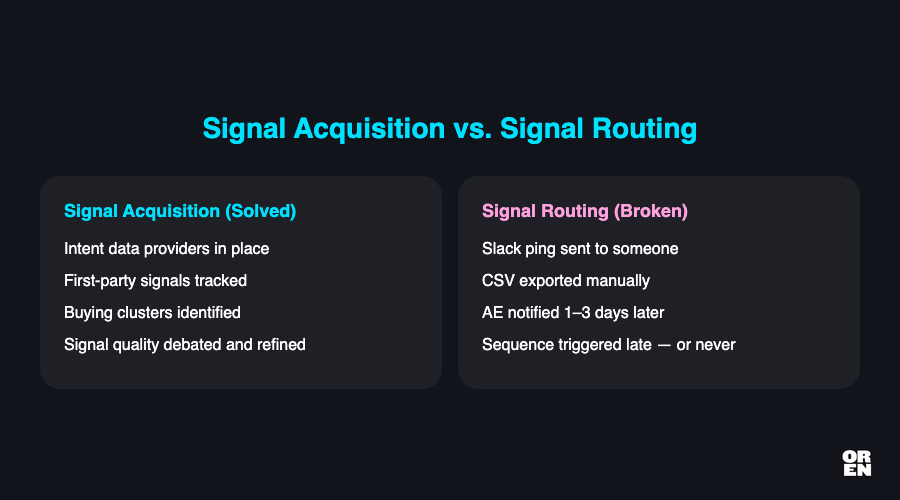
You've invested in intent data. Set up triggers. A target account visits your pricing page 3 times in a week. A new CRO joins a key prospect.
The signal fires.
Then what?
In most B2B SaaS companies, the honest answer involves a Slack ping, a forwarded email, or a rep who spots it 2 days later.
That's not a signal routing GTM strategy. That's a notification system with no owner.
"Pick any signal that should drive revenue: a target account hires a new CRO, an enterprise lead visits your pricing page 3 times, a renewal account goes silent. Can your system act on it within an hour without anyone manually noticing? If the answer involves Slack pings, CSV exports, or 'I'll forward this to the AE,' your stack isn't a system yet." - ZoomInfo Pipeline
This is the operational gap that almost no content in the signal-based GTM space addresses.
The dominant conversation is about signal acquisition and scoring. Routing gets treated as a natural downstream consequence.
It isn't. It's a failure-prone system that deserves its own architecture.
---
Speed-to-route is not speed-to-contact
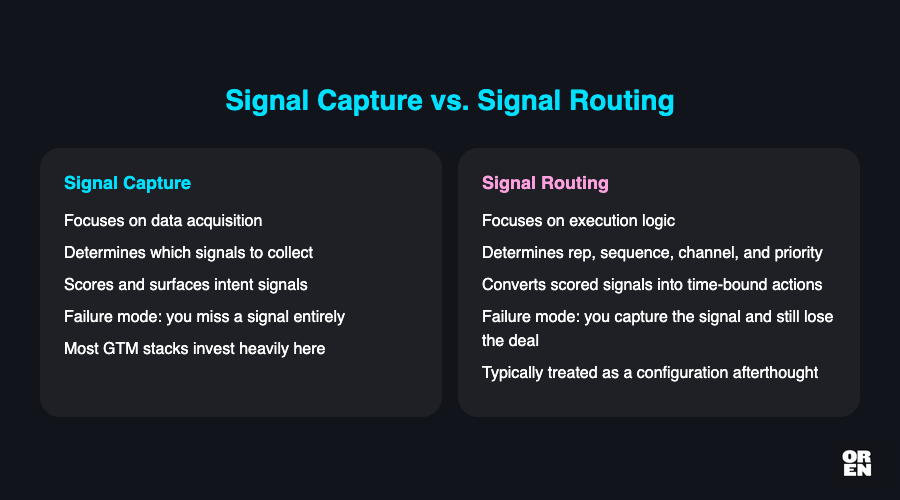
These 2 get conflated constantly. They are not the same thing.
Speed-to-contact measures how quickly a rep reaches out after a signal fires.
Speed-to-route measures how quickly the signal reaches the right rep in the first place.
You can have fast speed-to-contact and catastrophic speed-to-route. The damage is invisible because the rep who receives the misrouted signal still acts quickly. They just act on an account that belongs to someone else, sits in the wrong territory, or has an existing relationship the routing logic didn't account for.
Misrouting destroys conversion probability even when response time is fast.
The signal is time-sensitive by definition. Over 80% of buyers finalise mid-market SaaS decisions within 6 months, often completing most of their research before engaging a vendor [Signal-Based Marketing: A Buyer Behavior GTM Playbook, 2025]. A signal firing during that active research window is a narrow opportunity. Send it to the wrong place and the window closes before the correction happens.
The companies that fix this see measurable results.
Structured signal routing produces a 39% reduction in routing time, an 86% increase in pipeline, and a 2x increase in MQL conversion [LeanData Signal-Driven GTM Execution eBook, 2025]. Rocket Software increased marketing qualified lead velocity by 75% [LeanData Customer Story, 2025].
These numbers don't come from better signals. They come from better routing.
---
The routing logic nobody maintains
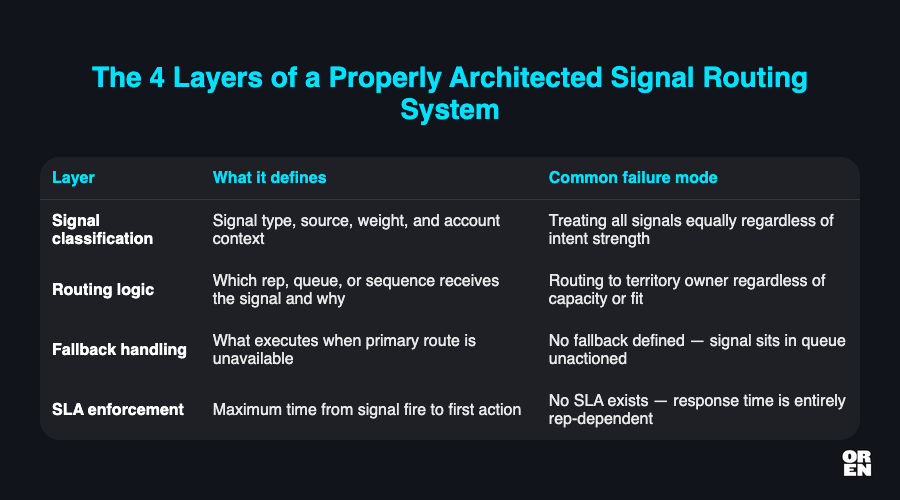
Routing rules decay. That's the problem that compounds over time.
You set up your routing logic when the team was 8 people. Territories were clean. Rep ownership was clear. Twelve months later, 3 reps have churned, territories have shifted, 2 accounts have been reassigned mid-cycle - and the routing logic still reflects the org structure from Q1 last year.
Nobody owns the maintenance of that logic.
It gets treated as a RevOps configuration task done once at setup, not a revenue-critical system with its own SLA and review cadence. The result is that signals fire accurately into a routing layer that is structurally out of date.
This is not a hypothetical edge case.
Only 38% of go-to-market leaders say their strategy is actually effective, according to a survey of over 500 GTM leaders [LeanData x Harvard Business Review Analytic Services, 2026]. The number one driver of increased revenue identified in that same research is improved go-to-market execution - not better signals, not more tools.
"A lot of teams still seem to be treating execution as operational hygiene rather than the growth lever that it is." - Dana Guthrie, Senior Director of EMEA Marketing at LeanData
Routing logic maintenance is exactly this kind of neglected execution layer.
---
Fallback logic is the gap nobody has designed
Most routing systems handle the clean case: signal fires, account is owned, rep is active, territory matches. Route it. Done.
The clean case is not where pipeline evaporates.
Pipeline evaporates in the exceptions:
- Signal fires for an unowned account
- Signal fires for a dormant territory with no active rep
- Signal fires for a contact with no CRM match
- Signal fires for a rep who is at capacity or on leave
These are not rare conditions. They are routine.
And almost no signal routing GTM architecture has explicit fallback logic for them. The signal either goes nowhere, sits in a queue until someone notices, or gets auto-assigned to a rep who has no context and no capacity.
The fix is not complex. But it requires deliberate design.
Every routing rule needs a fallback owner, a time-based escalation, and a minimum-viable action for the exception state. That's what separates a routing system from a routing configuration.
This connects to a broader point about GTM architecture: the failure is rarely the technology. It's the absence of designed process before the technology is configured. The same pattern appears across GTM stacks more broadly - if you haven't seen it, this piece on GTM architecture problems is worth your time.
---
The org layer, not the tech
The routing problem is also an ownership problem.
In most founder-led B2B SaaS companies, nobody has explicitly claimed signal routing GTM as their responsibility. The intent data platform is owned by marketing. The CRM routing rules are owned by RevOps. The rep who receives the signal is owned by sales.
The 90-second window between signal fire and rep action falls in the gap between all 3.
"Strategy alone doesn't drive growth. Execution does, in particular aligning execution to the buyer journey." - Dana Guthrie, Senior Director of EMEA Marketing at LeanData
Fixing signal routing is not primarily a tooling problem. It's an ownership and process problem.
Someone needs to own the routing layer as a system - with defined SLAs, documented fallback logic, a quarterly review of routing rule accuracy, and a clear escalation path when exceptions occur.
If that sounds like an argument for doing the structural work before buying more tooling, it is. A proper growth audit will surface this gap before you've compounded it with another platform purchase.
Worth flagging: signal routing decisions should be invisible to the prospect. The signal identifies who to contact and when. It does not become the opening line of an outreach message. The routing layer exists to put the right rep in front of the right account at the right moment - the value delivery that follows should stand entirely on its own.
---
What a functioning routing layer actually looks like
The signal fires. Within 90 seconds, the system has:
- Matched the signal to an account record
- Checked account ownership and territory assignment against current data
- Confirmed rep availability and capacity
- Applied fallback logic if any of the above fail
- Queued the appropriate action - not a generic sequence, but the right play for the signal type and account tier
- Logged the routing decision for audit and review
This is not a description of a complex AI system. It's a description of a well-designed process with clean data underneath it.
Companies are now spending £2 in sales and marketing to earn £1 of new ARR - a 14% jump from 2024 [Benchmarkit's 2025 report, 2025]. Cold email open rates have dropped from 36% to under 28% in 2 years [Signal-Based Marketing: A Buyer Behavior GTM Playbook, 2025]. The margin for wasting a fired signal has never been thinner.
"outbound performance depends less on messaging refinements and more on structured decision-making." - Ilija Stojkovski, CRO at HeyReach
The routing layer is where structured decision-making either exists or doesn't.
If you're working on signal-based GTM and haven't yet mapped your warmest audiences as the first routing priority, that's the place to start before designing fallback logic for cold accounts.
---
The routing layer is a revenue decision
Signal quality matters. Signal sources matter.
Neither converts to pipeline if the routing layer is broken, stale, or unowned.
Treat signal routing GTM as a revenue-critical execution layer with its own SLA, its own owner, and its own maintenance cadence. Audit your routing rules quarterly against current territory and rep data. Design explicit fallback logic for every exception state. Measure speed-to-route separately from speed-to-contact.
The 90-second window is not a RevOps configuration detail.
It's where your pipeline is won or lost.